
Film Review: “Clown Panic” — Bring on the Clowns, Spare Us the Grand Theory
By Sarah Osman
Ed Perkins’s documentary finds a fascinating story in America’s 2016 creepy-clown craze, then buries it beneath sweeping analogies and frantic editing.
Clown Panic, directed by Ed Perkins. Streaming on Hulu.
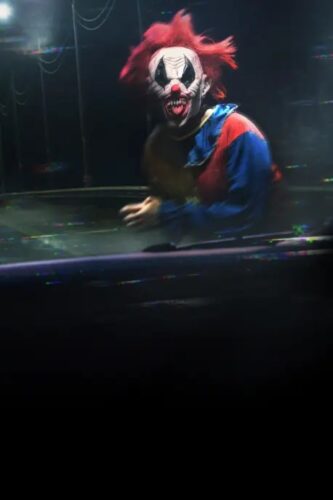
A glimpse of the creepy enemy in Clown Panic. Photo: Hulu
In 2016, between summer and Halloween, America had a clown problem. It began when a child in Greenville, South Carolina, spotted a creepy clown and told his mother, who called the police. The cops reportedly asked if she was on crack. They treated the sighting as a bizarre one-off.
It wasn’t. Soon, creepy clowns were turning up across the country, and some weren’t content just to lurk. Videos circulated of clowns carrying machetes and charging cars; reports of stabbings followed. The phenomenon appeared to be particularly prevalent in impoverished rural towns, an unsettling detail that, among so much else, invited closer scrutiny.
Those sightings are the subject of director Ed Perkins’ new documentary, Clown Panic. At its best, the film offers a fascinating account of a strange national obsession. Unfortunately, Perkins wants the coming of the clowns to explain America itself. At one point, the film declares that ‘the story of the clowns is the story of America.” Really? What could have been the investigation of a series of peculiar but revealing events buckles under the weight of a two-ton thesis.
The first half of the documentary traces the panic that gripped Greenville, South Carolina, and Flomaton, Alabama, early on, before it spread elsewhere. Along the way, Perkins raises questions about police indifference to poor, isolated communities, fears of school shootings, and internet pranks that spill into real-world danger. He also explores the history of clowns and pop culture’s role in turning figures of fun into objects of dread.
There’s plenty here for a compelling documentary. But Perkins keeps piling on interviews and grand historical comparisons—Salem, McCarthyism, the Satanic Panic—as if scale alone could supply meaning. The clown sightings may have felt all-consuming where they landed; from Los Angeles, where I recall little alarm, the national frenzy looked pretty anemic. Rather than paper over that disparity with sweeping analogies, the film needed to interrogate it.
The problem is not that episodes of public fear cannot illuminate one another. It is that Perkins never earns these comparisons. The Salem witch trials and McCarthyism destroyed lives and stripped people of their freedom; what links those campaigns of persecution to people frightened by clown videos? A death connected to the panic might have complicated the argument, but Perkins saves it for the closing stretch rather than placing it at the film’s center.
The 2016 election is another strained reference point. Perkins implies a connection between the clown sightings and the chaos of Trump versus Clinton, but proximity is not causation. Both occurred in the same year. What else are we meant to understand?
The editing deepens the confusion. Every new interviewee arrives beneath giant yellow title cards, yet the procession of faces becomes so relentless that no one registers for long. The most promising subjects scarcely finish a thought before Perkins rushes toward another news clip or historical parallel.
One working clown describes losing bookings after frightened customers abandoned clown parties. Here, at last, is a concrete consequence—and a story worth pursuing. What did it mean to watch your livelihood become a national nightmare? Perkins does not stay to find out. Again and again, the film trades particularity for inflated portent.
Whether Clown Panic could spark a revival is another matter. I bet against it. America has no shortage of horrors competing for attention, and fresh viral clown footage would face an immediate obstacle: persuading anyone it was not AI-generated.
Perkins treats the clown panic as a defining event of the twenty-first century without establishing what it defined. The subject is strange and troubling enough without being asked to stand for everything wrong with America. For now, assume that scary clowns will stay in the movies.
Sarah Mina Osman is based in Los Angeles. In addition to The Arts Fuse, her writing can be found in The Huffington Post, Success Magazine, Matador Network, HelloGiggles, Business Insider, and WatchMojo. She has an MFA in Creative Writing from the University of North Carolina Wilmington and is working on her first novel. She has a deep appreciation for sloths and tacos. You can keep up with her on Instagram @SarahMinaOsman and at Bluesky @sarahminaosman.bsky.social.
Tagged: 2016 clown sightings, American culture, Clown Panic, Ed Perkins, creepy clowns, documentary film, film reviews, internet culture, mass hysteria, moral panic
