
Visual Arts Feature: Where Art Meets Nature — Andres Institute’s 2026 Sculpture Symposium
By Mark Favermann
Three international artists add new granite works to the New Hampshire sculpture park, continuing a tradition of creative freedom, community support, and art in the landscape.
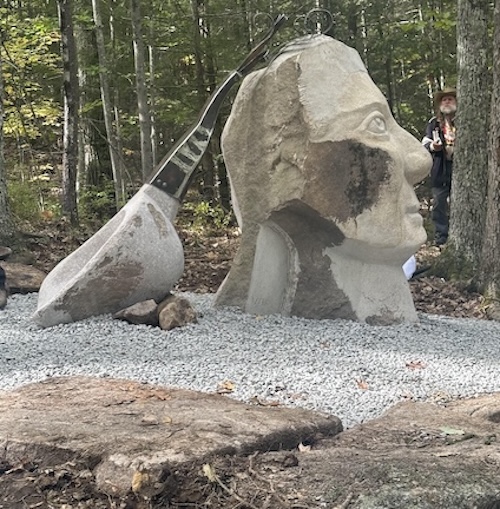
Dankha Somaya’s Nostalgia, Steel and New Hampshire granite. Photo: Mark Favermann
As the leaves turn different colors, the evenings grow cooler, and the days become shorter each fall, the Andres Institute of Art Sculpture Park celebrates the marriage of art and nature by holding its annual symposium. Each year, three international artists participate in a three-week residency on Big Bear Mountain in Brookline, New Hampshire. They create sculptures, primarily in granite, that are added to the Institute’s collection of more than 110 pieces set along 11 hiking trails across its 1,400 acres. The Andres Institute of Art (AIA) is the largest sculpture park in New England and one of the largest in the United States.
Big Bear Mountain served as a ski area for many years before former dot-com engineer and entrepreneur Paul Andres purchased it in the mid-1990s. He founded AIA with longtime Brookline resident and master sculptor John Weidman, from whom he had previously commissioned artwork. Several of John’s large sculptures welcome visitors to the park, which is free and open to the public year-round.
Public art can be strong or weak, brave or apologetic. Its surroundings can diminish it—through weather, neglect, or social indifference. The Andres Institute of Art is both strong and brave: it lets sculpture stand within the landscape rather than merely occupy it.
The first International Bridges and Connections sculpture symposium took place in 1999, when seven artists were invited to Brookline, New Hampshire, for two weeks to create works for permanent display on the mountain. Sculptors came from Lithuania, Latvia, England, the Czech Republic, Ukraine, New Hampshire, and Vermont. Later, it was determined that artists needed three weeks to complete their artworks.
Some cut, bent, and welded steel; others split, shaped, ground, and polished stone. The results ranged from elegantly refined to deliberately rough and primitive.
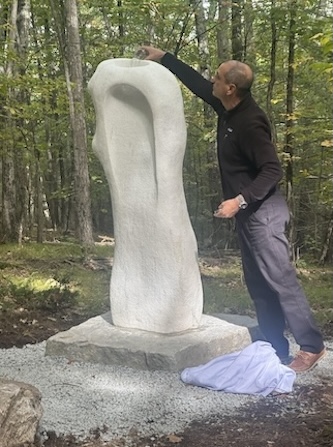
Fermin Castro’s Intrepid, New Hampshire granite. Photo: Mark Favermann
In the years since, each participating artist has received a modest stipend, but the greater reward has been freedom: the liberty to make whatever sculpture they choose, in whatever style they choose. The collection reflects that freedom—from roughly hewn forms to polished stone carvings, from steel rods drawn into three-dimensional space to metal-sheathed structures.
The works often share a creative spontaneity—a common language of form, material, and gesture that needs little verbal translation. Across its sculptures, monuments, and small vignettes, the Andres Institute achieves a rare communicative universality.
The Institute is a shining example of what vision, organization, and high aesthetic standards can accomplish. Since its founding, master sculptor John Weidman has served as its artistic director—the creative spirit driving its growth and continued vitality. He mentors visiting artists, helps them solve the technical challenges of realizing ambitious work, and has fostered both the quality and the distinctive character of the collection.
Weidman’s own sculptures are part of the landscape. Near the start of the steep trail to the summit stands his large, horizontal, gateway-like steel structure, its open screen welcoming visitors into the park. The piece suggests a whimsical narrative of fantasy figures and abstract forms.
This year’s recently completed symposium brought three artists to Brookline for three-week residencies: Marin Murakoshi, Fermin Castro, and Dankha Somaya.
Syrian American artist Marin Murakoshi created Vessels of Friendship, an elegantly carved granite work depicting books and fabric. It memorializes shared elements of human civilization and culture. Cuban American artist Fermin Castro contributed Intrepid, a vertical granite sculpture that is at once abstract, organic, and aerodynamic—suggesting movement while remaining firmly grounded. Japanese American artist Dankha Somaya’s Nostalgia pairs a human head with a large serving ladle; from a distance, the ladle resembles a musical instrument, while the head carries a quiet, sphinx-like presence. Like the other pieces, it underlines enduring connections between people and society.
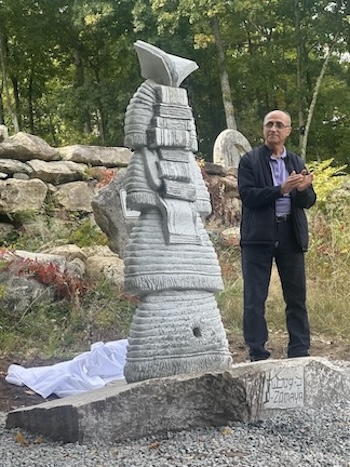
Marin Murakoshi’s Vessels of Friendship, New Hampshire granite. Photo: Mark Favermann
As in past years, local Brookline families hosted the artists, with neighbors contributing meals and conversation. Visitors can watch the sculptors at work in the Institute’s studio; their skill and discipline are remarkable to behold as each piece takes shape.
The park also serves the wider community. School groups, scouts, and civic organizations regularly tour the grounds, while the Institute’s programming has expanded to include lectures, workshops, iron-melting demonstrations, and concerts held several times a month. Featuring professional performers in folk, jazz, bluegrass, and pop, the concerts double as fundraisers for the Institute.
A rotating indoor gallery at the Welcome Center now presents smaller two- and three-dimensional works—paintings, photographs, mixed media, and sculpture—with exhibitions changing roughly every two months.
The permanent staff is small, but a large, enthusiastic corps of volunteers sustains the Institute: greeting visitors, leading tours, assisting with events, and helping prepare and install sculpture sites. With heavy equipment, they move finished works from the studio to their places on the mountain. The first symposium added seven sculptures; this October, three more joined them.
Trail maps are available at the trailhead behind the parking lot of the adjacent Big Bear Lodge, now the Welcome Center. Visitors can also download current trail information from the Institute’s regularly updated website before arriving.
Each sculpture trail is rated for hiking difficulty, from easy to most difficult. The main trail to the artists’ studio is steep, but the climb is well worth the effort.
Mark Favermann’s firm, Favermann Design, was one of five design consultancies chosen from 481 to design the 1996 Centennial Olympic Games in Atlanta. He is an urban designer specializing in strategic placemaking, civic branding, streetscapes, and retail settings. In 2024, he was awarded the Journalism and Communications Award by the American Planning Association/Massachusetts for his decades of writing on the built environment. In 2025, the Mass Cultural Council awarded him a Creative Individual Award for Sculpture.
Tagged: 2026 Sculpture Symposium, Andres Institute of Art, Art and Nature, Artist Residencies, Big Bear Mountain, Brookline NH, Community Arts, Dankha Somaya, Fermin Castro, Granite Sculpture, International Artists, Marin Murakoshi, New Hampshire Art, john-weidman, public art, sculpture
