
Doc Talk: The Simulation According to Musk
By Peter Keough
In Alex Gibney’s exhaustive documentary, Elon Musk emerges as a visionary, a menace, and a man determined to escape the world he has helped imperil.
Musk, directed by Alex Gibney. At the AMC Boston Common 19
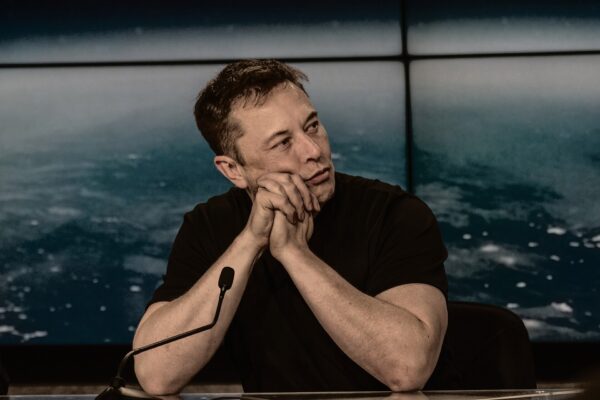
Elon Musk at a 2028 press conference. Photo: WikiMedia
For me, one of the most disturbing disclosures in Alex Gibney’s jam-packed, nearly four-hour takedown of Elon Musk is not DOGE’s shutdown of USAID, which is estimated to result in the deaths of millions of starving children across the globe. Nor is it the hundreds of billions he has invested to reelect Trump and MAGA in 2024, or the possibility, broached by his estranged lover and former MAGA influencer Ashley St. Clair, that he employed other, more nefarious methods to achieve that goal (“An anomaly in the Matrix,” is what he texted her). Nor even his temporary shutdown in 2022 of the communications-satellite system Starlink for the Ukrainian military, depriving them of a crucial tool in fighting the Russian invasion — a stunt he pulled again just this past week with Starshield, though he blamed Trump for it.
Instead, it’s the revelation that the trillionaire entrepreneur believes that the world is a figment — his figment — and that he has the power and wealth to control it and impose it on everyone else. “Like, what are the odds we are in base reality?” he speculates at the beginning of the film through a recurring AI avatar created by Gibney that resembles a cross between Arnold Schwarzenegger’s Terminator and Max Headroom. “Like, maybe we’re in a simulation. And if simulation theory is correct, only the most interesting simulation will survive.”
Clearly, Musk believes he is the most interesting simulation. Many agree, and Gibney himself admits in voiceover that, at one time, he begrudgingly admired Musk as the visionary entrepreneur and inventor he claimed to be. Who wouldn’t be impressed by the awe-inspiring sight of two SpaceX rockets landing simultaneously, pristinely intact, and right next to each other, or by many of his other seemingly miraculous, sci-fi-like achievements that Gibney presents?
But as is made clear in a montage of missiles crashing and burning, reports of Tesla self-driving vehicles turning murderous, complaints about his chatbot Grok turning pornographer and assuming the persona of MechaHitler, and the many other misfortunes that have befallen his various companies, there is a big gap — an uncanny valley, if you will — between what Musk claims to have achieved and his failures, malignity, and folly. His real talent, it seems, lies in closing that gap between illusion and reality: selling himself and winning over the minds (and money) of the weak-willed, the credulous, the venal, and the greedy.
Musk is not the best documentary of the year, or even one of the best in Gibney’s career. It gathers together multitudes of damning facts, many of which we have already learned from other sources, and as such the narrative is at times overwhelming and unwieldy. Its attempt to mitigate this overload is earnest but uneven, including using such devices as the AI Musk, or by depicting as a first-person-shooter video game the massacre of jobs following his takeover of Twitter and, on a vaster scale, in the federal government after the institution of DOGE.
Still, it is one of the year’s most important documentaries, and it must be seen. It is further proof that, alongside recent films such as Yuval Abraham and Rachel Szor’s NAZA, independent documentarians are filling the void left by the failure of a co-opted, corporate-owned mainstream media’s to cover urgent issues. (By the way, has anyone seen a review of Musk or NAZA in the Boston Globe? Neither have I.)
In the end, Musk haltingly tries to explain to an interviewer why he does what he does. “I want to create a future that doesn’t make me sad,” he finally mutters. Admirable, perhaps — except that this future is one in which human consciousness, meaning Elon Musk, would never die, while the planet and everyone else would be doomed. His escape plan might be a spaceship to Mars, where Musk could set up shop on a dead planet in a settlement that, as one expert surmises in Rudolph Herzog’s 2022 documentary Last Exit: Space, would likely resemble “an Amazon Fulfillment Center.” The peons lucky enough to be employed there, as Rudolph’s father Werner intones in that documentary, would “hunker down in radiation-proof bunkers enjoying drinks of recycled urine.”
Peter Keough writes about film and other topics and has contributed to numerous publications. He was the film editor of the Boston Phoenix from 1989 to its demise in 2013 and has edited three books on film, including Kathryn Bigelow: Interviews (University Press of Mississippi, 2013) and For Kids of All Ages: The National Society of Film Critics on Children’s Movies (Rowman & Littlefield, 2019).
Tagged: Alex Gibney, DOGE, Donald Trump, Elon Musk, Grok, Maga, Musk documentary, SpaceX, Starlink, artificial intelligence, documentary film, film review, politics and film, technology billionaires
