
Film Review: “Fjord” Puts Conviction on Trial
By Noah Goldstein
Cristian Mungiu’s Palme d’Or winner asks whether understanding others requires seeing their side—or questioning our own.
Fjord, directed by Cristian Mungiu. Screening at the Coolidge Corner Theatre, 290 Harvard Street, Brookline.
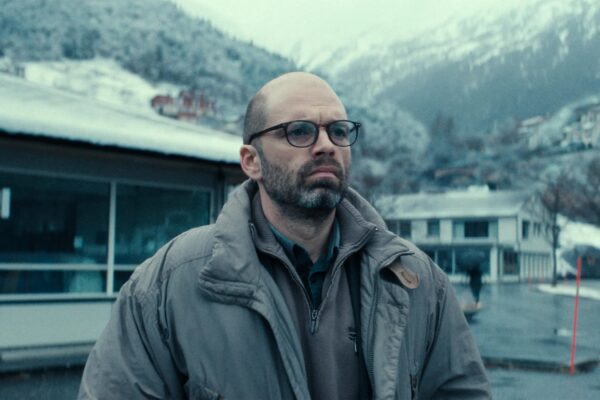
Sebastian Stan in a scene from Fjord. Photo: Neon
Everyone is doing their best in Fjord, the tightly constructed, Palme d’Or–winning latest feature from 4 Months, 3 Weeks and 2 Days director Cristian Mungiu. Conflict abounds despite each character’s insistence that they are acting in everyone’s best interest, leading us eventually to stop asking who is right and start asking what “right” means at all.
It makes a strong double bill with Mungiu’s previous effort, R.M.N., another film that examines the artificiality of social division—and the roots of belief itself—through the story of migrant workers arriving in an unnamed, largely conservative Transylvanian village. Both films were inspired by real news stories, but here the setting is a far more picturesque—and, more important, politically progressive—community in Norway.
This time, the intruders are the fastidiously religious Gheorghiu family. Father Mihai (Sebastian Stan, with less hair and a thicker accent than ever) has decided to move his family from Bucharest after the death of his parents. It is a homecoming for one parent, after all, and mother of five Lisbet (a bespectacled, impressively restrained Renate Reinsve) will hopefully receive better support in her native land.
“We’re pretty much all neighbors here,” remarks school principal Mats (Markus Tønseth) during an early visit from his own cabin, perhaps 100 yards from the Romanians’ new home.
What is meant as a welcome will later read as a warning. At first, though, the proximity serves both families well: the two eldest Gheorghiu children—Vanessa Ceban’s Elia and Jonathan Ciprian Breazu’s Emmanuel—get along swimmingly with Mats’s only child, Noora (Henrikke Lund-Olsen). There is real give-and-take in their friendship: one moment, Noora lures the children out their windows for an unsupervised speedboat ride; the next, she attentively studies the lyrics to the Biblical songs the siblings have been teaching her. Such are the advantages of globalization.
Even the adults overcome their differences in parental ideology—Mihai uses a points system to rank his children’s Bible-study performance; Mats’s family, shockingly, does not—and begin to bond. Mihai works alongside Mats as the school’s IT guy, a job for which the former aeronautical engineer is wildly overqualified. Lisbet takes a cautious liking to Mats’s wife, Mia (Lisa Carlehed), and an interest in his father, Åke (Øyvind Venstad Kjeksrud), who spends his days silent and staring bleakly at the vista after a stroke has left him immobilized. That latter pairing is one of the film’s more intriguing dynamics: fleeting glimpses of Lisbet’s individuality emerge as she guides Åke’s wheelchair through the landscape, away from the home and Mihai’s vigilance.
To be clear, there is no suggestion that Lisbet, or anyone in the Gheorghiu clan, is unhappy with the traditionalism of life at home. Rather, it is at the workplace where they begin to butt heads. Mihai is told that his rendition of “Amazing Grace” on the cafeteria piano is not cheerful enough for lunchtime entertainment, and Lisbet is eventually scolded for placing a crucifix in a coffin — without the bereaved family’s knowledge — at her nursing-home job. Still, they find solace in the local church and in the Bible-study sessions held at their home.
The Gheorghiu philosophy does not mesh well with what the film suggests is a “woke” Norwegian society. The conflict between family and neighbors begins when a red mark appears on Elia’s back. Suspicion of abuse is enough to warrant a call to child protective services; one suspects that some of Mihai’s coworkers had the number on speed dial long any evidence arrived. As a director and writer, Mungiu has a knack for making his most devastating situations feel inevitable. When a black van arrives to retrieve the children—even the diaper-clad infant—it feels like the natural next step on a traumatic path laid the moment the family stepped off the ferry.
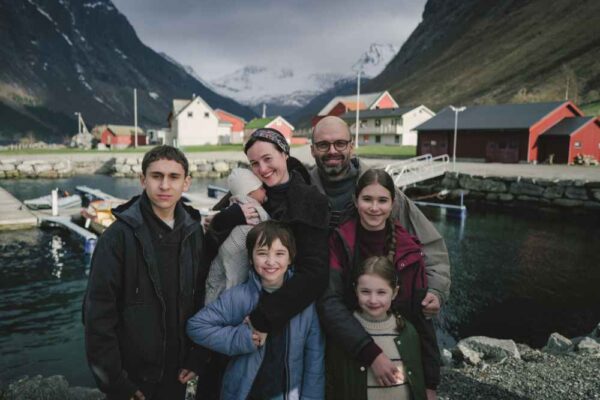
The family at the center of Fjord. Photo: Neon
It would be foolish to search for a singular truth in a film where beliefs collide at every turn. Indeed, interpretation is central in a story where accusations fly hither and. yon. Language is crucial when it comes to understanding each character’s morality, and the linguistic barriers grow more troublesome as the script slyly shifts into something like a courtroom procedural. This miscommunication is especially torturous for Mihai, who understands Norwegian but does not speak it well—a limitation that opens a gulf between the strong-willed patriarch and the courts who now hold power over the family he hopes to win back. A rage boils beneath the surface of Stan’s performance as he meticulously constructs a man forbidden from speaking his mind, hemmed in not only by language but by the constraints of an unfamiliar society.
Tense conversations in hushed tones have always been Mungiu’s forte, and his aesthetic of intimately captured long takes remains captivating as characters discuss reaching what one party of the other considers to be an impossible compromise. Cinematographer Tudor Vladimir Panduru, who also shot R.M.N. and Graduation for Mungiu, transforms the grandeur of the fjord into a site of hostile confinement — the mountains loom, with silent menace, behind many crucial scenes.
Mungiu’s script relies on its own careful neutrality, the means to force viewers to look inward and scrutinize their own judgments. Checks and balances are everywhere, all in service of balanced objectivity; the film would feel over-engineered, its neutrality neutering, if not for the precision of its cast. Nearly everyone is defined more by their flaws than their strengths; characters are not only bedeviled by their external foes, but grapple with internal doubts.
The film’s determined complexity, together with its inherently volatile subject, opens a conversation that continues after the cut to black. Futile debates over whether the family should have been punished, will inevitably follow. Were the red marks on the girl’s back signs of abuse? But these are distractions. Ultimately, Fjord asks us to understand those with whom we differ — not by seeing things from their side, but by questioning why we stand on ours.
Noah Goldstein is a student at Tufts University pursuing a dual degree in Film and Media Studies and Cognitive Brain Sciences. He covers the film and music beats for the Tufts Daily, as well as occasional sports coverage. He is originally from New York City.
Tagged: Brookline, Cannes, Coolidge Corner Theatre, Cristian Mungiu, Culture Clash, Fjord, Norwegian cinema, Palme d'Or, Renate Reinsve, Romanian cinema, Sebastian Stan, child protective services, family drama, film review, foreign film, immigration, international cinema, movie review, religious conservatism
