
Film Review: “Strangers and Their Babies” — The People the World Didn’t Count
By Jeremy Ray Jewell
Asio Liu’s documentary uncovers the forgotten history of unlisted Vietnamese “boat people” refugee camps in the Penghu Islands in the Taiwan Strait following the end of the Vietnam War in 1975.
Strangers and Their Babies, directed by Asio Liu, is streaming in the U.S. through the Viet Film Fest.
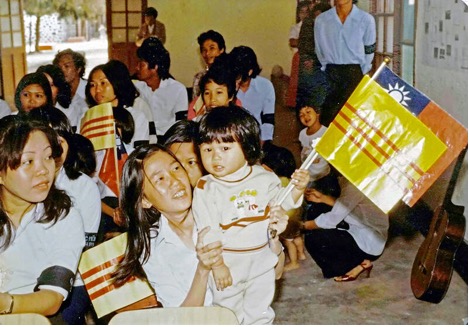
A scene from Strangers and Their Babies. Photo: Viet Film Fest
Châu Kiết Nhi remembers eight or nine people dying on the boat that carried her out of Vietnam in 1979. The government that took her in, she says, recorded no deaths at all. In Asio Liu’s documentary Strangers and Their Babies (陌生人與他們的小孩), she is credited the way the camp once registered her: by name and number, “Boat 21 Refugee (1979), Penghu Camp.” That small typographic choice holds the key to the film. Liu has made a documentary about people who fell between the world’s records, and he keeps the record himself.
Strangers and Their Babies recently made its North American premiere at Viet Film Fest in Santa Ana, California, the largest Vietnamese diaspora film festival in the United States. It is the first Taiwanese movie the festival has selected. The choice is apt: many of the families Liu follows resettled in the United States. The festival’s artistic director, Eric Nong, calls the film’s subjects “the lucky ones.”
Between 1977 and 1988, two camps on Taiwan’s Penghu Islands—first at Hsiyu, then at Chiangmei village in Paisha—took in more than 2,000 Vietnamese boat people who arrived on 51 vessels. One hundred and six babies were born there, many of them, as the festival’s program note observes, without documentation. Taiwan’s Public Television Service, PTS, has described the camps’ story as “a blank” in the UN’s relief records, because when the first refugees landed, the Republic of China no longer held a UN seat. In 1971, Resolution 2758 had expelled “the representatives of Chiang Kai-shek” from the UN and its related organizations. In September 1977, three months after Penghu received its first boat, the Socialist Republic of Vietnam—the state the refugees were fleeing—took its own UN seat. The country that sheltered them could not be counted, so neither could they.
Strangers and Their Babies, which premiered on PTS last year, follows four of those babies, now adults living in the United States and Taiwan, as they break their parents’ silence to investigate their families’ past. Nguyễn Quốc Việt, born in the camp in 1982 and now living in Seattle, reunites with Huỳnh Cẩn Du, the camp’s former deputy director. Liu also tracks down Huang Chin-Chih, one of the Hsiao-liu-chiu fishermen who rescued Việt’s family at sea. Nguyễn Tân Vinh Anthony, born there in 1984, returns with his wife. Yen-Yen Ni grew up in Penghu, where her mother, Châu Kiết Nhi, married a local man and stayed while the rest of her family resettled in the United States.
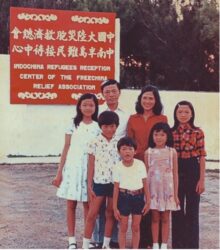
A scene from Strangers and Their Babies. Photo: Viet Film Fest
Liu has pursued this history since filming the empty camp on 16mm shortly before its demolition in 2003. He works like an archivist. His reunions double as research: a baby leads to a boat, a boat to the fishermen who found it. Even the subtitles keep count, introducing Nguyễn Tân Vinh as one of the 106. The camp’s identification system has become the film’s credit system, a quiet way of restoring people to a record the UN never kept.
The fourth subject exposes another gap in that history. Nguyễn Thị Hà comes from a North Vietnamese family. As Brian Hioe has noted, countries such as the United States treated northerners as “economic refugees rather than political ones.” Her family, the Taipei Times reports, had trouble obtaining asylum and stayed in Taiwan. The others seek their parents’ stories; Hà wants to know her own camp number. Passed over by the countries that accepted other families, she she goes looking for the record that counted her in.
The film shows how selective the official record could be. The deaths on Boat 21 went unrecorded. Châu Kiết Nhi also recalls a boat captain sentenced to three years in jail for helping refugees rather than leaving them adrift. Her own camp wedding, by contrast, made state media: an ethnic Chinese refugee marrying a Penghu man suited the government’s preferred story of overseas Chinese fleeing communism for the motherland.
The deaths the state did publicize were those aboard the Thanh Phong, only 34 of whose 146 passengers survived. A series in a military newspaper, “Blood and Tears of the South China Sea,” featured the disaster, which was also adapted into a film. Visitors to the camp, many of them soldiers and students, were led past a mural depicting its starving passengers under the same title.
Only at the end does Liu turn to this use of suffering as propaganda. Over an image of the mural, credited on screen to the ROC Army’s Penghu Defense Command, he calls its message clear: fight communism or become a refugee. That is the propaganda’s own summary, the one a separate, largely fabricated text, “Blood Letter from the South China Sea,” carried into school textbooks: fight for freedom today, or become a refugee at sea tomorrow. By then, the film has shown what the slogan leaves out: the uncounted dead of Boat 21 and a captain sent to jail. Yet Strangers and Their Babies could press the contradiction further: what did it mean for a government ruling under martial law to demand that its people fight in the name of freedom?
The record still matters. On September 1, Taiwan launched its annual campaign for inclusion in the UN system, and on October 10 President Lai Ching-te said Taiwan “must become a ‘city upon a hill.’” It still has no refugee law. Strangers and Their Babies draws none of these connections. Its achievement is quieter: it answers an absence with a ledger of names, boat numbers, and a baby’s place in a register of 106. The UN never counted these people. Liu does.
Jeremy Ray Jewell is an American writer and creative technologist who applies systems thinking to culture, politics, and digital media. He holds an MA in History of Ideas from Birkbeck, University of London.
Tagged: Asio Liu, Penghu, Strangers and Their Babies, Taiwan, Taiwanese cinema, Viet Film Fest, documentary film, refugee history
