
Book Review: Daniel Silva’s “Ransom” — A Spy Thriller for an Unsettled Present
By Clea Simon
Daniel Silva’s latest Gabriel Allon novel sidelines Israeli politics for an unusually timely, expertly paced tale of Russian aggression, drone warfare, and fraying Western alliances.
Ransom by Daniel Silva. Harper, 416 pp., $32
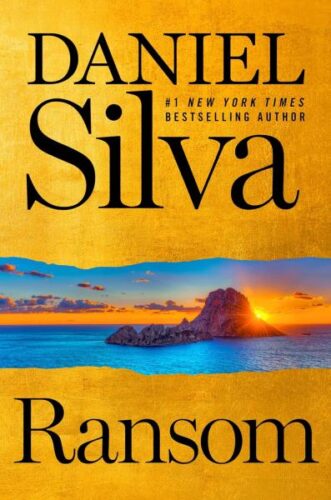 Some summer treats you outgrow. Creamsicles, for example. Fudgsicles, too, used to be a source of unbridled joy. And, though I’m still a sucker for ice cream sandwiches, this July I had more or less decided that Daniel Silva fell into the discard category.
For those not into novels of international suspense, Silva is the author of the hugely popular Gabriel Allon series and has regularly produced one per summer since 2000’s The Kill Artist. For me, they’ve been essential summer beach reads, superbly crafted spy thrillers that accompanied me to Provincetown each August, with the fact that they tend to be long (400-plus pages) being a major advantage for this fast reader. Plus, these bricks have helped hold down the blanket while I was in the water. Though one or two have faltered (as I recall, 2024’s A Death in Cornwall seemed a bit slim on plot and long on shortcuts), the series has reliably captured my imagination with its combination of real-world prompts and enjoyable characterization, even as Silva has added to his crew of regulars, including a gorgeous Danish hacker and a former supermodel-turned-gallery owner. (With few exceptions, such as the brilliant Alma Katsu, the genre tends to be dominated by male writers who give most of the action to their male characters.)
The problem was with the series protagonist himself. Allon, as conceived by the US-based Silva, is Israeli, the son of a Holocaust survivor. In fact, his first outing is roughly based on the Mossad response to the 1972 Munich massacre. Over the course of the first 20-odd books, Allon progressed from being an active agent to running the Israeli secret service. And, although the last few have leaned more heavily on his other career (and regular cover) as an art restorer, the Israel connection has remained strong.
This summer, as I contemplated what I wanted to read, I realized I just didn’t have the stomach for a protagonist I feared would be a Netanyahu apologist. I still love the idea of a Jewish hero and I’m very aware of the rise of antisemitism globally, but the idea of anything approaching a defense of Israel’s current administration just didn’t sound fun.
And yet… the night before we took off for the Cape, I downloaded Silva’s latest, the 27th in the series, Ransom, and, after a few days lounging at Herring Cove beach, I opened it.
Reader, my faith has been restored. It has been a while since Silva’s protagonist has lived in Israel, but in this book he not only never visits his homeland, he rarely mentions it. Allon’s previous adventures are referenced, if at all, by painful memories: drawn by his adversary to the city where his young son was killed and his wife disabled, he says, simply, “I’m not terribly fond of Munich, if you must know.” Also, none of his former Israeli team—Uzi Navot, Eli Lavon, Dina Sarid, etc.—make an appearance.
Granted, over the course of the series, he has made a new life with his Venetian second wife in that city (after many books agonizing about divorcing his first wife, who was trapped in a fugue state, constantly reliving the car bombing that also killed their son) and on the coast of Wales. But in Ransom, Silva has completely relocated his protagonist’s emotional center, creating a page-turner that eschews Israeli politics (and Netanyahu’s war crimes) and manages to be chillingly timely as well.
Not that the international intrigue at which Silva excels is apparent at first. Instead, Ransom opens on a quartet of Oxford classmates who, on their annual vacation, are realizing that they may have outgrown their college friendship. When one—a beautiful socialite who married money—is kidnapped, Allon is coerced into handling her retrieval. Domestic suspense soon gives way to a much larger conspiracy, however: a crew of Russian bad actors has been manipulating others to fund their war in Ukraine.
This plot line plays to the author’s strengths, building suspense with believable complications, keeping to a minimum the deus ex machina devices (such as the Mossad hacking software that turns cellphones into clandestine microphones and transmitters) that derail too many books in the spy-thriller genre. (Why we mourn Le Carré.) Yes, adhering to the norms of the genre, almost all of Silva’s characters are physically attractive, and almost everyone on Allon’s team is also brilliant, deadly, or both. But Silva is an agile writer with a keen eye for detail and an understanding of the descriptive possibilities embedded in good dialogue, and so Sarah Bancroft, the lovely ex-CIA operative-turned-art dealer, will not be confused with the hacker (and professional thief) Ingrid Johansen. Nor is Alice Winter, the kidnapped beauty, the stereotypical passive or oversexualized pawn.
Where Silva also excels is in his incorporation of reality and potential reality. Other critics have pointed out real-world inspirations for Allon and previous cases, often down to minor details. The Collector (2023) borrowed from the Isabella Stewart Gardner Museum heist, for example, and in Ransom, Larry, the chief mouser at 10 Downing Street, makes an appearance. But drone warfare, rather than one person or case, is the foremost realistic staple in this outing. And when Silva takes this current weaponry one fictional step further—assassinating a character with a spray of nerve agent delivered by a mosquito-sized drone—he enters the realm of feasible nightmares. “No political leader or opposition figure will ever be safe again. Welcome to a world gone mad,” notes one character.
To complicate matters, Allon and his allies recognize that the United States is no longer a reliable ally. Without ever naming the current president, Silva has a variety of characters commenting on this turn of events. A European prime minister, for example, realizes that “she was contending with an erstwhile ally in Washington that had declared its willingness to use military force to annex Greenland.”
“So much for the special relationship,” says Allon.
The book’s final call, delivered by the head of the SIS (the British secret service), for the West to retaliate with hybrid warfare comes across as pragmatic rather than jingoistic: “As far as SIS was concerned, Britain and its European allies had no choice but to fight—for the simple reason that Russia was already at war with them.”
Like the best science fiction, international-intrigue novels are especially chilling if their speculation seems feasible. In Ransom, it does, leaving the reader wishing for a crew as capable (and as entertaining) as Daniel Silva has delivered. And hoping for leadership as progressive as the novel’s European governments. At least this author has responded to the challenge with a summer treat a sentient adult can enjoy.
Clea Simon is the Somerville-based author most recently of The Cat’s Eye Charm.
1 Comment
Leave a Comment
Simon should leave his politics at the door. He weaves his political angst into this review and he loses all credibility. I won’t say he is an antisemite, but he has no business attacking the Israeli government.