
Concert Review: Rush Returns with a New Drummer, Old Fire, and Renewed Purpose
By Paul Robicheau
At TD Garden, Geddy Lee and Alex Lifeson honored Neil Peart’s legacy without trying to replace him, as Anika Nilles powered a revitalized, emotionally resonant version of Rush through two distinct marathon sets.
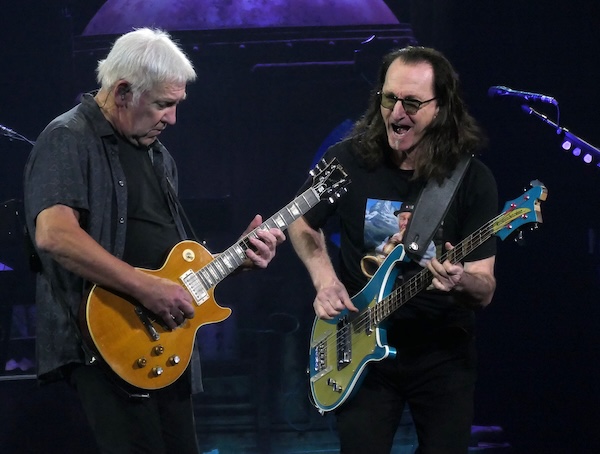
Alex Lifeson and Geddy Lee of Rush at TD Garden. Photo: Paul Robicheau
When drummer Neil Peart retired from Rush after the expansive power trio’s 2015 tour and subsequently died from cancer in 2020, nobody expected to witness the return of Canada’s foremost rock export. Given his virtuosity at a sprawling kit as well as his philosophical presence as a lyricist, Peart was Rush’s most animating force. Even non-drummers would barely take their eyes off him in concert.
But Rush singer/bassist Geddy Lee and guitarist Alex Lifeson really began to think about returning to what they do (with encouragement from Paul McCartney) after performing in a 2022 tribute to late Foo Fighters drummer Taylor Hawkins. They declined to draft willing all-star stickmen for the Rush throne but instead secretly tried out German drummer Anika Nilles, who their trusted roadie had seen playing with Jeff Beck.
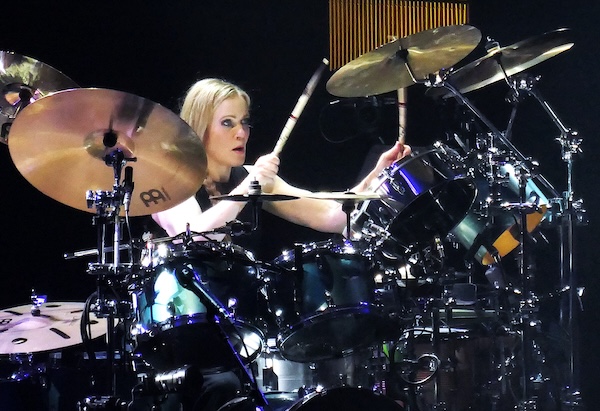
Anika Nilles of Rush at TD Garden. Photo: Paul Robicheau
After long rehearsals, Rush was back in business, first for limited dates and then an extensive tour that rolled into Boston on Saturday and Monday. The initial buzz around the Fifty Something tour centered around two questions: how could this new drummer fill Peart’s mighty shoes, and how could tickets warrant costing hundreds of dollars?
First-hand answers were rapidly revealed in Boston — along with Rush’s trademark geeky humor. Both nights began with a video of actors Paul Rudd and Jason Segal wielding guitars as bro-buddy wannabes, followed by hyper-aged card players Lee and Lifeson beset by teenagers in search of Rush, unlocking a closet of magic robes.
Suddenly, Lifeson and Lee appeared in foggy silhouette behind a boxed stage-front scrim, gripping double-necks that they soon brandished to whip the mythical prog of “Xanadu” into shape. Nilles slipped from the song’s trademark sprinkling of wind chimes and blocks (played on electronic multi-pads) into familiar drum flurries.
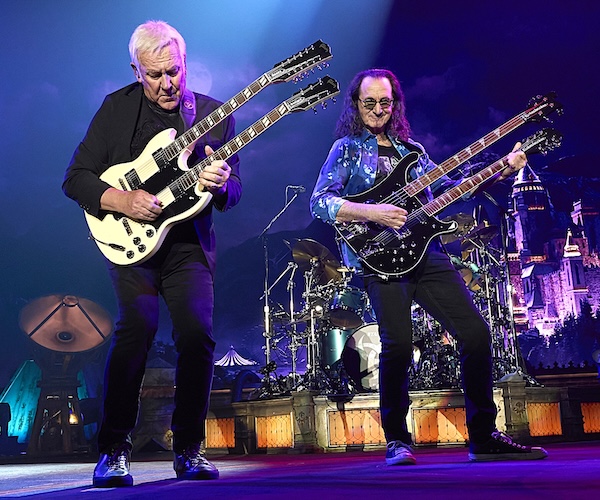
Alex Lifeson and Geddy Lee of Rush on the Fifty Something Tour. Photo: Richard Sibbald
From there, the adventure differed each night across two sets totaling 22 songs, reshuffled with only 13 repeats, and provided nearly three hours of music that erased questions about the worthiness of this recast Rush. The concerts variously served as a remarkable coming-out party for Nilles, a beautifully arranged tribute to Peart, and a joyous revitalization for boyhood friends Lee and Lifeson.
Nilles faced the most pressure, and she was no Peart, though no one ever will be. If his particular precision and intricacy were missed, Nilles literally hit her marks (crushing such air-drumming favorites as “Tom Sawyer” and the instrumental “XYZ”) while bringing her own scrappy style and personality to the kit. She rolled up, down, and around her ladder of toms and multi-cymbal combinations with impressive speed and facility throughout. She passed the test of shifting time signatures with ease in “La Villa Strangiato,” impressed with her fast kick-drum foot as much with the hi-hat finesse of “Freewill” and leaned into fusillades to power the oldie “Anthem,” one of Saturday’s highlights. Yet Nilles proved just as stunning on Monday when she drew on her intense propulsion and whiplash fills during “Headlong Flight,” a track from 2012’s Rush swan song Clockwork Angels.
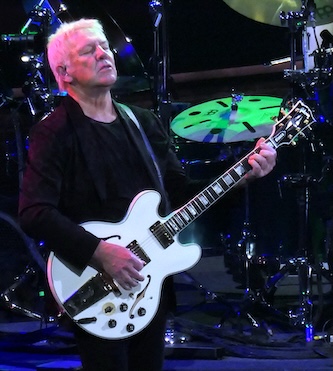
Alex Lifeson of Rush at TD Garden. Photo: Paul Robicheau
Rush evoked Peart on Saturday with that album’s “The Garden” (“The measure of a life is a measure of love and respect,” Lee sang) and on Monday with an early “Dreamline” (“We’re only immortal for a limited time”). But both nights also paid tribute with photos and self-narrated videos of Peart before “Bravado” and heart-tugging imagery in “Time Stand Still,” which also included video of Aimee Mann singing updated harmonies lower in the mix. Evoking one of Peart’s pastimes, a rider-less motorcycle crossed the desert into a forest where his lyric sheets blew in the wind, a heartfelt homage to a transformative drummer and friend.
Aided by a decade away from touring and recent voice lessons, Lee sang in his infamous upper register better at age 73 than he had in decades (thankfully not as high as in his shrill early years) scaling the high yowls of “2112.” Rush performed that 1976 epic in its 20-minute entirety on Saturday, reflecting the influence of the Who’s Tommy in Lifeson’s transitional chording, then capped Monday’s second set with an excerpt. Lee occasionally even leapt or skipped about the stage, freed to focus on pulling his bass strings in knotty vigor by sharing keyboard duties with Loren Gold (the Who, Chicago), who served as a fourth player.
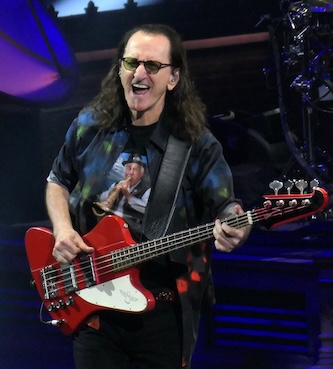
Geddy Lee of Rush at TD Garden. Photo: Paul Robicheau
Lifeson, long underrated for his unique sonic textures, particularly shone in a perfect spread of songs that closed Monday’s first set. He spaced glassy chords and harmonics in the electro-tinged “Red Sector A,” wove a ripping lead through the laser-laced instrumental showpiece “La Villa Strangiato,” and turned from mounted classical guitar to power chords and a gnarly, pitch-bent solo in a rare “A Farewell to Kings.” Then he toyed with the reggae rhythms of the Police-like percolation of “New World Man” and revved up a crowd-igniting set finale of “The Spirit of Radio.”
As if to top that, Rush played its full 1981 masterwork, Moving Pictures, to launch Monday’s second set. The first half bunched classics that were separated on Saturday, including “Red Barchetta” (a sci-fi tale of breaking motor laws with a gleaming sports car that came to life onscreen) and the riffing favorite “Limelight.” But the album’s back half mined deeper cuts, with Gold getting to improvise on piano to lead into the 10-minute New York City ode “The Camera Eye” (with its synth-widened textures), the brooding “Witch Hunt,” and reggae-tinged “Vital Signs.”
Guitar players often make faces as they perform for the sake of the crowd, but Lee and Lifeson were playing off each other with giddy expressions, six-decade friends overjoyed to be still getting to share a Rush. And they clearly connected with the 30-year-younger Nilles, who matched their frisky faces during the nightly finale “Working Man” (which also sported pictures of first-album drummer John Rutsey) while its rock ‘n’ roll feel allowed her to let loose with extra fierceness on the drums. Who knows how this will all work in the long run, but Rush was back in prime shape, displaying a bold new sense of balance and purpose. And that was something.
Paul Robicheau served more than 20 years as contributing editor for music at the Improper Bostonian, in addition to writing and photography for The Boston Globe, Rolling Stone, and many other publications. He was also the founding arts editor of Boston Metro.
Tagged: Alex Lifeson, Anika Nilles, Fifty Something tour, Geddy Lee, Neil Peart