
Classical Music Review: Flutes, Stones, and Ecstasy — Terry Riley’s “The Holy Liftoff”
By Jonathan Blumhofer
Claire Chase and her collaborators make a persuasive, vivifying case for Terry Riley’s hourlong score of freewheeling fantasy, grief, birdsong, and release.
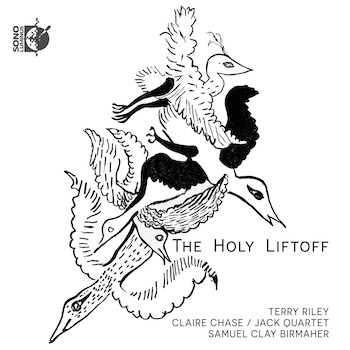
You’ve got to hand it to Terry Riley: the man knows how to come up with a good title. Now 91, the creator of Poppy Nogood and the Phantom Band and The Moonshine Sonata is the latest inductee into flautist Claire Chase’s Density 2036 project. Appropriately, his contribution is a substantial, 60-minute-long fantasy for flutes, strings, and stones called The Holy Liftoff.
If that moniker conjures visions of medieval iconography and comic books, so it should: the composer’s manuscript score for Chase contained a mix of musical notation and imagery meant to illustrate the music’s mood—cartoon characters doing gymnastics, angels wearing cowboy hats, and so on. Those, in turn, helped spur Riley’s development of the larger work (it falls into 22 mostly connected movements) and helped guide Chase’s colleague, Samuel Clay Birmaher, in crafting a performing version of The Holy Liftoff.
The end result, for a collective of eight flutes, string quartet, and stones, may well grow and develop. Indeed, Riley’s lifelong enthusiasm for collaboration, which comes out refreshingly in Jenny Judge’s comprehensive liner notes, means that The Holy Liftoff is “composed” in only the loosest sense, with Chase and her associates—here, the excellent JACK Quartet and stone player Nathan Davis—given considerable latitude for interpretive flexibility. Whether or not the current double bar is temporary, the undertaking is resoundingly uplifting.
Despite his long association with minimalism, Riley’s musical language is anything but static, and The Holy Liftoff is marked by a broad range of colors and textures. Some of them—like the ocarina-esque combination of low flutes at the beginning of “The Holy Liftoff Chorale”—are trippy and ethereal. Other spots, such as the whimsical “Angels in the Snooker Parlor” and “Horizon Streakers Rag,” deliver moments of cheeky playfulness.
There is, throughout the work, a clear sense of direction and journeying, even as The Holy Liftoff isn’t goal-oriented in the same ways as much Western music. Riley’s connections to Eastern traditions and mysticism (he currently lives in Japan) are never far off: “Parked Between Two Clouds” suggests a state of Zen-like bliss, while the two “ishi” movements utilize the sounds of rocks being scraped and struck (“ishi” means “rock” in Japanese).
Structurally, The Holy Liftoff is weighted in a manner that suggests the Golden Mean, its focal point falling a bit past the halfway mark. Called “The Tragedy of What We Lost,” the movement is a pungent memorial to the 2022 murders of 19 students and two teachers at Robb Elementary School in Uvalde, Texas. This is music of understatement and subtlety, Chase’s keening threnody eliding seamlessly into vivid evocations of birdsong—not for the first time does Riley seem to make a nod to Olivier Messiaen.
That dark centerpiece notwithstanding, The Holy Liftoff is (like much of Messiaen’s) essentially music of joy and release. “All Arise,” the score’s answer, after a fashion, to “The Tragedy of What We Lost,” is both purgative and, as it leads into the work’s final sections, ecstatic.
Taken together, the performance is, if not definitive (Riley’s open-form scoring and insistence on creative freedom prohibit any such claims), then at least emphatically vivifying. Chase navigates all of the flute parts with her usual aplomb. So does the JACK Quartet, whose contributions are expertly balanced with the wind chorus. Davis handles the stones discreetly.
Riley is present, too, and not just in the notes: he announces several of the movement titles as they come up. Funnily enough, the sound of his voice—aged, gentle, welcoming—is anything but disruptive to the proceedings. Rather, like seemingly everything else associated with the backstory of The Holy Liftoff, it fits the music perfectly.
Jonathan Blumhofer is a composer and violist who has been active in the greater Boston area since 2004. His music has received numerous awards and been performed by various ensembles, including the American Composers Orchestra, Kiev Philharmonic, Camerata Chicago, Xanthos Ensemble, and Juventas New Music Group. Since receiving his doctorate from Boston University in 2010, Jon has taught at Clark University, Worcester Polytechnic Institute, and online for the University of Phoenix, in addition to writing music criticism for the Worcester Telegram & Gazette.
Tagged: "The Holy Liftoff", Claire Chase, JACK Quartet, Samuel Clay Birmaher, Sono Luminus