
Film Review: The Real Love Story in “The Love Hypothesis” Isn’t the Romance
By Sarah Osman
Lili Reinhart charms as a cancer-curing Stanford Ph.D. candidate, but Amazon’s uneven adaptation works best when it follows Olive’s friendship with Anh—not her contrived fake-dating romance.
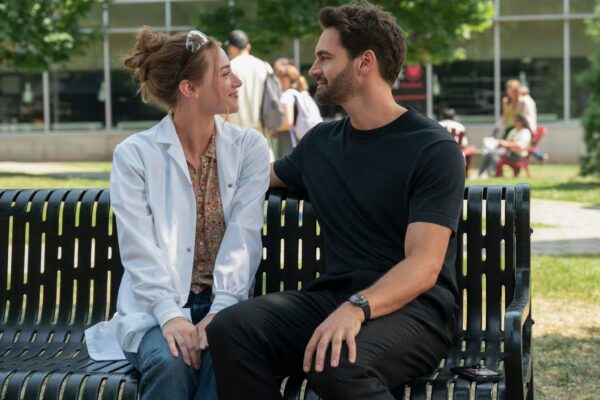
Lili Reinhart as Olive Smith and Tom Bateman as Dr. Adam Carlsen in The Love Hypothesis. Photo: Philippe Bossé/Amazon MGM Studios
I have not read Ali Hazelwood’s The Love Hypothesis, a beloved BookTok romcom staple. Friends of mine have, and they loved its mix of STEM and steam—an unusual combination for the genre. So my knowledge of—and impression of—The Love Hypothesis is based solely on its film adaptation, a charming, if uneven, addition to Amazon’s rom-com canon.
Lili Reinhart stars as Olive Smith, a Stanford Ph.D. candidate in biology. Extrovert Anh (Rachel Marsh) adopts Olive, and the two quickly become besties, to the point that Olive spends every holiday with Anh’s family. Since I came into The Love Hypothesis blind, I initially assumed it would be a love story about two kickass Ph.D. lesbians. Marsh and Reinhart have more chemistry than Reinhart has with anyone else in the film, so I was disappointed when their friendship did not blossom into something more. Still, their relationship feels like the heart of the story—male love interests be damned.
Olive’s crush, Jeremy (Nicholas Duvernay) has some chemistry brewing with Anh. Being the loyal bestie, Anh refuses to date Jeremy. Knowing that Jeremy is perfect for Anh, Olive lies and tells her best friend that she has a hot date. (That hot date is actually a lab mouse.) Sensing that her bestie is not being entirely truthful, Anh goes to spy on Olive. Olive spots Anh and, to get her off her back, impulsively kisses a random man. That guy turns out to be Dr. Adam Carlsen (Tom Bateman), a.k.a. Dr. Evil, the most feared professor in the biology department.
Here is where things get really rom-commie: Dr. Carlsen proposes that he and Olive fake-date. Olive needs a man so Anh will realize it is okay for her to date Jeremy, while Dr. Carlsen needs a girlfriend to convince the administration that he has a reason to remain at Stanford—and, therefore, that they should continue funding his grant. I am not sure how things work at Stanford, but apparently, in this universe, dating your graduate student means you receive more money.
Reinhart shines as a rom-com heroine. She plays Olive with charming neurosis: this is the type of girl who sweats profusely when she has to talk about what she does in the lab and gives mini high-fives to her mouse friends. Her dedication to research is impressive; it is refreshing to see a rom-com heroine focused on curing cancer rather than hunting down scoops in journalism. Reinhart carries most of the film; her male co-lead falls flat.
Bateman, while smoldering, unfortunately plays Dr. Carlsen as the kind of hero who seems autistic-coded. The film never explicitly says that Dr. Carlsen is autistic, but he feels awfully slanted in that direction. The idea is that he is learning how to be human thanks to Olive. Personally, I am getting tired of the autistic-scientist trope, especially when it is played for laughs. Autistic people are a varied lot; not all of them are fixated on science or fail to recognize other people’s emotions. My own husband is on the spectrum, and he possesses none of these qualities—there is a reason it is called a spectrum. It is unclear whether that is due to Bateman’s performance or the writing, but the character is so impersonally one-note it is not until the end of the movie that Olive’s attraction to him begins to make sense. We need time to develop affection for Dr. Carlsen. So it is a mistake to load everything we need to know about him in order to like him at the end of the story.
In truth, I found myself more invested in Olive and her friends’ hijinks than in her romantic plot. I liked her gay bestie, Malcolm (Jaboukie Young-White), who is, yes, a bit of a rom-com stereotype. But Young-White’s performance keeps him from becoming a caricature. He is Olive’s roommate and he happens to be gay, rather than a gay character whose sole function is to be her roommate.
I have never been to a party where everyone decides to make Rube Goldberg machines, but that is these wacky scientists’ idea of fun—and it is fun. Anh and Olive’s friendship is especially refreshing because, at no point, do they break up or turn on one another. Their affection remains steady throughout the film. To me, their friendship—and their strength as women in a sexist field—is the real love story here, proving a hypothesis that the film doesn’t consider.
Sarah Mina Osman is based in Los Angeles. In addition to The Arts Fuse, her writing can be found in The Huffington Post, Success Magazine, Matador Network, HelloGiggles, Business Insider, and WatchMojo. She has an MFA in Creative Writing from the University of North Carolina Wilmington and is working on her first novel. She has a deep appreciation for sloths and tacos. You can keep up with her on Instagram @SarahMinaOsman and at Bluesky @sarahminaosman.bsky.social.
Tagged: "The Love Hypothesis", Ali Hazelwood, Lili Reinhart, Nicholas Duvernay, Rachel Marsh
1 Comment
Leave a Comment
I’m on the editorial team at Trill Magazine. I came across this piece, and would like to point out that one of our writers recently published an article about a similar topic, titled “The Love Hypothesis Now on Screen: Tangible Chemistry or Failed Experiment?” It is also worth a look. We would greatly appreciate it!