
Book Review: “Talking in Tongues” — What It Means to Make Bones Sing
By David Mehegan
In this rich collection of essays and introductions, translator and writer Peter Wortsman considers language as an intimate, imperfect act of resurrection—and guides readers toward a varied company of German- and French-language authors.
Talking in Tongues: Essays on Language and Literature by Peter Wortsman. PalmArtPress, 278 pp. Paper. $25.
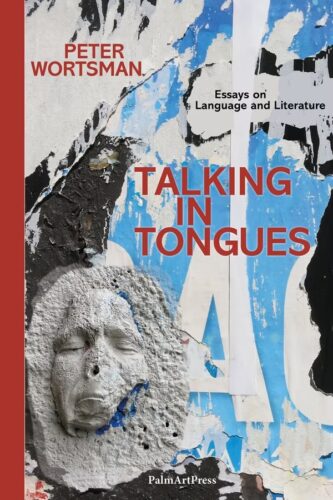 Doubtless most people worldwide are monolingual, probably even most of the formally educated. It is therefore one of the marvels of human history that what is normally an absolute barrier between peoples—their inability to understand one another—should have been so often overcome to the benefit of our kind. We do find ways to talk to one another. Were it not so, we would all still be standing around scratching our heads, like the builders of Babel.
For this we owe thanks to interpreters and, especially, translators. Printers and publishers deserve credit as well, but they would be helpless in the face of world literature without translators. With this book, Peter Wortsman shows himself to be among the more discerning and thoughtful of their number. This acute, insightful collection makes me grateful for the work of his tribe.
The book has two parts: “Talking in Tongues,” essays on language and translation, and “Making Bones Sing,” introductions to works by writers whose writing Wortsman has rendered into English. The first offers facts and reflections drawn from his personal history. Born in New York to Jewish refugees from Vienna who had fled Nazism, Wortsman spoke English at school and in public life, German with his parents, and later French—learned at home and at school—with his French wife and bilingual children.
For Wortsman, each language has a discrete emotional and psychological color:
“…German, the vernacular of my communion with my parents from the time I started talking until my father’s death in 1979 and my mother’s in 2007, and English, the vehicle of public palaver—as well as French, as a third, adoptive, ‘step-mother’ tongue tailor-made for romance….”
Speaking three languages would make most of us proud, but Wortsman’s father spoke seven fluently and was studying Turkic and Arabic at the time of his death. Translation had to be in the air and water of the family culture; it is not surprising, then, that Wortsman has made it his primary life’s work, alongside plays, poetry, nonfiction, and fiction of his own. Talking in Tongues lists twenty-two translations, all by European writers and all works of literature or works about literature.
One could not translate so much without thinking deeply about translation—not only its process but its meaning—and Wortsman shares much of that thought. “With his ear pressed to extinguished lips,” he writes, “the translator acts as a kind of medium who literally derives inspiration transmitted by strange syllables. Translation from one language into another, particularly the words of the dead, is a kind of mouth-to-mouth resuscitation in which you breathe new life into expired syllables.”
And from a 1987 lecture at Boston University: “Translation, an apparently safe compromise between the psychic risks of original composition and the grip of inertia, tricks the ego into lowering its guard—all risk dispelled by the reassuring presence of the original text—just long enough to release the airy impulse of voice.” He even compares translation to a sexual tryst: getting inside the skin of another, where union accompanies necessary separateness. There is also, for him, at times what sounds like a Freudian, Oedipal element—at any rate, a resistance to genuflection before the admired: “A certain degree of repressed animosity serves to temper too much reverence, particularly in the case of dead masters.”
Stepping back, we can infer from these grapplings with ghosts the intrinsic mutability of meaning in language, which is at best a partial and approximate currency of understanding. The finest translator necessarily falls short of conveying an author’s exact meaning—as the author herself necessarily fell short in the original.
Rich as all this is, the heart of the book, for this reader, lies in its second part: introductions and essays on Alexander Kulisiewicz, the singer and archivist of Holocaust song, and on the European writers Wortsman has translated into English. They include Franz Kafka, Adelbert von Chamisso, Heinrich von Kleist, E. T. A. Hoffmann, Rahel Levin Varnhagen, Heinrich Heine, Peter Altenberg, Robert Musil, Kurt Schwitters, Raymond Federman, and the Brothers Grimm, counted here as one. Six of these figures were Jewish, at least nominally; all were assimilated into gentile European society—no shtetl storytellers here.
The texts discussed in these essays and introductions include Chamisso’s 1813 Faustian novella Peter Schlemiel, The Man Who Sold His Shadow; Varnhagen’s letters; selected prose by Kleist; Hoffmann’s The Golden Pot: Tales of the Uncanny; selected Märchen by the Brothers Grimm, un-Disneyfied folk tales; Heine’s travel writings; Musil’s 1935 Posthumous Papers of a Living Author; and Konundrum: Selected Prose of Franz Kafka.
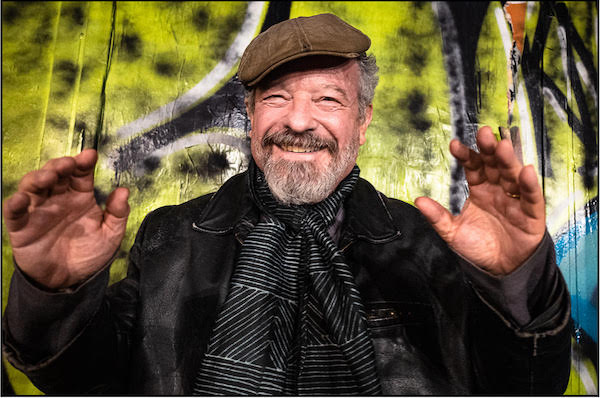
Writer and translator Peter Wortsman. Photo: Jean-Luc Fiévet
This monolingual American had not heard of several of these writers and had read embarrassingly little of most of the others. That is precisely what makes a collection such as this so enriching. Having entered the translator’s tryst with them, Wortsman is especially well equipped to understand these creative figures, describe the social and historical context of their work, and explain why they reward reading.
The book repeatedly conveys the workings of the unconscious and its catalytic role in the making and remaking of art through a lesser-known and decidedly creepy Grimm story: “The Singing Bone,” from which Wortsman takes the title of Part Two, “Making Bones Sing.” A wandering shepherd boy finds a small white bone under a bridge and fashions it into a mouthpiece for his horn. But when next he blows the horn, instead of the music he intends, the plaintive sound of a voice is heard, that of a youth murdered by his envious brother: “The bone you blow on,” the voice moans, “knows no joy / My brother slayed me, / beneath the bridge he laid me. …” The bone is from the victim’s body.
Enumerating the ways and times this ancient story has been told and retold, Wortsman remarks: “What else is fiction … but a selective recycling! … Like an author who goes back and scours old notebooks for impressions, stray remarks overheard and observations noted, fragments waiting to be reconstituted into a whole. … But the function, whether for tomorrow’s avant-gardes or yesterday’s traditionals, remains essentially that of a talking tombstone, a singing bone.” The translator, too, is part of that voice.
A 2024 Arts Fuse conversation with Peter Wortsman.
David Mehegan is the former Book Editor of the Boston Globe.
Tagged: "Talking in Tongues", "Talking in Tongues: Essays on Language and Literature", Peter Wortsman
1 Comment
Leave a Comment
This is the review of a lifetime. And in a sense, David Mehegan, whose writing and role as book review editor of The Boston Globe, I did not know, has brilliantly and insightfully encapsulated and appreciated a lifetime’s work that happens to be mine. He gets it. You get it, and thanks to Mr. Mehegan’s superb prose, you, the reader, whoever and wherever you are, have a shot at it. I cannot thank you enough. Please also convey my appreciation to him.
I cannot say if my failing health will still permit me a journey to the Boston realm, where I spent my college years. The Arts Fuse is a rich and precious resource, its roots reaching back to the realm and nourished by the spirit of Henry David Thoreau, whose acquaintance I first made in the pages of “Walden Pond.” Thanks again. The Arts Fuse is a rich resource, particularly so in these dark times. Thanks again.
Peter