
Opera Review: Boston Lyric Opera’s “William Tell” Takes Aim at Revolution—and Hits Its Mark
By John Tamilio III
Rossini’s epic arrives at the Emerson Colonial Theatre in a visually audacious, musically potent production that turns a familiar liberation story into a contemporary warning.
William Tell (Guillaume Tell), Music by Gioachino Rossini. Libretto by Victor-Joseph Étienne de Jouy & L.F. Bis. Staged by the Boston Lyric Opera and performed with the BLO Chorus & Orchestra at the Emerson Colonial Theatre, 106 Boylston St., Boston, September 27 and October 2 and 4.
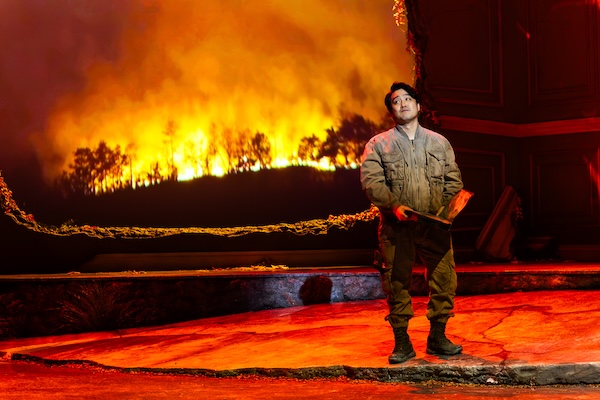
Arnold (Konu Kim) reminisces about his home while his community is ablaze in Boston Lyric Opera’s William Tell Photo: Nile Scott Studios
A friend once remarked that the definition of class is hearing the William Tell Overture without thinking of the Lone Ranger. “Class” is also an apt term for the Boston Lyric Opera’s opening of its fiftieth season Friday night at the Emerson Colonial Theatre: a stunning visual, vocal, and orchestral production of this historic tale. Victor-Joseph Étienne de Jouy and L. F. Bis’s poetic libretto, set to Gioachino Rossini’s legendary score, found novel artistic expression in costuming and set designs that transported the opera from its original 1829 Paris setting to a modern, apocalyptic, revolutionary context.
As the curtain rose during the familiar finale of the overture, the cast entered single file from stage left, disguised as prisoners being scanned by armed guerrilla constables in black attire. The pastel, earth-toned costumes, beautifully crafted by Costume Works, Inc., cloaked the diverse cadre of singers in bucolic tenderness. The commanding set, constructed and painted by the Huntington Theatre Company, served multiple purposes: first as a stately drawing room and, eventually, as a battlefield. The creatively lit backdrop shifted from a lush forest to a distant village set ablaze and then to a blistering blue surf. The latter was quite apropos: as the first drops of the expected nor’easter began to fall on Boylston Street, the audience felt sea swells wash over them as lightning lit the sold-out theater. The work of lighting designer Eric Southern, along with the aesthetics of projection designers Victoria (Vita) Tzykun and David Adam Moore, dazzles.
The narrative concerns love, cultural fidelity, and the struggle for liberation. The impoverished Helvetians are oppressed by the affluent Allemanians. Led by the title character in revolt against the tyrannical Allemanian Governor Gessler, the tension builds to the familiar scene: Gessler forces Tell, known for his skill as an archer, to shoot an apple from the head of his daughter, Jemmy. (In the historic Swiss version, the child is his son.) He must do so before his tyrannized countrymen and a politician flanked by bourgeois apple-polishers. What those unfamiliar with the legend may miss is that this famous scene presents a Sophie’s choice: if Tell does not comply, Gessler will kill both him and his child. The only way Tell can save her is to risk impaling her with his arrow. The archery scenes were incredibly realistic, with projectiles popping from behind the target to suggest crossbow fire.
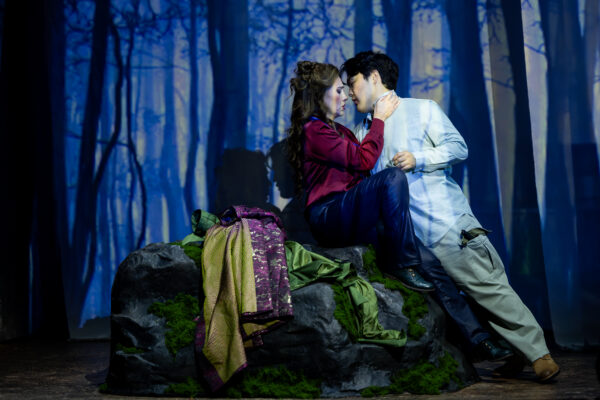
Mathilde (l., Anya Matanovic) and Arnold (Konu Kim) steal time together in Boston Lyric Opera’s William Tell. Photo: Nile Scott Studios
The setting BLO employs evokes the Cuban Revolution. With a backdrop that intimates the conflict that followed Castro’s overthrow of Fulgencio Batista in the 1950s, the cast made use of anachronistic props powered by modern technology: iPhones, police batons resembling lightsabers, and an eye-and-hand security scanner. Art cogently mirrors life, as associations with contemporary repressive and insurgent regimes across the globe were unmistakable—not to mention the burgeoning (mis)use of artificial intelligence.
This opera is long, clocking in at nearly three hours. Yet the stellar vocal repartee among the members of this prestigious cast, with the assistance of the brilliant special effects, never failed to compel. Of particular note was tenor Konu Kim as Arnold. The power and serenity of his voice are resplendent. He is elegantly paired with Anya Matanovi; together, they enacted the opera’s subtext: a Romeo-and-Juliet-esque love story between enemies that becomes quite suggestive at times. They personify one of the work’s themes, aptly stated in the program notes: “patriotism collides with personal loyalties.”
William Tell is the perfect operatic entrée for those unfamiliar with the genre but versed in modern musicals. The acting by the entire cast is vivid and energetic, rarely touching on the hyperbolic. Angie Jepson was handed a choreographic challenge, given the sizable troupe. The commanding presence of internationally renowned baritone George Gagnidze, who played Tell, is consistently robust. His exchanges with Brianna J. Robinson as Jemmy—a soprano with a crystalline voice—are very endearing. The drama is enhanced by a supporting cast of formidable strength.
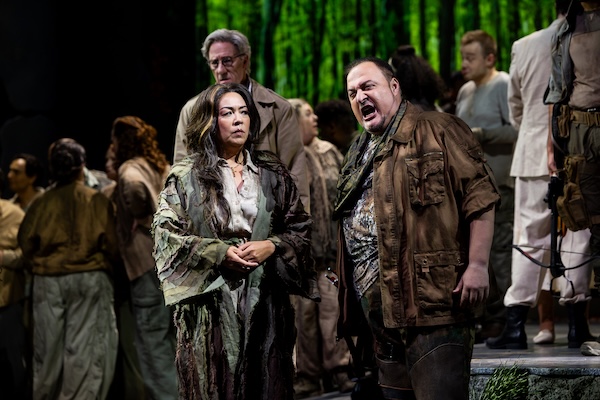
Nina Yoshida Nelsen (l., as Hedwige) is concerned for husband William Tell’s (George Gagnidze) urge to fight in Boston Lyric Opera’s William Tell. — Photo: Nile Scott Studios
The BLO orchestra is equally impressive. Under David Angus’s baton, the players give the performance a cinematic sweep and fluidity. From the overture’s opening—when principal cellist Brent Selby’s sublime playing pierces the darkened theater—to its potent finale, the score’s vision of liberty as a struggle continually needing to be renewed gains hypnotic force. With the pit set only a hair below stage level, the orchestra becomes an active presence in the drama.
The lone distraction is the placement of the surtitles. The French libretto’s English translation appears on two flat screens flanking the stage at balcony height. Because the text is dense and rapidly paced—unlike, say, the recurrent lines of Handel’s Messiah—the audience must keep shuttling its gaze between the action and the captions. Inevitably, something is lost. A single screen above the proscenium would serve the production better. BLO, the Boston Symphony Orchestra, the Tanglewood Festival Chorus, and the Boys of the St. Paul’s Choir School used just such a setup for last year’s Symphony Hall presentation of Korngold’s three-act Die tote Stadt. Perhaps the Emerson Colonial’s architecture, or the demands of this staging, make that solution impracticable.
One final observation: this William Tell is, in effect, a play within a film. It begins on a movie set, complete with director, lighting crew, and clapperboard, as the story is ostensibly being shot. I half expected the director to return at the end and call, “Cut!” The conceit soon recedes, however, as the opera’s drama takes hold.
The device faintly recalls Monty Python and the Holy Grail, whose Arthurian quest is periodically interrupted by the framing device of a documentary, culminating in the death of “a famous historian.” The association is especially apt—or at least pleasantly absurd—because Graham Chapman, who played King Arthur, also played William Tell in a comic sketch filmed for the German-made Monty Python’s Fliegender Zirkus. Seek it out—but only after catching one of BLO’s two remaining performances of William Tell.
Here’s to another fifty years for one of Boston’s cultural mainstays.
John Tamilio III, Ph.D. is the Pastor of the Congregational Church of Canton, a professor of Philosophy at Salem State University, and a professional guitarist who plays solo acoustic and for the Boston-based classic rock band 3D. His playing has been applauded by David Brown (Simon & Garfunkel, Billy Joel), Jack Sonni (Dire Straits), and Carter Allen (WZLX). An aficionado of classical music, particularly the Baroque era, Tamilio’s publications are vast, covering not only music, philosophy, and theology, but the poetry of T.S. Eliot as well. He resides in Beverly with his wife Cynthia.
Tagged: "William Tell", Anya Matanovič, BLO Chorus & Orchestra, Boston-Lyric-Opera, David Angus, George Gagnidze, Konu Kim
3 Comments
Leave a Comment
Thank you for this informative review!
Important to mention people who created this concept – Victoria (Vita) Tzykun & David Adam Moore who co- directed this production and co-designed scenery and costumes (in addition to video projections).
While I don’t normally approve updating operas, an upturn into turmoil in any country can be handled well by the William Tell opera of Rossini. It is a super-long opera uncut, and I’m sure a few cuts were made. But the reality into which the people are thrust is quite understandable today. The ballets, the choral ensembles, the great duets and arias, all add together to make those of us who are fans of this opera simply ecstatic that someone is actually staging it. I just wish I could have seen it.
Thank you for this review which certainly should encourage many to support this forward looking performance.