
Concert Review: Yo-Yo Ma Elevates a Dispiriting Boston Symphony Orchestra Opening Night
By Lloyd Schwartz
The BSO avoided a strike and greeted its music director warmly, but an oddly programmed opening night culminated in a deeply disappointing Brahms Fourth.
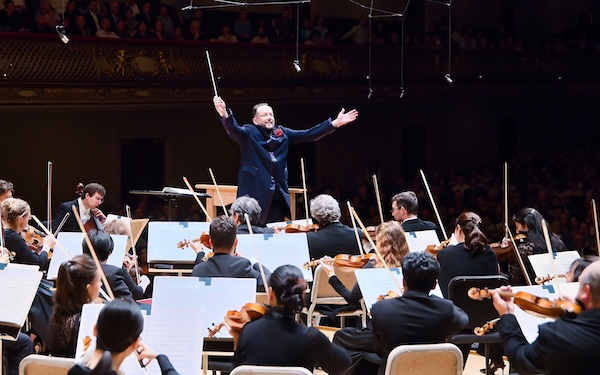
Andris Nelsons conducting the Boston Symphony Orchestra on Opening Night. Photo: Hilary Scott
I’m relieved the contract between the BSO musicians and the board of trustees has been approved by the musicians and that there is no danger of a strike that would delay this season’s concerts. I see a genuine step forward in giving the musicians more power in the power structure, even if some of the final decisions still aren’t entirely in their hands and any renewal of music director Andris Nelsons’s contract was not even on the table. Anyone who noticed the news reports of the change in Nelsons’s contract well over a year ago, a change that would make his non-renewal easier, should have clearly seen this coming. And since I’ve been increasingly disappointed with Nelsons’s performances—sometimes shockingly disappointed—I was quietly hoping that Nelsons might be on his way out (I suspect the brouhaha was at least partly engineered by Nelsons’ own management).
I attended the opening night concert for several reasons, some of which had little to do with the program itself. I was of course eager to hear Yo-Yo Ma playing the Elgar Cello Concerto (I think this was the major reason the performance was sold out—Ma sells out virtually every concert in which he appears). But I was also curious about the state of Nelsons’ conducting, and about the way the audience would receive him. On the corner of Westland and St. Stephens, there were two ardent fans of Nelsons who made front-page news in the Globe last summer distributing the red paper roses signifying sympathy for him. But there were no dramatic showdowns in front of Symphony Hall.
The concert began with words of greeting from Mayor Michele Wu and BSO CEO Chad Smith, who has been the object of vigorous attack from Nelsons fans because of the clumsy way the board announced Nelsons’ dismissal (which will come at the end of next summer’s Tanglewood season). But they were both greeted with warm applause. I had feared some audible outrage for Smith, but it was all more than polite. Then Nelsons emerged and got a standing ovation and spoke a few halting, sentimental words about how the flowers represented love.
I admit I was dubious about why a BSO opening night in the midst of the celebration of the United States’ 250th birthday should begin with a tango (called Tango) by a Latvian composer, Arturs Maskats (one of Nelsons’ teachers). This was supposed to be a tango version of Ravel’s La Valse, in which Ravel shows us, through ironic and then devastating waltz music, the end of a civilization. The Latvian piece seemed to have no such ambitions—just a mild Pops piece with less allure or power than a work by Astor Piazzola. Maskats was present and his bow was more emotional than anything in the music. Here was an opportunity for Nelsons to answer his critics by starting the season with a significant or celebratory piece of American music—say Ives or Ellington. But the leader of one of the great American orchestras blew it.
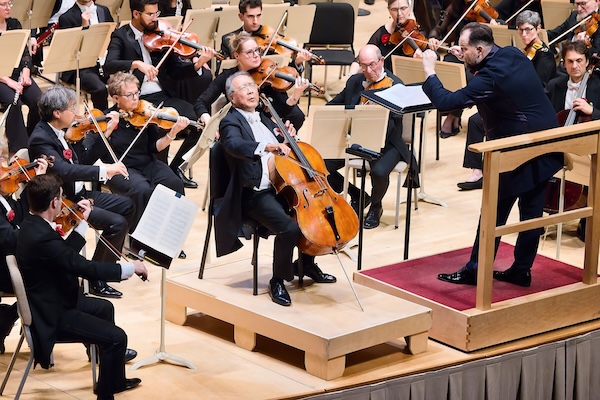
Yo-Yo Ma performs Elgar’s Cello Concerto with Music Director Andris Nelsons conducting the Boston Symphony Orchestra. Photo: Hilary Scott
Yo-Yo Ma was extraordinary in the Elgar Cello Concerto, which he played on the soul-stirring Stradivarius once owned by the great Jacqueline du Pré, the acknowledged master of this concerto. Heartfelt and buoyant, Ma took the players with him, and Nelsons didn’t get in the way. This was one of Ma’s best performances of one of his standards. For an encore, Ma generously invited the entire cello section to join him in Pablo Casals’s exquisite arrangement of the “Song of the Birds.”
But there was no Yo-Yo Ma in the Brahms Fourth Symphony, which was the big piece after intermission. I’m not sure why one of Brahms’s darkest works was chosen for a celebratory evening. And here Nelsons was a major impediment. Galumphing and elephantine, there was little sense of the way Brahms’s tragic music moves both forward and backward. This is hard to do, but that’s what a conductor is for. In my experience of him, Nelsons has never been able to get slow music to move forward. And he has never quite learned how to deal with the warmth of Symphony Hall’s extraordinary acoustics. The lower registers—percussion and brass—were so loud that they drowned out the upper voices, where Brahms’s melodies mainly lie. I couldn’t hear some—many—of the middle notes in those glorious melodic phrases. The playing was a little sloppy here and there despite this being a piece the orchestra has played numerous times. I found the whole performance almost intolerable.
It got a lot of applause, though. Including between movements, which led me to think that there were a lot of people in the audience who were not familiar with the etiquette of attending performances of classical music. Could bringing to Symphony Hall so many musical novices be Yo-Yo’s “fault”? Will anyone in the audience new to classical music—we want this!—return for any other BSO concerts, without Yo-Yo Ma’s well-earned star power? I hope so. Etiquette is easy to learn, but the habit of going to the BSO or any other of Boston’s panoply of great classical groups might be harder to achieve. I think—I at least hope—the excitement aroused by an extraordinary new conductor—maybe a woman—who gets everyone excited, either through spectacular reviews or, even more important, through word of mouth, will solve a lot of the BSO’s alleged problems.
The following performance, instead of repeating the entire program, exchanged Yo-Yo Ma playing the Elgar Concerto for Emanuel Ax playing Mozart. I didn’t go back.
Lloyd Schwartz is the Pulitzer Prize-winning classical music and art critic for NPR’s Fresh Air and WBUR’s arts website. An award-winning poet, he’s the current poet laureate of Somerville. His latest book is Artur Schnabel and Joseph Szigeti Play Mozart at the Frick Collection (April 4, 1948) and Other Poems (Arrowsmith). He’s the Frederick S. Troy Professor of English Emeritus at UMass Boston.
Tagged: Andris Nelsons, Boston Symphony Orchestra, Opening Night
2 Comments
Leave a Comment
What does it mean to be “shockingly disappointed”? And what is going on here?: “I’m not sure why one of Brahms’s darkest works was chosen for a celebratory evening. And here Nelsons was a major impediment. Galumphing and elephantine, there was little sense of the way Brahms’s tragic music moves both forward and backward.” Where is the noun in that last sentence? Or is this a comment on Nelsons’s girth and his podium movements? And as for people applauding between movements! Shocking! Someone should teach these people how to behave, or else tell them they don’t belong in Symphony Hall with the cognescenti. We don’t need the unrefined hoi polloi there, anyway. But wait — Chad and Barbara want MORE people there, don’t they?
Are you being disingenuous?. The noun is understood.
But I will not be holding my breath for an exciting new conductor who also agrees to live in Boston and take on a more Koussevitsky -like role of directing 20+ programs a year. As much as he has been touted as the savior of the NYPhil Dudamel has only 8 weeks this season and 12 next. And I doubt he will be at the podium for any of the four film weeks on the schedule.
Personally, I would love to see the reemergence of the Koussevitsky/Burgin collaborative model:
A vibrant MD and a live-in Assistant conductor to fulfill the programming vision throughout the season. Koussevitsky’s concertmaster Burgin was tasked with conducting some Anerican premieres and repeating important recently composed works when Koussy was away. The orchestras’ repertoire was able to grow this way. There has been no growth in the repertoire for almost half a century now.
Silverstein was the last concertmaster to carry on that tradition in the BSO. And as far as I know it exists in no other American orchestra, either.