
Book Review: “Deserted” — How the Local News Crisis Is Devastating Rural Communities
By Dan Kennedy
Social change and corporate greed are destroying newspapers in small-town America. What happens to the people left behind?
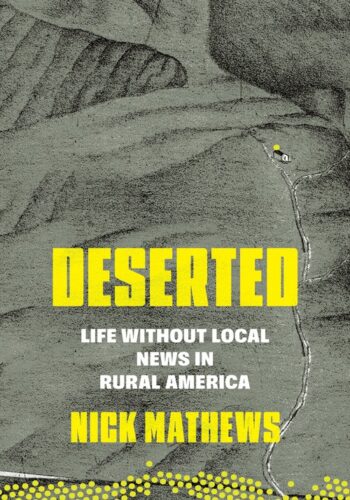
Deserted: Life Without Local News in Rural America by Nick Mathews. University of Illinois Press, 168 pages, $110 (cloth), $24.95 (paper)
Local news is in crisis everywhere, but the challenge is more daunting in rural areas than it is in cities or affluent suburbs. Consider the Storm Lake Times Pilot, which serves a farming community in Iowa. As cofounder Art Cullen explains in the 2021 documentary Storm Lake, the rise of agribusiness wiped out much of the local advertising that had once sustained the paper while the spreading tentacles of social media grabbed another large chunk. When Cullen appeared that same year on the podcast that Ellen Clegg and I host, What Works: The Future of Local News, he told us that both he and his brother, John Cullen, were living on Social Security rather than take a salary out of their precarious newspaper revenues.
The Storm Lake Times Pilot is emblematic of a national phenomenon. In 2025, the Local News Initiative at Northwestern’s Medill School found that 213 US counties lacked a local news outlet, and that nearly 80 percent of those counties were in rural areas.
This depressing state of affairs is the focus of Nick Mathews’s new book, Deserted: Life Without Local News in Rural America. Mathews, an assistant professor of journalism at the University of Missouri, studied Caroline and Nelson Counties in rural Virginia. The weekly Caroline Progress shut down in 2018. Another weekly, the Nelson County Times, became part of Lee Enterprise’s national chain in 2020. The new owners hollowed it out and filled it with nonlocal content, transforming what had been a vital source of community engagement into a “ghost newspaper,” to use a term coined by local-news researcher Penny Abernathy.
Mathews’s findings are grounded in 89 interviews, most of them with residents of the two counties. The identities of the folks Mathews talked with are kept anonymous, which is not unusual for an academic book, although it seems odd given that he previously worked more than two decades in journalism. Fortunately, he has an eye for the colorful detail, opening each chapter with well-told anecdotes. For instance, take Aaron, elderly and alone following the death of his wife and only child; Mathews tells us that Aaron himself would join them before publication.
“When it closed, I lost a loved one,” Aaron said about the demise of the Caroline Progress, adding: “The newspaper marked you. If you read it for just a few minutes, you had to wash your hands. My fingers are too clean now.”
Although Mathews’s subjects tell us much about life without a reliable source of news and information, there are limits to their insight. In particular, some of those he talked with in Nelson County struck me as self-satisfied and entitled, telling him that they didn’t care about the government-accountability stories that the Times continued to publish because they were content with hearing directly from their elected officials in the local Facebook group. Instead, they wanted the Times to run more positive features about local residents and businesses.
Although Mathews keeps the proceedings resolutely apolitical, a distinct whiff of Trumpism arises from what he describes as his subjects’ “feelings of disrespect, betrayal, and even anger,” traits that he says are among those that characterize “a rural social identity.” And, of course, these same resentful residents tell Mathews they couldn’t dream of living anywhere else. At one point, Mathews expresses his frustration to a woman named Teresa over her preference for “firsthand accounts” from local officials, writing: “I mentioned to Teresa that the traditional function of newspapers in monitoring local governments. ‘They are independent observers,’ I said of the journalists. Teresa scoffed loudly. ‘They’re strangers,’ she said dismissively. ‘They don’t live here.’”
The late media scholar Howard M. Ziff grappled with the Teresa dilemma years ago in an essay about what he called the “cosmopolitan” and “provincial” models of journalism. To oversimplify, the cosmopolitan model, as practiced by most large news organizations, is based on strict adherence to traditional notions of objectivity, whereas the provincial model is grounded in compassion and doing what’s best for the community. But Ziff—like Mathews—argues that what’s best for the community is holding the local power structure to account. Somehow that failed to get through to Teresa and others with similar views.
Developments that have helped counteract the decline of local news have largely bypassed rural communities. Independent startups, mostly digital, many of them nonprofit, are concentrated in urban and suburban communities, where broadband is widespread and where the sorts of philanthropic individuals and organizations that support journalism are nearby. In addition, a nascent effort to provide government assistance to support local news has proved more successful in blue states than in red. For example, an ambitious bill to provide tax credits to news organizations that hire and retain journalists is now awaiting the governor’s signature in deep-blue California.
Yet even blue states have large rural areas dominated by Trump voters. Howard Owens, who publishes The Batavian, a small for-profit digital outlet in rural western New York, told me recently that he’s hoping to take advantage of a tax credit that the state has implemented. Still, when he appeared on our What Works podcast in 2023, he lamented what he regards as Big Philanthropy’s bias in favor of news projects that align with the urban, more liberal parts of the country.
“We all know the studies about newsrooms being predominantly progressive or partisan in a particular left-leaning way. I don’t share those views, and knowing a lot of the people involved in these organizations, I know what their politics are and what their political agendas are,” Owens said. “A lot of times they’re pretty explicit about what they will fund and not fund. I think it’s a real challenge for rural publishers to get any kind of assistance from those types of funders.”
In Deserted, Mathews focuses more on what’s been lost than on possible solutions, although he does profile an owner-publisher-editor named Anne Adams whom he holds up as a workaholic exemplar. But he does have three worthwhile ideas for how journalism can reconnect with rural communities:
- “Educate community residents.” Certainly Mathews has folks like Teresa in mind. But he also writes that his interview subjects didn’t seem to know the Nelson County Times had a robust web and social media presence in addition to its print edition, and that those digital sources of information were providing a lot of the real-time news they said they wanted.
- “Celebrate community residents.” Residents told Mathews that the local Facebook group had become their top choice for sharing news about weddings, births, youth sports, and the like. A concerted effort to bring such fare back to the paper, Mathews writes, “can create connections with residents and achieve a meaningful small win.”
- “Meet community residents.” Mathews says it’s imperative that journalists find a way to be visible by working with local businesses such as coffee shops to host weekly or monthly get-togethers. Indeed, such outreach has become a key part of what many local news outlets do, from showing up at farmers markets to organizing community storytelling events.
Of course, these ideas presuppose the existence of a local news organization whose leaders actually care about connecting with their audience. But they serve as a good reminder that community journalism’s role is not just to report the news but to serve as a catalyst for civic engagement.
Deserted has its strengths, but its unrelenting focus on interviews with anonymous participants makes it more of an academic study than an engaging narrative. Mathews has the academic’s habit of coining awkward phrases, such as the “lived news desert” (a community served by a ghost newspaper), the “Atlas Complex of the Rural Journalist” (the sense some journalists have that they must be working all the time lest they miss even a small story), and the “Fishbowl of the Rural Journalist” (the pain of constantly being recognized in public and roped into conversations with readers).
“Community news organizations, once rooted in their local areas, have been overtaken by corporate powers that treat rural residents as mere afterthoughts, numbers on a balance sheet rather than the heart of the stories they once told,” Mathews writes. “The result is a barren landscape, devoid of genuine connection, where news no longer reflects the lived realities of the community but instead is shaped by far-away powers with no care for the community.”
Mathews has produced a useful study of how rural communities have been harmed by the local news crisis. The voices he’s gathered are a poignant reminder of what they—and we—have lost over the past 20 years, as technological and social change have starved journalism of revenues and as greed has supplanted an ethic of public service.
Dan Kennedy is a professor of journalism at Northeastern University, where he co-leads the project What Works: The Future of Local News and co-hosts its twice-monthly podcast. His blog, Media Nation, is online at dankennedy.net.
Tagged: " rural America, "Deserted: Life Without Local News in Rural America, Nick Mathews, local news deserts
1 Comment
Leave a Comment

Love the phrase “an academic study rather than an engaging narrative” because you definitely reach a wider audience with an “engaging narrative.” Good insight, but are we beating the proverbial dead horse? I fear so.