
Book Review: Alexander Herzen’s “Future” Has Arrived
By Tom Connolly
A new annotated translation of Past & Thoughts restores the Russian revolutionary writer’s intimate family drama and brings his penetrating critique of tyranny, populism, and political extremism to American readers.
Past & Thoughts: An Annotated Critical Edition by Alexander Herzen. Translated by Robert N. Harris and Kathleen F. Parthé. Edited by Robert N. Harris. Harvard University Press. 416 Pages. $35.
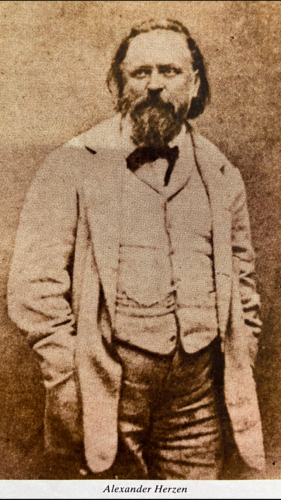
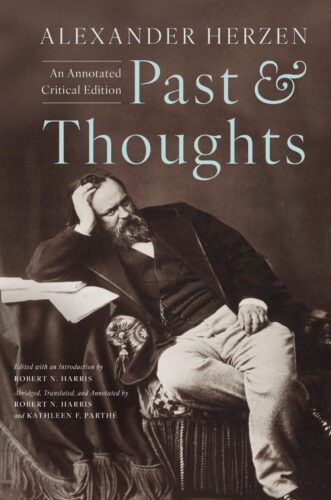 Alexander Herzen (1812–1870) is one of the nineteenth century’s greatest cultural and political thinkers. A founder of Russian socialism and advocate for agrarian populism, Herzen supplied the intellectual foundation that shaped generations of dissidents. Forced into lifelong exile in Europe in 1847, he established the Free Russian Press in London. He published The Pole Star, The Bell, and Voices from Russia, all uncensored and smuggled directly into the Russian Empire. Beyond his combative political journalism, Herzen earned enduring literary stature through his masterpiece, Past &Thoughts, an expansive autobiography whose narrative breadth, psychological insights, and stylistic brilliance led Isaiah Berlin to rank it alongside the novels of Tolstoy and Dostoevsky.
When Tom Stoppard’s Tony-winning play trilogy The Coast of Utopia hit the New York stage, it sparked a resurgence of interest in Herzen and his circle. Bookstores quickly sold out of Isaiah Berlin’s Russian Thinkers, and E. H. Carr’s classic 1933 biography, The Romantic Exiles, was rushed back into print to satisfy readers eager to explore the dramatic lives of these nineteenth-century revolutionaries. Despite his turn on stages in London and New York, Herzen remains under-appreciated, here and elsewhere. At a time when so much political discourse has degenerated into demagoguery, Herzen, the great opponent of amoral extremism, is a desperately needed voice.
Born illegitimate in Moscow in 1812 to a wealthy landowner and his young German mistress, Herzen derived his surname from Herz (the German word for “heart”). His early life was punctuated by war and political upheaval, beginning with Napoleon’s invasion of Moscow during his infancy. His early exposure to the cruelty of serfdom — compounded by the execution of the Decembrists by Czar Nicholas I in 1825 — forged his lifelong revolt against authoritarianism, thrusting him into a central role within Russia’s emerging intelligentsia.
One of the most stirring passages in nineteenth-century memoir writing is Herzen’s account of the exact moment he and his closest friend, Nikolai Ogaryov, pledged their lives to the Revolution. In the summer of 1827, two years after the Decembrist debacle, and barely a year after the execution of its leaders, fifteen-year-old Herzen and thirteen-year-old Ogaryov climbed the Sparrow Hills overlooking Moscow and swore a sacred vow to avenge the fallen martyrs. Herzen’s tone here is at once serious and slightly self-mocking, an embrace of nuance that is the hallmark of his brilliance. He never becomes heavy-handed, comfortably deriding fatheads and discounting prognosticators.
After twice being sent into internal exile for political agitation, Herzen used a large inheritance to leave Russia in 1847. As he traveled through a Europe convulsed by revolution, he witnessed the Paris uprisings of 1848 and the flames of Italy’s Risorgimento. These experiences helped shape his pioneering, human-centered vision of Russian Populism, rooted in the mir, the Russian peasant commune.
Herzen’s critique of the mir reveals the central tension in his Populist thought: how to reconcile collective social structures with individual freedom. He saw the commune’s shared land and mutual aid as an embryonic socialism that might allow Russia to bypass Western capitalism. Yet he refused to romanticize the peasantry, as the Narodniki did. He recognized its patriarchal repression, hostility to individual liberty, and deep-rooted monarchism—the belief that the tsar was a benevolent “Little Father.” Herzen imagined a reformed mir that would preserve its economic solidarity while embracing the Enlightenment ideal of personal autonomy.
Breaking with Marx by proposing reforms grounded in human nature and native traditions rather than unconditional precepts, Herzen drew on wit, irony, dissent, and persuasion to fight Czarist oppression– he championed free speech, serf emancipation, and Polish independence while opposing political terrorism and state centralization.
Herzen’s magnum opus, Past & Thoughts, is arguably the most influential memoir published in nineteenth-century Russia—an epic of political agitation, marital scandal, death, betrayal, and despair. The Russian scholar Isaiah Berlin called it the “ark” in which Herzen preserved his life story for posterity; the critic Joseph Frank described it as “perhaps the greatest work of its kind published anywhere in the 19th century,” ranking it with Rousseau’s Confessions and Goethe’s Dichtung und Wahrheit as a portrait of both a life and an age.
 Despite Herzen’s importance, the left-wing literary critic Dwight Macdonald lamented his undeserved obscurity in the West. “So far, he hasn’t crossed the Atlantic,” Macdonald wrote in 1948. For decades, he tried to introduce American readers to Herzen, comparing him with Stendhal, Gibbon, Tolstoy, Henry Adams, Trotsky, and Churchill—figures who, “like Herzen, knew how to assimilate the personal to the historical.” In 1973, Macdonald published a 700-page abridgment based on Constance Garnett’s translation. But the edition had a serious flaw: It omitted the unvarnished domestic history of Natalia Herzen’s affair with the German poet Georg Herwegh.
Kathleen Parthé and Robert Harris have spent years bringing Herzen to American readers. Earlier this year, Parthé published Herzen’s Letters: A Life in Opposition, a biography drawn from translated correspondence. In 2012, she and Harris co-edited A Herzen Reader, a selection of one hundred essays from The Polar Star and The Bell. Now they have built on that foundation with the first new English translation of Past & Thoughts in a century. Most important, they restore the crucial “Family Drama” section omitted by Macdonald.
Herzen has been described as an “aristocratic, Proustian raconteur,” and Parthé and Harris capture a voice at once detached and deeply engaged. He is most compelling when he takes us into the wrenching moment when he realizes that his wife has betrayed him—and then follows the difficult path toward forgiveness. He is fully human: he rages against Herwegh and painstakingly records his efforts to destroy the poet’s reputation. Yet after Natalia’s death, Herzen himself had an affair with his best friend’s wife, also named Natalia. Remarkably, Ogaryov forgave him.
The passions unfolding behind the historical upheavals of Herzen’s life animate his thoughtful, lively commentary. This lively interplay, between the personal and the political, is what most concerns the editors. Their command of Herzen’s life and work enables them to supply the dense context and extensive notes necessary to appreciate the range of his achievement.
Their labors should do much to bring Herzen to serious readers of Russian literature in English. This edition is not, however, for the casual reader: Its cross-references on nearly every page can resemble the critical apparatus of a classical Greek text. Still, the apparatus never becomes burdensome. Also worth noting: Parthé and Harris’s judicious editing restores material missing from earlier one-volume editions while keeping the book considerably shorter than Macdonald’s abridgment.
One revealing editorial decision is the removal of “My” from the title. The original contains no possessive pronoun. This seemingly minor change underscores the editors’ effort to enlarge Herzen’s work beyond the confines of personal memoir.
“Herzen awaits his readers in the future,” Tolstoy declared. Let us hope that future has arrived. As a poignant investigation of the human spirit and its enemies, Past & Thoughts offers a nuanced critique of tyranny, personal servitude, and the conflict between Western democratic reform and reactionary nationalism. It remains a vital book for our own time.
Tom Connolly is is Professor Emeritus of Humanities and Social Sciences at Prince Mohammad Bin Fahd University. He recently edited Images from Jewish Life in Döbling Vienna: Tracing History Through Memory (Bohlau Verlag , 2026). He has published three books and numerous journal articles on theatre, film, and futuristic studies.