Classical Music Album Review: The Limits of Musical Consolation
By Jonathan Blumhofer
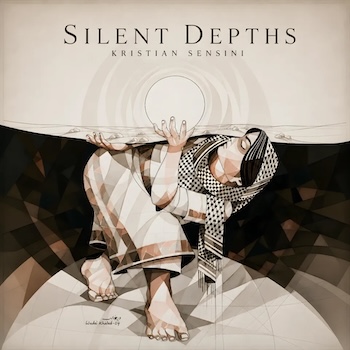
In Silent Depths, Kristian Sensini responds to the suffering of civilians in the West Bank and Gaza with sincere, accessible music that ultimately needs greater tension and complexity.
Commonplaces, according to Norman Rockwell, never become tiresome. Though the illustrator rarely focused his art directly on carnage, that sentiment applies especially well to wartime—just recall the poppies blooming in Flanders fields.
Fittingly, an appreciation of the fact undergirds Kristian Sensini’s Silent Depths. For this album, intended to “respond … to the human cost of war, to the suffering of civilians—especially children,” the Italian composer has taken as his specific subject the ongoing strife in the West Bank and Gaza.
Rather than let his eight-movement suite function entirely in the abstract, Sensini has incorporated field recordings from a pair of Palestinian sound artists, Mohammad Balawneh and Mohamed Yaghi. These are employed discreetly (sometimes perhaps a bit too discreetly) but effectively: there is, we’re reminded, something universal about the hum of traffic, the chirping of crickets, and the sound of children playing together. Under the threat of destruction, life endures and the seemingly mundane takes on a new poignancy.
The music Sensini has written to engage with these recordings is certainly reflective and sincere. Yet for all its accessibility, it is also rather prosaic. Tempos are generally on the slower side and a meditative air prevails. There is, welcomely, a bit of textural variety on offer: the latter part of “Fading Kafan” involves a sort of heterophonic effect, and the layering of voices in “Perceptual Reveries” works well (the latter recalls, after a sober fashion and on a smaller scale, Berio’s riotous arrangement of Boccherini).
A folk-like aspect marks the melodic writing in “The Stillness We Breathe,” while “Fragments of a Reach” offers something approaching lightness and whimsy. Yet the latter’s object is anything but charm: Sensini writes of the section representing “the attempt to reach someone or something of which only fragments remain.”
Similarly, “Grasping at Shadows” purports to evoke “a feverish nightmare in which one desperately searches for something to hold onto in order to climb back towards the light.” One is hard-pressed, however, to latch on to anything heated or delirious in this section, which, while a bit livelier than the prayerful opening movement, “Eternally Still,” that precedes it, hardly evinces a terrifying dream state.
That’s the rub with the larger undertaking: Sensini’s extensive notes on each part don’t always seem to live up, musically, to their written aims. For all its purposeful nobility and approachable content, one can’t avoid noting that the handful of successful works tied directly to events—say, Strauss’s Metamorphosen, Shostakovich’s String Quartet No. 8, and Bruce Springsteen’s The Rising—don’t shy away from complexity; rather, they embrace it. Silent Depths would benefit from a bolder engagement with musical grit and tension.
Nevertheless, the performances, taped in Italy and at the Edward Said National Conservatory of Music in Ramallah earlier this summer, are recorded with clarity and warmth. It’s particularly touching to read the biographies of the four Palestinian musicians—violinist Ram Rabi, violist Hanni Rjoub, cellist Bettina Ezbedi, and flautist Nader Turjman—and hear their performances (alone among the tetrad, Ezbedi trained in the United States).
They’re joined by the composer on piano, saxophonist Giuseppe Morgante, and flautist Itami Kris. Together, this combination of players and the field recordings goes some way to smooth over the most glaring of Silent Depths’ discrepancies between aims and result; what obtains in its strongest moments is some meaningful commentary on shared humanity.
Ultimately, the irony that this essentially simple and straightforward music was inspired by a conflict for which solutions seem anything but easy is hard to miss. So is the realization that shouting and demonstrating about the plight of Palestinian civilians hasn’t yet eased their situation—so maybe something more subdued can help? It certainly can’t hurt.
Jonathan Blumhofer is a composer and violist who has been active in the greater Boston area since 2004. His music has received numerous awards and been performed by various ensembles, including the American Composers Orchestra, Kiev Philharmonic, Camerata Chicago, Xanthos Ensemble, and Juventas New Music Group. Since receiving his doctorate from Boston University in 2010, Jon has taught at Clark University, Worcester Polytechnic Institute, and online for the University of Phoenix, in addition to writing music criticism for the Worcester Telegram & Gazette.
Tagged: "Silent Depths", Bettina Ezbedi, Gaza, Giuseppe Morgante, Hanni Rjoub, Israel, Itami Kris, Kristian Sensini, Mohamed Yaghi, Mohammad Balawneh, Nader Turjman, Ram Rabi, Terrorism