
Poetry Review: Thom Gunn’s AIDS Elegies Still Refuse Abstraction
By Leigh Rastivo
A new edition of The Man with Night Sweats brings the poet’s formal restraint, domestic intimacy, and unsparing attention to individual loss into sharper focus.
The Man with Night Sweats by Thom Gunn. Introduction by Colm Tóibín. Farrar, Straus and Giroux, 112 pages, $11.99.
Last week, Thom Gunn’s The Man with Night Sweats was reissued in the United States. First published in 1992, the collection gathers Gunn’s elegies for friends who died during the AIDS epidemic of the 1980s. He chronicles not only their deaths but also life in hospital rooms, failing bodies, exhausting caretaking, and the pervasive fear that preceded their ends. At the same time, he preserves glimpses of the lives that existed before and around illness.
The book came to be regarded as one of the defining literary responses to the AIDS crisis, in part because Gunn refuses to make the epidemic abstract, philosophical, or sentimental. His subject is always the individual person and the particular shape of his dying. Now, as the crisis Gunn recorded recedes into history, these poems remain acts of witness that have outlived the emergency.
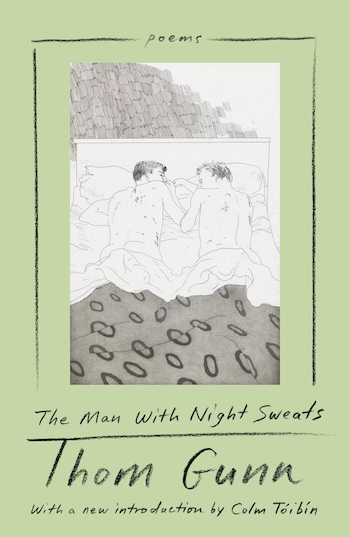
At first glance, the new edition seems unassuming: a compact paperback with a monochrome drawing of two men asleep beside each other on the cover, beneath a title and author’s name rendered in gray, hand-penciled-looking lettering. The new introduction runs to just five pages. Yet this restraint is misleading. The artwork, the introduction, and the passage of time all meaningfully reframe how we encounter the poems.
The muted cover art is by the late David Hockney, the influential gay British artist who, like Gunn, made California central to his life. Hockney’s quiet image does considerable work. It connects Gunn to the queer artistic world he inhabited while offering a literal response to the book’s title: two male bodies asleep and vulnerable. It also draws attention to another dimension of The Man with Night Sweats, especially its early sections—ordinary domesticity, daily life, and the intimacy threatened by illness.
Modest in length, the introduction is no less consequential. Its author, the Irish novelist and critic Colm Tóibín, places Gunn’s elegies within the formal tradition of English poetry by beginning not with AIDS but with Gunn as a reader. In August 1991, shortly before The Man with Night Sweats appeared, Gunn reviewed an anthology of 16th-century poetry and lingered over two highly structured poems in which Sir Thomas Wyatt grieves the executions of people he knew. Tóibín is careful not to claim a simple line of influence. His more illuminating point is that Gunn recognized what English poems of lament could accomplish through “strategies of control and containment.” In such poems, emotional force emerges through syntax, diction, meter, and the refusal to let grief overwhelm structure. Gunn gives grief a formal shape, achieving what Tóibín calls a “reticent eloquence.”
For readers returning to the collection, this framing brings the poems’ domestic intimacy and formal discipline into sharper focus. For new readers, the volume’s four-part structure makes the movement toward loss gradual. Section 1 begins not with death but with a birthday and a body held in an embrace. In “The Hug,” the central gesture is not primarily sexual; what matters is weight, contact, and duration. The poem ends with “The stay of [a] secure firm dry embrace.” At the collection’s outset, then, the body is a source of shelter. By the end of Section 1, however, bodily exchange has become more unstable. In “Seesaw,” desire is held in temporary balance within a mechanism that rises, falls, and stops: “off we climb / and no one wins.”
Section 2 consists of a single poem, “A Sketch of the Great Dejection,” and its solitary position gives it impressive weight. Here, the confident body of the opening poems arrives at “a place of poverty, / of inner and outer famine” and sits exhausted “upon a disintegrating gravestone.” “My body insisted on restlessness / having been promised love,” Gunn writes, “as my mind insisted on words / having been promised the imagination.” This language of depletion and disintegration prepares us for the hospital rooms of the final section.
Section 3 widens the field once again. Gunn turns outward, attending closely to people, animals, plants, and city life. In “Patch Work,” the mockingbird appears through its “characteristic shine / of white patch cutting through the curved ash-grey.” He observes human figures with the same precision: a skateboarder emerges through a chain, a single glove, and hair rising in “pale flames.” Yet death has begun to intrude upon this sharply observed world. “To Isherwood Dying” and “The Beautician” address it directly, while apprehension enters elsewhere more obliquely. The outward gaze remains alert, but what it sees has changed. By the final section, Gunn has subtly prepared us for the culminating sequence of AIDS elegies.

Poet Thom Gunn. Photo: Body
Signaling the collection’s final turn, Section 4 is the only section introduced by an epigraph: lines by Charlie Hinkle, a young poet and friend of Gunn’s who died of AIDS in 1987. The images of punishing rain and sorrow over “what fails” lead into the title poem, “The Man with Night Sweats,” followed immediately by “In Time of Plague” and “Lament.” All three confront terror and grief through the formal control Tóibín notes in his introduction. “The Man with Night Sweats” is written mainly in iambic trimeter, with an ABABCC rhyme scheme that repeatedly places a closing couplet after a quatrain. “In Time of Plague” uses compact, rhymed stanzas, while “Lament” employs heroic couplets in iambic pentameter.
In the title poem, the frightened speaker wakes drenched in sweat and gathers himself into his own arms, attempting to protect the body with the body. The gesture darkly reverses the collection’s first poem, “The Hug.” There, the simple word “stay” makes another person’s arms a source of security; here, the plain, one-syllable word “shield” carries the weight. Early in the poem, “flesh [is] its own shield.” Then “The given shield was cracked.” By the final stanzas, the shield itself needs protecting: “Hugging my body to me / As if to shield it from / The pains that will go through me, / As if hands were enough / To hold an avalanche off.” The body that once offered shelter has become a source of fear.
The poems that follow move from dread to the practical work of illness, caretaking, and grief. “Lament” begins with the almost bureaucratic declaration, “Your dying was a difficult enterprise.” The second person matters: Gunn does not announce what he feels but records what dying required of the other man—pills, tests, waiting, pain, and diminishing strength. In “Words for Some Ash,” Gunn again addresses a dying friend directly, recalling how he used a dental sponge to wet the man’s parched mouth. In “The Reassurance,” a dead friend briefly returns, whether as ghost, dream, or wish. This is Gunn’s “reticent eloquence”: plain language resisting abstraction. As the deaths accumulate, private bereavement becomes collective loss precisely because Gunn preserves the individuality of each person who died rather than reducing them to a category.
The reissue changes the frame, not the work. Readers in 1992 could not know how the history would unfold; readers today know that treatment would eventually allow many people with HIV to live long lives. Yet the poems make the same demand: attend to a body embracing another, a patient awaiting a test, a mouth needing water, a dead friend returning. Form holds each detail. Thirty-four years later, the collection has become historical, but not distant. It asks a new generation to look where Gunn looked: at one person, and then another, disappearing.
Leigh Rastivo is a fiction writer, reviewer, and essayist. She holds an MFA from the Bennington Writing Seminars, where she was also a postgraduate fellow. Her work has appeared in L’Esprit Literary Review, MicroLit Almanac, and other publications, with more forthcoming.
1 Comment
Leave a Comment

I lived through those terrifying years and lost my husband. I look forward to reading Gunn’s work. Thank you.