Jazz Concert Review: Brad Mehldau’s Elliott Smith Tribute Finds Light in the Darkness at Groton Hill
By Paul Robicheau
With Chris Thile, Blake Mills, Matt Chamberlain, John Davis, and A Far Cry, the pianist transformed Smith’s songs into an expansive blend of jazz, indie folk, and chamber music.
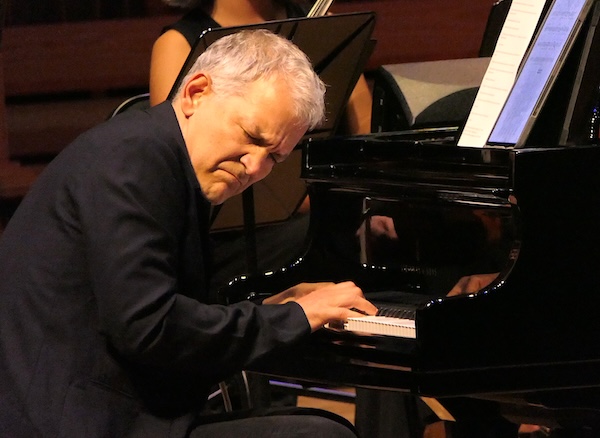
Brad Mehldau at Groton Hill. Photo: Paul Robicheau
It’s easy to understand why jazz pianist Brad Mehldau called the Groton Hill Music Center a “treasure” on Wednesday, making it the only venue beyond California on a short tour showcasing Ride into the Sun, his homage to the late indie-folk artist Elliott Smith. Groton’s striking 1,000-seat main concert hall proves surprisingly intimate for such a towering space, its ribbed ceiling and walls resembling the hull of an arc, though smaller bands can look overwhelmed on its also-sprawling stage.
That wasn’t an issue with Mehldau’s ensemble for Ride into the Sun. His core all-star quintet included album collaborators in mandolinist/singer Chris Thile, bassist John Davis, guitarist/singer Blake Mills and drummer Matt Chamberlain. And they were backed (with room still to spare) on the subtly tiered stage by local 17-piece chamber orchestra A Far Cry, conducted by Mehldau associate Dan Coleman.
The bulk of the 100-minute program featured Mehldau’s rearrangements of songs by Smith, who the pianist met in the ’90s at producer Jon Brion’s curated nights at the LA club Largo—and felt a connection not only with Smith’s music, but also his issues dealing with depression. Wednesday’s concert added some of Mehldau’s original music as well as tunes by Big Star (a gentle, contemplative “Thirteen”) and Nick Drake, whose “Sunday” was given flute-laced orchestration. After that song, the pianist linked Smith and Drake — who both died young in disputed suicides—for both conveying “a darkness and also a little light peeking in, and there’s healing.”
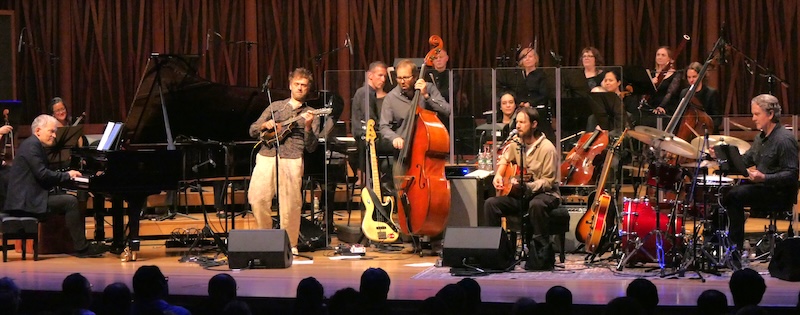
Brad Mehldau’s Ride into the Sun ensemble at Groton Hill (c) 2026 Paul Robicheau
That kind of light was immediately evident in Mehldau’s bright, bouncy piano in “Better Be Quiet Now” and the circus-like feel of “Everything Means Nothing to Me,” where bassoon and clarinet swells led to surging flourishes atop a shuffle from Chamberlain, with Thile and Mills joining in to augment the piano.
“Tomorrow, Tomorrow” first added vocals to the mix (Mills taking a first lead, with Thile singing backup), and Mehldau dove into a solo rendition of Smith’s “Sweet Adeline” with his left hand locked into a ribbony crawl while his right fingers danced up the keyboard in frisky filigrees.
From there, it was clear the album was being presented in its original sequence, yet the stage was different from the studio in terms of visual engagement for an audience. Thile and Mills practically sat on their hands early on, when the focus was on piano or orchestration, and when the core band fleshed out “Between the Bars,” the orchestral players took their turn at just sitting out. Chamberlain walked offstage before the strings marked the melancholy, layered rise of “The White Lady Loves You More,” iced again by bassoon and especially clarinet, while Mehldau built his own tension with chordal clusters.
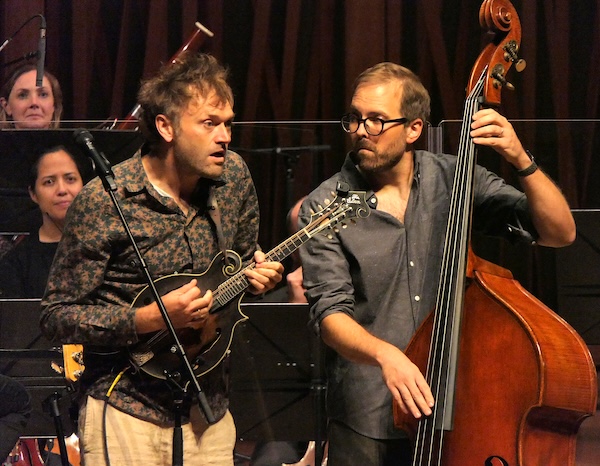
Chris Thile and John Davis at Groton Hill. Photo: Paul Robicheau
Any fans who came Wednesday mainly to hear the virtuoso Thile (a headliner in his own right who’ll be back at Groton with Aoife O’Donovan for a Dec. 2 holiday show) might have been underwhelmed until about two-thirds of the way into the program. That’s when Thile initially rocked out on mandolin in “Everybody Cares, Everybody Understands,” where Davis played electric bass and Mills played jazzy hollow-body lines, briefly brushing his entire finger against the guitar strings.
Then “Southern Belle” took it over the top, coming somewhat closer to bluegrass. Mehldau set the tone with a sharp, sprightly flow and Thile briskly strummed over Chamberlain’s hand-tapped snare, inserting a quote of “Oh! Susanna” over a Mills solo. As the jam built and curled in rhythmic eddies, with Davis on acoustic bass and Chamberlain moving to his full kit, Thile uncorked a mandolin solo that was playful and intense. It was a flash of peak stuff that earned cheers as fans stood in an ovation after all that sitting and waiting.
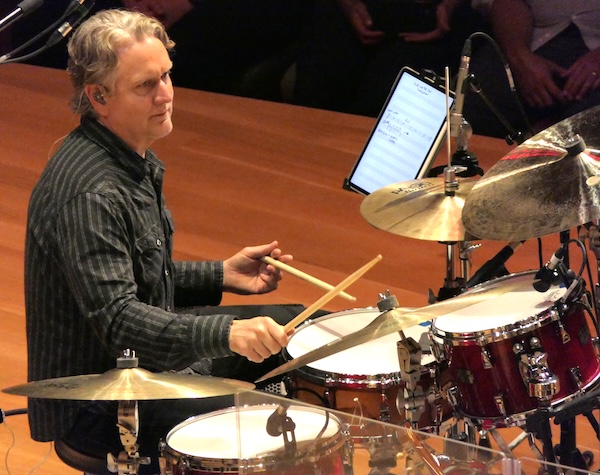
Matt Chamberlain at Groton Hill. Photo by Paul Robicheau
In the wake of that climax, Mehldau introduced the band—and any sense of momentum dissipated. Frankly, the canvas had been painted for the rest of the show to ride toward sunset. The chamber orchestra fulfilled much of that space in “Sunday” and the conclusion of the title track, which drew its name from a line in “Color Bars,” played shortly before that. “Everyone wants me to ride into the sun, but I ain’t gonna go down,” Thile sang. “Laying low again, high on the sound.”
Despite slight low points, the night provided a perfect setting to revel in Mehldau’s genre-crossing palette of jazz, indie-folk, and classical music, bestowed upon a sold-out audience that exited the venue high on the sound of a lucky experience.
Paul Robicheau served more than 20 years as contributing editor for music at the Improper Bostonian, in addition to writing and photography for The Boston Globe, Rolling Stone, and many other publications. He was also the founding arts editor of Boston Metro.