
Book Review: The Wild, Dirty, Dignified World of Garbage Collection
By Preston Gralla
This book is the best travelogue you’ll ever read about a terrible place you’ll never want to visit but want to experience vicariously.
Trash! by Simon Paré-Poupart. Translated by Pablo Strauss. Melville House, 192 pages, $18.99.
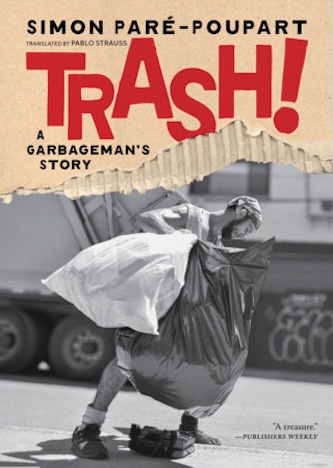 I’ve been waiting decades for a book like this to be published: an intelligent account of a garbageman’s daily life that makes you smell the trash and feel its heavy weight on your back as you haul it. One that delves into the brotherhood of trashmen and examines what the garbage a society throws out says about its values.
Why have I been waiting so long for a book like this? Because hauling trash is in my blood.
My father worked for years at the town landfill in Spring Valley, New York, a small town twenty-five miles north of New York City. The town contracted with private trash companies to pick up its garbage. At the landfill, my father weighed incoming garbage trucks and kept a ledger determining how much the town would pay each contractor.
When I graduated from college, I was determined to be a writer. But I had no practical experience. No one would hire me. I needed work of some kind. So my father asked around to see whether any garbage trucks needed crew members. It would be temporary, we agreed, until I got on my feet as a writer.
Back then, the mob controlled trash collection in metropolitan New York. So it was no surprise that when my father found an opening, the truck was run by someone named Dominick, helped by his nephew, “Little Tommy,” who stood six feet six inches tall and was built like a cement truck. Or, more accurately, a garbage truck.
I took the job, which had the added benefit of paying me off the books. (Like I said, mob-controlled.) It wasn’t the first time I had done physically demanding or demeaning work: I had worked at a sewage-treatment plant, on road crews, at construction sites, and building swimming pools.
But nothing had prepared me for this: waking before dawn in a miserably cold New York winter filled with grim, gray skies and steady sleet to make it to work on time; hanging off the rear of the truck in brutal winter weather as we drove from neighborhood to neighborhood and house to house; jumping off the truck as sleet fell, then hauling unwieldy, heavy metal trash cans filled with loose garbage to the truck. (Plastic bins and plastic trash bags weren’t used back then, at least in my town.)
Each time I emptied a can into the truck, I was showered with garbage: orange peels, half-eaten pork chops, rotten vegetables, unwashed soup cans, half-full capless bottles, old nails. Coffee grounds got down my neck and into my hair. No matter how hard I tried to wash the grounds out of my scalp later, they remained for as long as I kept the job.
And I did it all while being treated by some people as if I were like the trash I hauled. Dirty, backbreaking work in foul, miserable weather. There was only one bright spot: Dominick and Little Tommy, the gentlest of men, who treated me with more care and dignity than anyone had on any job since.
After more than four months, I left the crew and left the town. Several months later, I found my first job in journalism, as a reporter for an alternative weekly newspaper, The Valley Advocate in Western Massachusetts. Since then, I’ve never wanted to recapture my garbage-bound days in print; the memories aren’t good ones. But I’ve always wanted someone else to write about life as a garbageman.
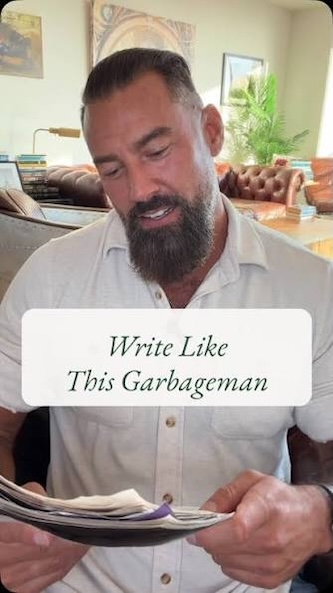
Simon Paré-Poupart. Photo: Instagram
Now, in Trash, Simon Paré-Poupart has done the deed. And he’s done it better than I ever could, with honesty, sharp writing, wit, style, visceral descriptions of garbagemen’s lives, and a clear-eyed analysis of the role of garbagemen and garbage in Western society.
He started working as a garbageman in Montreal more than twenty years ago to help pay for college and continued working as one while earning postgraduate degrees in sociology and business. Even after that, when he could have found more prestigious white-collar work, he continued riding the trucks and hauling the trash. He still does it. Somehow, he enjoys the work.
The book starts with a bang. In the very first paragraph, he writes: “People sometimes mistake me for the trash I handle.” From there, he’s off to the races. He tells a loving story, but not a pretty one. The work he describes is ugly and brutal. He shows how, in polite society, he’s not really the low man on the totem pole—he isn’t even on it.
He takes you on an unexpectedly intellectual journey as he digs deep into trash collection and the role of garbage in modern society, with stops along the way for the novelist Victor Hugo, the French theorist Georges Bataille, and the French sociologist Pierre Bourdieu.
He describes not just the job’s difficulties but also its unexpected pleasures. Children, he says, treat him like a god. When they see a garbageman, he says, “they fall in love. He’s their idol. They’re so impressed by the truck that they worship the man who seems to tame its force, unafraid of its growling engine and its iron maw … They’re the only ones who can look beyond the dirt and the smell to love us.”
Like me, he found a deep bond of camaraderie with fellow garbagemen. But his brethren are different from mine. Many are drug addicts or beset by demons. Most, if not all, can’t cut it in “normal” society and seek out its edges, finding a place there in the world of garbage collection.
It’s a macho culture, he writes, noting, “For garbagemen of my generation, there’s an undisputed hierarchy. Garbage collection is for real men, recycling is for amateurs, and compost is beneath contempt.”
Throughout, he makes clear why, despite the dirt, the smells, the brutality, and the pain, he keeps at it, even after decades of hard labor: “The world of garbage is a Wild West, and that’s exactly what I love about it … I love the joyful chaos of garbagemen, our anarchic spirit and vague desperation … I like the chaos of the garbage truck for its own sake. It gives me a space of freedom I can’t find anywhere else.”
You probably don’t want to join him there. Luckily, you don’t have to, even if you want to share his life for a while. This book is the best travelogue you’ll ever read about a terrible place you’ll never want to visit but want to experience vicariously.
It’s a great book. I’m glad I didn’t write it.
Preston Gralla has won a Massachusetts Arts Council Fiction Fellowship and had his short stories published in a number of literary magazines, including Michigan Quarterly Review and Pangyrus. His journalism has appeared in the Los Angeles Times, Dallas Morning News, USA Today, and Boston Globe Sunday Magazine, among others, and he’s published nearly 50 books of nonfiction which have been translated into 20 languages.
Tagged: "Trash! A Garbageman’s Story", "Trash", Pablo Straus
1 Comment
Leave a Comment

Brilliant review of a messy business. Garbage in/garbage out clearly not applicable for talented writers.