
Dance Preview: Dancing the Odissi in my Spine — Bijayini Satpathy’s New Journey
By Smitha Radhakrishnan
In her Boston solo premiere, Rāgachitra, the former Nrityagram artist draws on a lifetime in classical Indian dance to create searching, contemporary works shaped by memory, mythology, gender, and an inward turn.
Bijayini Satpathy in Rāgachitra At the Multicultural Arts Center, Cambridge, on August 30 at 6:30 p.m. The performance is currently sold out. Go here to join the waitlist.
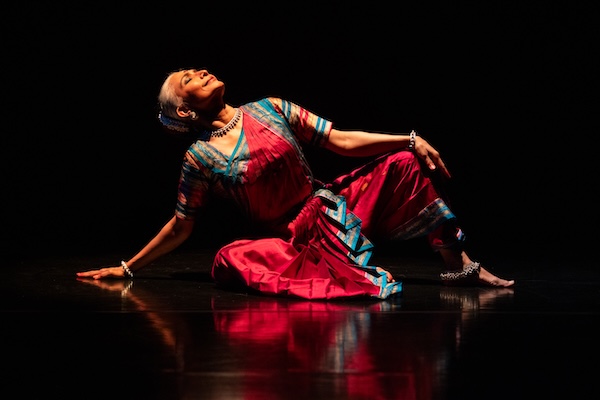
Indian dancer, choreographer, teacher, and scholar of Odissi, Bijayini Satpathy. Photo: Maria Baranova
A luminous, petite, silver-haired woman with an unmistakable sparkle in her eye, Bijayini Satpathy exudes power, control, precision, and playfulness in every movement. She has refined every aspect of her craft: the deep plié, the resounding percussive stamp of her feet, and the signature three bends of her style, Odissi, shifting to accompany a vibrant beat. From hyperextended fingertips to expertly placed toe tips, Satpathy challenges audiences to look away, knowing that, if they do, they will undoubtedly wonder what they have missed. Thanks to the grassroots work of local presenter Rasik, Boston audiences will have an opportunity at the end of this week to see her first solo show in the area.
Raised in Orissa, Bijayini Satpathy traveled to the south Indian state of Karnataka as a young woman to audition for Nrityagram, a dance village on the outskirts of Bangalore, dedicated to the dance style Odissi. When she was selected for the ensemble, Satpathy said, “I stood there and realized, okay, this is what I was looking for…. There was no confusion, no doubt…. I left academics completely.”
Before the importance of conditioning for longevity in Indian dance was well known, Satpathy was paying attention to exercises from Pilates, martial arts, yoga, and theater traditions.
Soon, Satpathy became the ensemble’s rehearsal director and the school’s primary teacher. Protima Bedi, Nrityagram’s founding artistic director, put her in charge of the dancers’ daily conditioning.
Satpathy also began working collaboratively with Surupa Sen, another legendary Nrityagram dancer who later became its artistic director. The duo expanded the movement and expressive repertoire of Odissi, often through a back-and-forth process of collaboration that built upon Satpathy’s highly conditioned body.
“I was being created on,” Satpathy explained, “so every new choreography was being made on my body, and because of the conditioning, those units of movement that came out on my body didn’t exist [in traditional Odissi]. Once I could access it, it remained in the choreography, and then it became part of the choreographic images.”
Sen and Satpathy became a renowned duo, performing on some of the most prestigious stages in the world. Under their leadership, the quaint utopian dance village became an iconic symbol of excellence, authenticity, and artistry around the world. The Nrityagram ensemble earned high praise from New York to Copenhagen and all over India.
But one day, she decided to “shake the curd,” which had “settled thick at the bottom of the pot.” After so many years, she felt the urge to pivot from performing to creating.
“I had never choreographed before. I was asked a lot of times, why don’t you choreograph? I always used to justify saying that, you know, every doctor can’t be a surgeon. That’s a different path, and I don’t feel like I lack anything. But maybe something was happening within me. Things were feeling rigid.” After an invitation from a friend at Duke University, Satpathy realized, “I wanted to say what I want to say through dance.”
Thus began a new journey. At age 50, Satpathy was not going to pretend to look young. She let her hair grow silver while her body and mind started searching for a new artistic vision. To find it, she needed to shift away from the eye of the audience and cultivate an “I” within.
“When I stepped out [of Nrityagram], the first thing that went away was the outside eye. Suddenly, it felt like, who do I connect with then?”
For a lifelong performing artist, facing oneself without a ready audience was a startling experience. “I was not used to it. It made me feel pangs of pain, but at the same time, I had to find something to connect with, something larger than the audience’s eyes. My speaking then became bigger. I felt like I had to speak to the hollow, the abyss that is there…. I have to speak through it to reach somewhere.”
During an intense period of practice and self-reflection in the pandemic, Satpathy felt that she had changed how she danced her form. “Then came the confidence to say what I wanted to say, and not really fear anything, not conform to anything that I knew, because I could feel inside me something that was much … more precious and deep than good technique, good stamina, good energy, good choreography.”
That new confidence has ignited a new path for Satpathy. The first tour of her original solo choreography, Abhipsaa, “A seeking,” developed what she wished to do with Odissi. Satpathy was inspired by theistic and devotional themes, but expressed them through new imaginative approaches. She has grown bolder since then. Her choreography is rooted in an intense and ongoing research process; it is not bound by specific musical traditions, religious themes, or even costuming.
“I want to separate Odissi from everything familiar—its family, its music, its rhythm, its sounds, everything. I want to take it away, and then I want to dance the Odissi in my spine…. Now Odissi, for me, is a universal form. It’s a way of moving, it’s a way of expressing through the body.”
This summer, Satpathy is in the United States for a series of performances and collaborations, beginning with the Boston solo premiere of Rāgachitra, an original work comprising three pieces that reflect her ongoing process of inquiry, creation, and reflection.
In one piece, building on her recent research into gender identity in Indian classical dance and art, she revisits the story of Ardhanarishvara, the form of Shiva representing his divine union with his partner, Shakti, from the perspective of a village girl promised to marry a man she has never met. In another piece, she recounts the events leading up to the goddess Sita’s abduction in the epic Ramayana, as told from the perspective of six characters.
Boston audiences will have a chance to see an inimitable dance artist whose focus is singular, whose attention to detail is mesmerizing, and whose presence is unforgettable.
Rāgachitra is presented by Rasik, a Boston-based arts organization dedicated to presenting exceptional Indian classical dance to Greater Boston through fully produced concerts by master artists. Rasik is working to situate the most sophisticated, globally acclaimed forms of Indian classical dance in our region’s professional arts landscape.
Smitha Radhakrishnan is a lifelong Bharatanatyam dancer and the artistic director of Natya Dance Collective based in Natick. She is Marion Butler McLean Professor in the History of Ideas and Professor of Sociology at Wellesley College and an award-winning author.
2 Comments
Leave a Comment

A fascinating and inspiring article. I feel deeply connected to this woman‘s journey to find her choreographer self. I am a painter whose artistic expression began as a dancer. I have struggled with the desire to not paint for commercial success. What Bijayini said about seeing her art through the eyes of the audience changed my understanding of my goal.
Thank you Bijayini and Smitha.
Hello!
Wonderful article. 👏👏
It was my unfulfilled dream to join Nritya Gram and learn Odissi from Bijayniji. ☹️
I still have a wish to join her n get a chance to learn from her. 🤞
She is just amazing. Wishes for her performance. 💐💐👍