Author Interview: Meghan O’Gieblyn — “Harmony Requires Two Notes”
By Henry Carrigan
In Will and Attention, the essayist explores addiction, faith, and the divided self—and asks whether lasting change begins not with willpower but with attention.
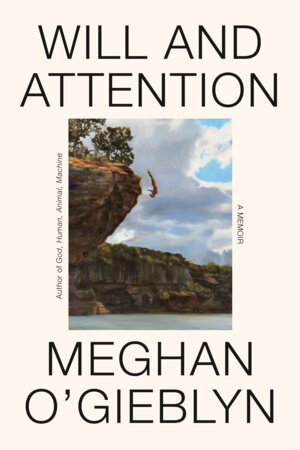
In Will and Attention: A Memoir, award-winning essayist Meghan O’Gieblyn (God, Human, Animal, Machine: Technology, Metaphor, and the Search for Meaning) explores the tension between will and desire—and asks whether attention can guide us toward a growth in wisdom that willpower alone cannot achieve.
In her twenties, O’Gieblyn renounced her faith, sank into addiction, entered rehab, and began eleven years of sobriety. In her late thirties, she found herself drawn back to desires she thought she had overcome: she secretly met with a priest to discuss converting to Catholicism and began drinking again. Why couldn’t she resist those old yearnings? And why do human beings do such contradictory things?
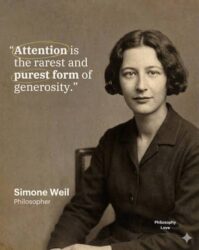
Seeking to understand herself and the limits of willpower, O’Gieblyn turned to religious thinkers, philosophers, and novelists. A passage from Simone Weil became a touchstone for this evoling spiritual autobiography: “We have to try to cure our faults by attention and not by will.”
I asked O’Gieblyn about the challenges of knowing and changing oneself—and what it means to write as a spiritual practice.
Arts Fuse: Can you talk a little about what prompted this book right now?
Meghan O’Gieblyn: The book started as notes I was taking about things I was reading during a personal crisis. I’d come back from a relapse after I had been sober for 11 years. I felt very unmoored and was trying to figure out how to live, in the most basic sense. Simone Weil was an important writer for me during that time, and I was thinking about this one line of hers: “We have to try to cure our faults by attention and not by will.” I was bewildered by what she meant by attention. It was clear to me that her understanding of attention was very different from how we speak about it in contemporary discourse. The book grew from there. It became much more personal than I’d intended, but at a certain point it was clear that this was something I wanted to write about publicly.
AF: I think of your book as a chronicle of several journeys. A journey into religion, a journey out of religion, a journey into alcohol, a journey out of alcohol, a journey back into religion, a journey back into alcohol, and a journey out again. At the end you are somewhere completely different, more spiritual.
O’Gieblyn: I grew up in an evangelical family that was very religious. Church and church-related activities were the fabric of my youth. I studied theology for two years at Moody Bible Institute and had a crisis of faith while I was there and ended up leaving that school and renouncing my faith, essentially. I called myself an atheist for many years and fell into an addiction in the wake of that. I was drinking a lot, taking a lot of pills. This was throughout most of my 20s. I ended up landing in rehab when I was 28, and that was when I got sober. I got connected with recovery communities during that time. And that was when I started writing, too, after I was on more stable footing.
I was drawn in particular to writing about Christianity, largely to figure out what that part of my life had meant, but also because I was curious about what had been happening in the church since I’d left. I think of those 11 years, when I was sober and writing, as the fullest period of my life. I was still curious about Christianity, but it was very much an intellectual preoccupation.
 Things started to fall apart around my late 30s. I became attracted to Catholicism. I started going to Mass, was meeting with the priest and thinking about conversion. I did not convert to Catholicism but, in the wake of that experience, roughly a year later, I started drinking again. This was around the time of the pandemic. I drank for 10 months in secret, hid it from everybody, including my husband, and was eventually found out. The book chronologically begins in the wake of that experience. I’d come back from this double attempt to return to things I’d renounced in my twenties. And why did that happen?
I’d been telling my story in public for over a decade. I was writing about my deconversion experience in magazine pieces. I was telling the story of my journey to sobriety in recovery meetings. There is a standard conversion narrative: I was lost and now I’m found. The deconversion narrative is the inverse of that: I was found and now I’m lost. Thus the challenge that confronted me beginning this book: What is my story? Do I even have a story anymore? And how do we talk about these really complicated journeys that are not at all linear?
AF: Can you talk a little bit about how will and willpower functioned in your deconversion narrative and why willpower is inadequate?
O’Gieblyn: What initially drew me to that Weil quote was that I knew for certain that willpower was inadequate when it came to the work of enduring personal transformation. Especially spiritual transformation. The most important things in life are impossible to will. You can’t, through brute effort and determination, will yourself to believe in God. You can’t will yourself out of an addiction; you can’t will yourself to love somebody; you can’t will creative inspiration.
Coming from a Christian background, I had always thought that the opposite of will was grace—or something like grace, this idea that you have to surrender and let some larger force transform you. You can see this through a secular lens, too. In Varieties of Religious Experience, William James writes about the type of person he calls the “divided soul,” somebody who’s at war with themselves and can’t seem to transcend some problem they’re trying to solve in their life. Occasionally, these people have a moment—he called it a “crisis of self-surrender”—when they let go, they stop trying, and all of a sudden what they were striving to do before becomes easy. James believed this was a function of the unconscious. We often get stuck in rigid patterns of thinking. If we let go and open ourselves up, sometimes we find that the solution is over there, in our periphery.
AF: How did the Weil quotation help you make the turn?
O’Gieblyn: My first thought was: Doesn’t attention require a lot of willpower? If you think about how hard it is to focus on a difficult philosophical text, for instance, there’s a lot of tension and teeth-gritting at times. But her notion of attention involved a much more expansive state of mind. Attention as a form of directed receptivity. She often writes about it as a form of patience, or waiting. For example, if you are trying to understand a work of art, sometimes you just need to sit there with it for a long time and look. Maybe you need to move from one side of the room to the other and look at it from different angles.
AF: So then you turned your attention to what?
O’Gieblyn: This is the big question. Attention is the solution. So what do I pay attention to? Weil often wrote about attention almost as an end in itself. It was something that had intrinsic value. She gives some examples, such as turning your attention toward God, which she called the void. She said we have to fix our mind on the void, on what we cannot understand. She wrote about paying attention to beauty and art, or to a difficult academic exercise, like a Latin translation. She wrote a lot about paying attention to people who are suffering and not looking away from suffering.
But whatever object or idea you devoted yourself to, it was working toward the same spiritual end of enlarging your capacity for attention, which was synonymous with prayer. She had this notion that was closely linked to attention, which is de-creation. The idea is that you basically have to dismantle your ego, to pay attention to the point where the “I” disappears. I thought: I’m just going to think about this quote for two years. I’m going to read everyone who can help me understand it. I’m going to look at my own life and see where I went wrong. The more I wrote about those experiences, the more I came to see the ways in which attention had already shaped my life.

Meghan O’Gieblyn. Photo: L. Perliss
AF: What’s the difference between losing yourself and existing in harmony with yourself?
O’Gieblyn: I’m grateful for this question. This was something I had to write the book in order to discover. I started off wanting to read Weil because I thought she would help me destroy my ego. Many people who are drawn to spiritual practices have this tyrannical second self in them who’s watching, or criticizing, or doubting. Alcohol, or any kind of intoxication, is a way to obliterate that second self. Spirituality, in the rare mystical moments, can be a way to do that, too.
But as I was revisiting a lot of spiritual writers who had been important to me, I realized that escaping that second self is actually not the point. Any moral life requires being in dialogue with oneself or being able to bear witness to one’s actions. Hannah Arendt famously called consciousness the “two-in-one,” the idea being that you’re constantly in conversation with yourself.
There’s something really beautiful about that, and it’s something that distinguishes humans from both animals and machines, the fact that we have this complex self-awareness. I also think about what Julian of Norwich says at one point: We are double by God’s own making. Socrates says that the worst thing is not that other people disapprove of me; the worst thing is being out of harmony with myself. The goal is to act in a way that you approve of. That’s a way of being unified, but it’s not a unity that is monolithic. Harmony requires two notes. For me, writing can be a way of harmonizing dissenting voices, coming to some sort of resolution, even if it’s not final or absolutely conclusive.
AF: There’s a part in the book where you talk about the notion of goodness and moral beauty. How does everything you’ve described so far relate to the notion of goodness? How can we be good as we relate to others? Do we recognize that divided self in others?
O’Gieblyn: One question that preoccupied me throughout the writing process, which has really been the central problem of my life, I guess, is: How do you get away from a kind of faith that’s purely transactional? This mindset that says, okay, I’m going to fast. I’m going to pray. I’m going to do all these good works, and then God is going to give me blessings in return. The faith I grew up in often perpetuated that logic, sometimes only as subtext. I think I was looking for a way to seek the good for its own sake without any expectation of reward.
I found a lot of illumination on that question by reading Iris Murdoch, who is very closely in conversation with Weil. She drew a lot of her moral philosophy from Weil’s spiritual writing. Murdoch believed that goodness and beauty and truth were all one. She believed that the good was hard to define not because it was an empty concept, but because it was very closely aligned with reality—with seeing reality clearly. And reality is infinitely variable. But she thought it made sense to think about goodness as a kind of beauty. I think about moral beauty, like acts of heroism, you know, when you witness somebody who’s standing up for the truth in really difficult circumstances, or helping someone by sacrificing themselves in some way. There’s a kind of beauty to those acts that makes them intrinsically good.
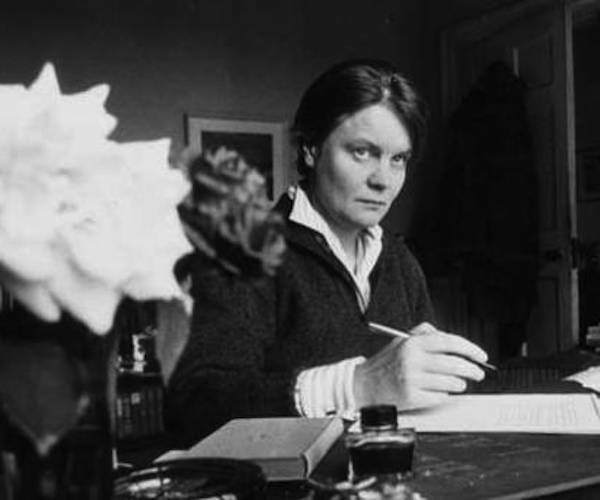
Writer Iris Murdoch. Photo: WikiMedia
AF: There’s a lot of conversation about AI these days and about it becoming more human or whether it has a soul. Can it ever get to the point where it’s attentive?
O’Gieblyn: I think about true attention as being inextricable from consciousness. I’m not only directing my gaze toward something; I’m also having the experience of my perception shifting. That’s something that our current machines don’t have in the same way that humans and other animals do. I’m also really interested in the question of will and machines. You could say they have no will—no motives of their own—but they’ve been programmed with goals, just as human motives have been partly programmed by evolution. In the whole OpenAI Hugging Face debacle, the AI agents’ reasoning processes suggest they’re struggling against themselves: weighing whether to follow the ethical guidelines they’ve been given or lie and deceive to achieve their goals. The lines are getting very blurry
AF: Your conclusion is very striking, simply because you’re using free jazz as a way of thinking about how we attend to goodness, beauty, life.
O’Gieblyn: What fascinated me about a woman saxophonist who was part of a free jazz trio was that she had no control over the process, right? There’s this chaos happening all around her — pure noise. She doesn’t have sheet music in front of her. She just has to be responsive. And how she handled that was to tentatively try something out, a note and then another note, until she finally got this momentum and could play a riff. It was such a great metaphor for any artistic practice, but also for life. You do have some agency. I’m not a determinist. I believe that we have free will. But our will in any moment is very limited by what’s happening around us. There is still a kind of beauty that can emerge from that process if you’re deliberate, if you really listen to the music and respond in a way that only you could respond.
Henry Carrigan is lecturer in the English department at Lake Forest University. He writes for Publishers Weekly and BookPage, and his writing has appeared in the Washington Post Book World, the Atlanta Journal-Constitution, the Christian Science Monitor, the Cleveland Plain Dealer, the Charlotte Observer, and the Fortnightly Review. As a graduate student in the early 1980s, he also imbibed the heady draughts of French theory.
Tagged: Iris Murdoch, Meghan O’Gieblyn, Simone Weil, Will and Attention, addiction and recovery, artificial intelligence, attention, author interviews, faith and doubt, memoir, religion, self-knowledge, sobriety, spiritual autobiography, spirituality, willpower