Visual Arts Review: A Museum That Won’t Act Its Age
By Lauren Kaufmann
At 90, Boston’s ICA revisits nine decades of boundary-pushing art, institutional reinvention, and a willingness to take risks.
90 Years at the The Institute of Contemporary Art/Boston. On view until March 7, 2027
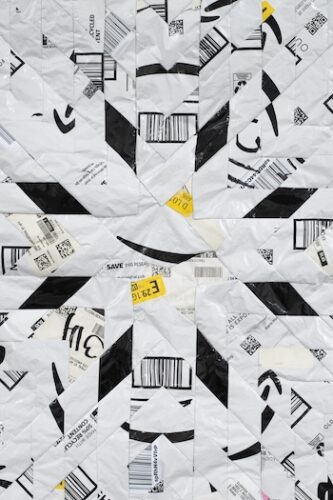
Clarissa Tossin, Manta/Mantle, 2025. Photo: courtesy of the ICA/Boston.
The ICA celebrates its milestone birthday by revisiting some of the touchstone exhibits that left an indelible mark on the museum. The exhibition is proof positive that Boston’s contemporary art museum is tough, innovative, and remarkably resilient.
Over its 90 years, the ICA has pushed artistic boundaries, broadening ideas about contemporary art while spotlighting artists whose work questions assumptions about American art, culture, and society. Never shying away from its valuable role as the edgy risk-taker in a city that prizes its history and traditions, the museum has welcomed visual artists from diverse backgrounds, particularly artists who experiment with technique, point of view, and subject matter.
By amplifying the voices of women and minorities, the ICA has been in the vanguard of the contemporary American art world. In recent years, the museum has expanded its reach by hosting performance artists whose work expands the definition of visual art.
Before moving into its current Seaport location 20 years ago, the ICA had 13 different homes scattered around the city. Along the way, the museum faced bankruptcy and, by necessity, needed to reinvent itself. Despite these challenges, the institution has always landed on its feet.
Since arriving in the Seaport in 2006, the museum seems to have found its forever home. It owns its building, perched in a sweet spot overlooking Boston Harbor. Having a permanent domicile has understandably prompted the ICA to begin building a permanent collection. Over the past twenty years, the museum has acquired 500 works of art—a good start in its campaign to establish itself as a leader in Boston’s contemporary art world and to support living artists.
For this anniversary exhibition, the museum’s curators divvied up the nine decades, revisiting one exhibit from each decade. When they began their research for this exhibition, the curators made use of the added benefit of the museum’s newly accessible archives. Because of its nomadic past — compounded by the lack of a dedicated archivist — the ICA hadn’t organized its archival documents. Over the last two years, staff members have devoted time to cataloging and digitizing its archives. Access to these records was invaluable, allowing the curatorial team to uncover details and documents pertinent to the exhibits that they featured in this show.
The first gallery is devoted to the geographic history of the museum. The central focus of the room is a large map of Boston, pinpointing the locations of the museum’s previous sites. Below the map are photos of the museum’s various locations.
Originally called the Boston Museum of Modern Art, the ICA was conceived of as a sister to the Museum of Modern Art. In 1936, the ICA’s founders, all from Harvard, leased space from the Fogg Art Museum, now the Harvard Art Museums. Led by Nathaniel Saltonstall, a Boston architect and patron of the arts, the founders conceived of the ICA as an “experimental laboratory.”
James Sachs Plaut was the museum’s first director and held the position for eighteen years. Plaut took a leave from the museum to serve in WWII, during which he was part of the Monuments Men, responsible for tracking down art looted by the Nazis. After the war, Plaut returned to Boston and his job at the museum. In 1948, he changed the museum’s name to the Institute of Contemporary Art, signaling a shift away from 20th-century European art and toward American art being made in the present.
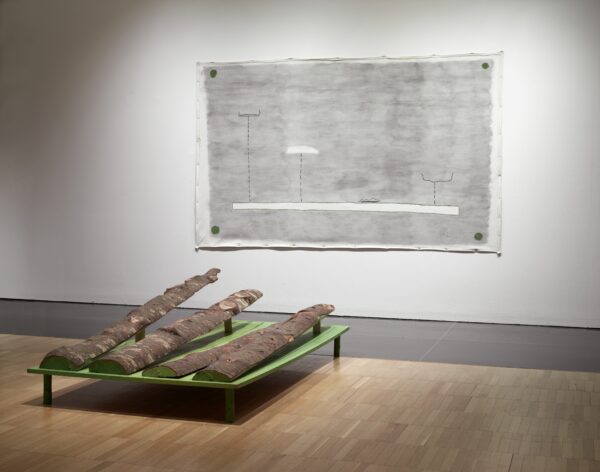
Ree Morton, Souvenir Piece, 1973, Photo courtesy of the ICA/Boston
The museum’s first exhibition presented the work of Expressionist painter Paul Gauguin. The show was the first in Boston to spotlight Gauguin’s artwork. One year later, in 1937, the museum moved to Newbury Street, where it mounted Picasso and Matisse, the first American exhibition that took a close look at the friendship and rivalry between two of the 20th century’s best-known and most beloved artists.
From 1938 to 1939, the museum leased space from the Boston Art Club on Dartmouth Street. Here the museum continued to feature work by internationally known artists, as well as art by New England–based artists. Choosing to focus on local and regional artists proved to be a savvy way to draw support from its home base and to become a fixture in New England’s cultural landscape. From the Boston Art Club, the museum moved to 210 Beacon Street, where it stayed for three years before relocating to 138 Newbury Street. In 1950, the museum collaborated with the Fogg Art Museum to curate an exhibition of the work of Edvard Munch.
Another gallery revisits an exhibit from 1941—Modern Mexican Painters—that showcased the work of twenty-one Mexican artists. Whereas labor and revolution had long been the dominant themes of Mexican art, these artists were influenced by Mesoamerican and contemporary folk art, as well as by Cubism and Post-Impressionism. ICA director James Plaut touted the exhibit as helping to highlight an important cultural link between North and South America, a sign of his aspiration to reach beyond the European and American art that dominated the art world at the time.
The focus of the next gallery is an exhibition from 1952 called Design in Industry. Plaut started the Department of Industrial Design within the museum—a decade-long partnership of New England–based designers and manufacturers. This effort aimed to produce objects that were both beautiful and functional. In addition to archival images, the gallery features several newly commissioned works by contemporary artist Clarissa Tossin. Her woven pieces, composed of recycled shipping boxes, plastic packaging, and copper leaf, carry a message that runs counter to the industrial optimism of the 1950s.
In an appreciation of Andy Warhol, a small gallery features Silver Clouds (1966), his immersive installation composed of free-floating balloons. The ICA curated Warhol’s second museum exhibition in the fall of 1966. While the shiny balloons invite visitors to play, their reflective surfaces hint at the overly surveilled world that we live in now.
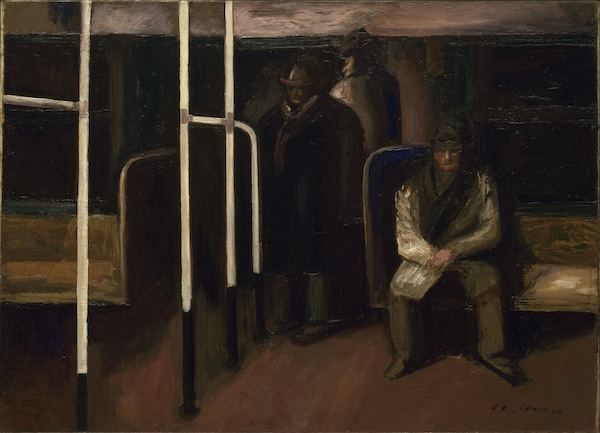
José Clemente Orozco, The Subway, 1928, Photo: courtesy of the ICA/Boston.
In 1973, the museum moved into a former police station on Boylston Street, where it remained for 33 years. In the winter of 1974, the ICA mounted Seven Sculptors: New Involvement with Materials, spotlighting work that drew on innovative materials. Several of the artists ultimately became key figures in the emerging field of feminist art. These women broke new ground in land art, installation, body art, and post-minimalism.
In another collaborative effort, the ICA partnered with GBH’s New Television Workshop to support the emerging field of video art. The Contemporary Art Television Fund, known as the CAT Fund, ran from 1984 until 1991 and featured work by video and performance artists. The work aired one night a week on GBH TV, and although this narrow slot probably didn’t garner a huge following, it signaled the important role of public media in championing new artwork.
Another gallery spotlights the Currents program. From 1983 until 1995, while still at its Boylston Street location, the ICA curated Currents, a series of changing exhibitions designed to show artists whose work was concerned with critical social issues, including gender, power, masculinity, and spirituality. Artists included Jenny Holzer, Anish Kapoor, and Yoko Ono, among others. 90 Years will bring in work from emerging artists in order to show that there is ongoing interest in the themes raised by the artists from the 1980s and ’90s.
The next gallery spotlights Ellen Gallagher, whose first survey exhibition, Water Ecstatic, opened at the ICA in 2001. Her work explores Black representation and the myth of Drexciya, an underwater civilization descended from pregnant enslaved women thrown overboard during the Middle Passage. In these pastel works on paper, disembodied eyes and lips evoke racial stereotypes.
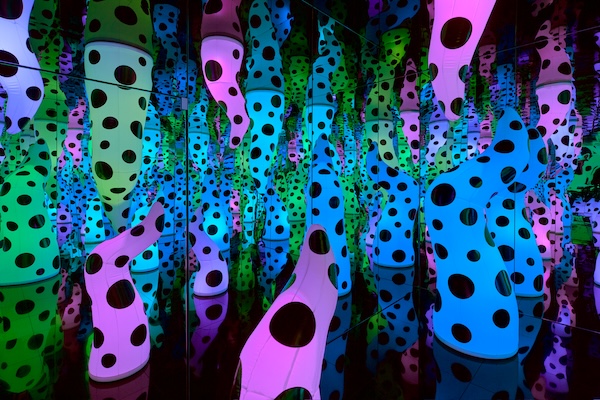
Yayoi Kusama, LOVE IS CALLING, 2013, Photo: courtesy of the ICA/Boston.
The much-beloved Yayoi Kusama, known for her polka dots and organic forms, is represented by an Infinity Mirror Room. In 1966, the ICA showed her work as part of an exhibition called Multiplicity, and in 2018, the museum acquired LOVE IS CALLING (2013), one of her largest Infinity Rooms. This interactive work invites visitors to become immersed in the bright colors, inflatable sculptures, and endless reflections that mark Kusama’s artwork. In January of 2027, the ICA’s theater will welcome a work by Andrew Schneider, an immersive environment inspired by Kusama’s creations.
The final gallery in the exhibition features the work of Simone Leigh, who, in 2022, became the first Black woman to represent the U.S. at the Venice Biennale. Leigh is represented here by two of her ceramic sculptures, which are now part of the ICA’s permanent collection. Her concern with Black femininity and the history of enslaved people reflects the continuing artistic impulse to confront the history of the country’s complicated attitudes to race and gender.
Leigh’s work is another example of artwork that highlights the museum’s ongoing willingness to embrace uncomfortable issues, prompting visitors to think more deeply about our culture and the problems with which we are still grappling. Determined to maintain its relevance, the ICA continues to play a critical role, not only in Boston but also in the larger art world. This exhibition shows how much the museum has to celebrate.
Lauren Kaufmann has worked in the museum field for the past 14 years and has curated a number of exhibitions.
Tagged: 90 Years, Andy-Warhol, Boston art exhibitions, Boston museums, Clarissa Tossin, Edvard Munch, Ellen Gallagher, ICA Boston, Institute of Contemporary Art Boston, Paul Gauguin, Performance Art, Simone Leigh, contemporary art, exhibition reviews, feminist art, museum history, video art