Theater Review: “Vanya” — One Actor, a House Divided
By Bill Marx
Mark H. Dold brings force and sensitivity to Barrington Stage Company’s compelling, uneven production, but the solo format undercuts Chekhov’s psychological complexity.
Vanya by Simon Stephens. After Anton Chekhov’s Uncle Vanya. Co-created by Simon Stephens, Andrew Scott, and Sam Yates. Directed by Alan Paul. Staged by Barrington Stage Company, 30 Union Street, Pittsfield, through October 24.
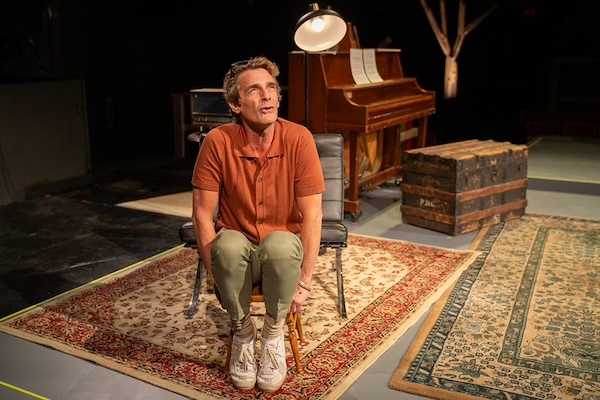
Mark H. Dold in the Barrington Stage Company production of Vanya. Photo: Andrew Cromartie
First, an apparent detour that leads straight to the point. In his stimulating new book, Chekhov’s Antidotes, Yuri Corrigan challenges the critical bromide that Chekhov was a “fetishist of meaninglessness and despair, the bearer of a ‘dark’ Russian temperament.” The Boston University professor also challenges those who insist that Chekhov’s designation of The Seagull and The Cherry Orchard as comedies calls for “cruelly satirical” productions. Corrigan offers a refreshing alternative: Chekhov’s dramas are neither melancholy inventories of human limitations nor farcical send-ups of them. This doctor does more than diagnose. He prescribes remedies for an ailing society — remedies that, Corrigan argues, make his work especially urgent today.
“Chekhov worries about the ingenious and often covert ways we anesthetize ourselves in modern culture,” Corrigan writes. “He worries about the narcotic quality of politics, our worldviews, and our way of relating to others … Chekhov’s body of work constitutes a definitive philosophical meditation on how to salvage an irreparably broken world and to cultivate meaning, dignity, heroism, and integrity as irreparably human subjects.”
I’m not sure Chekhov’s moral scrutiny was as systematic as Corrigan suggests. But he is onto something: these plays call for engagement with the world, not acceptance.
That brings us to Simon Stephens’s adaptation of Uncle Vanya for one performer, an experiment with genuine rewards and predictable problems. Set in an eccentric mix of the contemporary (kitchen appliances) and the 19th century (piano, aged trunk), the script strips away the customary mustiness and fussiness in favor of an amusingly scrappy minimalism. At its best, this version updates Chekhov with apt care: Vanya’s spoiled brother, Alexander, is an egomaniacal filmmaker whose once-respected career has fallen on hard times. Elsewhere, the adaptation tries much too hard to be jokingly au courant: the f-bombs pile up, with diminishing impact. And must the insecure Vanya have his own tape-machine cheering section? It is overkill, a sign that noise might predominate over nuance. It doesn’t, because Stephens has an obvious affection for the drama’s characters. He edges toward parody now and then, particularly among the supporting characters, but there is respect for the passionate confusion, the fruitless yearning, and self-destructive energies of Chekhov’s figures.
One payoff of this direct approach—and of this production—is the fusion of the political and the domestic. Michael’s slide show, intended by the doctor to impress a smitten Helena, charts the steady destruction of the region’s forests: nature erased in the name of mercantile progress. In these images and the doctor’s pointed commentary, Chekhov anticipates the climate crisis. But as the parcels turn from green to brown, they also map the unraveling of human bonds: a family divided by the brothers’ antagonism, a society paralyzed by warring factions. The doctor makes the devastation—and the catastrophe to come—plain as day, but his listeners are too absorbed in their private conflicts to act for the common good. It is a painfully timely lesson, driven home by Mark H. Dold’s emphatic doctor in Barrington Stage Company’s compelling, though uneven, production.
Dold plays all the other roles, bringing an animated sensitivity to the formidable task. But the dramatic limitations of Stephens’s streamlining are obvious. The serious problems that undercut Eddie Izzard’s recent one-man Hamlet recur here: admiration for the performer’s ability to meet the whirligig demands cannot compensate for the characters’ inability to react to one another. We want to see what is on Helena’s face as Vanya chatters away at her. Too often, Dold faces the audience, threatening to turn the play into a succession of monologues.
This eye-to-eye approach makes Vanya an intimate experience, reinforced by director Alan Paul’s decision to seat the audience onstage. Yet the constant demand for metamorphosis revs up the pace; the performance is forced to race along at an even gallop. (The staging runs just over 90 minutes without an intermission. No wonder Dold wears sneakers.) To help us follow his rat-a-tat transformations, Dold must distinguish the characters through broad physical gestures and vocal IDs—but that shorthand leaves little room for the complex psychological portraiture Chekhov demands.
That said, Vanya is always involving, in part because Dold creates one of the most forceful Vanyas I have seen. Often played as a wilted comic ditherer, Vanya here—frustrated, irritated, self-mocking—is a formidable match for his brother Alexander’s domineering narcissism. Their standoff suggests a family—and a society—in which opposing forces are evenly matched. Dold’s Michael is also effective, agonizingly conscious of his wasted potential. His Sonia and Helena are less successful; their dainty presences tend to blend together, lacking the sharp contrasts he establishes among the competing men. Still, Dold does a wonderful job with Sonia’s famous final speech, with its call for her and Vanya to accept their lot and duty to work. Here, her words struck me as less about stoical acceptance than about endurance: maintaining continuity in a society that is falling apart.
Bill Marx is the editor-in-chief of The Arts Fuse. For over four decades, he has written about arts and culture for print, broadcast, and online. He has regularly reviewed theater for National Public Radio Station WBUR and The Boston Globe. He created and edited WBUR Online Arts, a cultural webzine that in 2004 won an Online Journalism Award for Specialty Journalism. In 2007 he created The Arts Fuse, an online magazine dedicated to covering arts and culture in Boston and throughout New England.
Tagged: Alan Paul, Anton Chekhov, Barrington Stage Company, Berkshires theater, Chekhov’s Antidotes, Mark H. Dold., Pittsfield, Simon Stephens, Uncle Vanya, Vanya, solo performance, theater-reviews