
Film Review: Enlightenment Meets the Mountain in Louise Hémon’s “The Girl in the Snow”
By Betsy Sherman
A turn-of-the-century schoolteacher’s idealism collides with alpine tradition—and the land itself—in a beguiling, sensorially rich debut.
The Girl in the Snow/L’engloutie – Directed by Louise Hémon. In French and Occitan with English subtitles. Playing at the Boston French Film Festival at the Museum of Fine Arts Boston on August 1 at 2 p.m. and on August 15 at 11 a.m.
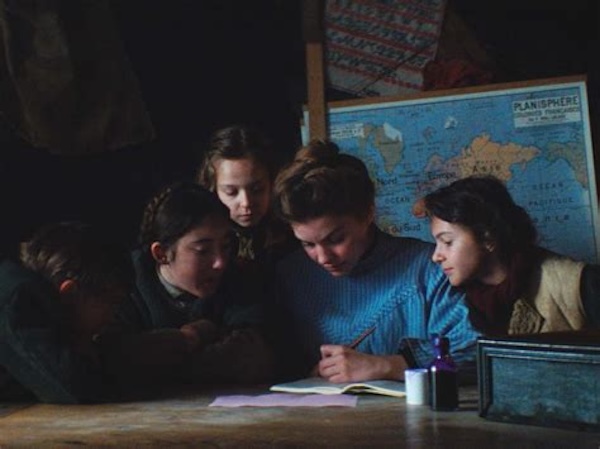
A scene featuring Galatéa Bellugi in The Girl in the Snow. Photo: courtesy of the Boston French Film Festival
Set in the winter when the 19th century passed the baton to the 20th, The Girl in the Snow contrasts the embrace of change with the need to hold onto the old ways. The beguiling debut feature by French director Louise Hémon centers on a young woman who arrives in Soudain, a remote alpine hamlet, to teach its handful of children. An idealist suited to the new age of progress, the teacher feels the undertow of superstition as she tries to bring new ideas to the isolated community. But does she have the right to push back on the traditional ways? The filmmaker weaves visual and auditory elements through the story that work subtly to counter audience expectations and introduce a third force: the mountain itself.
Winner of France’s prestigious Jean Vigo and André Bazin prizes, The Girl in the Snow will show twice in August at the Boston French Film Festival.
The film’s French title, L’engloutie, translates as “the engulfed one.” The word holds metaphoric implications as the story unfolds, and literally applies to those buried in the mountain’s frequent avalanches. Aimée Lazare (marvelously played by the baby-faced Galatéa Bellugi) is imbued with the principles of liberty, equality, and fraternity symbolized in a female-warrior bust she places in her makeshift school. The school, and her quarters, share a stable with cows. In an early instance of cultural difference, the teacher asks the pupils what sound a cow makes, and instead of “meuh” (the French equivalent of “moo”), she’s told cows go “broo broo.” Aimée’s mission is to teach the children French—the villagers speak the Occitan language—and open them to the world beyond their home. In the film, only French is subtitled; the viewer must have patience for the translation process from Occitan, as must Aimée.
Daily life in this region of the Hautes-Alpes is hard; travel and communication with surrounding towns are nearly impossible once the snowfall starts. The children’s mothers have left for the entire winter to work as maids for lowlanders. The kids are left in the care of the old folks. Some terrific non‑actors play the elder women, who don’t speak French: there’s a sense they have the real power in the community. One example of their displeasure with Mlle. Lazare comes after Aimée has bathed the little ones, giving them a lesson on germs as she scrubs. That wouldn’t fly today, but the women scold Aimée for a different kind of inappropriateness: they say she’s washed off the crust that protects the children’s brains. Aimée protests, but doesn’t expect acceptance to come easily.
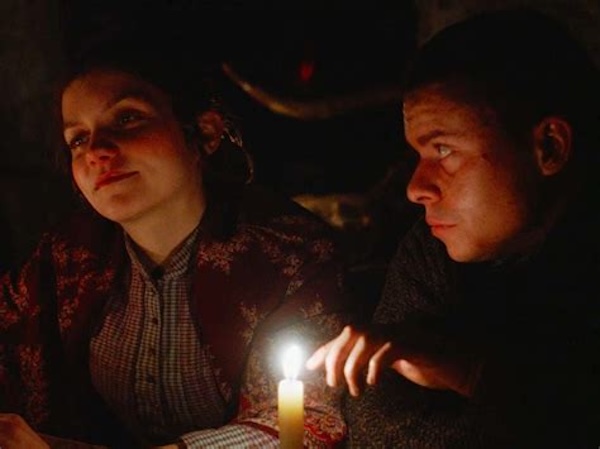
During the long evenings, amid light from the fire, candles, and oil lamps, the elders tell stories. They wouldn’t call them folk tales but truths of life. One is a story about the spirit of death and its victim; another is about a temptress. The children are aware of those who left the village, were never heard from again, and are presumed dead: these are cautionary tales implying they shouldn’t venture beyond familiar borders.
Aimée commits a worse transgression than the baths. When the old women find out she translated one of the Occitan stories into French and committed it to paper, they throw her notebook into the fire. A child explains, “They say if you lock the story, it will die.” Upset, she shouts, “I’m not here to steal! I’m here to share!”
The Girl in the Snow resists boiling down into categories such as culture clash, stranger-as-disruptor, and coming-of-age (there’s more than eye contact between Aimée and the village’s few young men). It doesn’t put the teacher on a pedestal. Yet we feel her anxiety when, after the elder Grandpa Jupiter dies, his coffin is placed on Aimée’s roof. He’s placed there, beyond the reach of scavengers, because a grave can’t be dug until the spring thaw. He’s on Aimée’s roof because, she’s told, it will be nice for him to hear the children playing
A scene from The Girl in the Snow. Photo: courtesy of the Boston French Film Festival
At this point, the faint macabre sense that has been bubbling beneath the surface rises. The unease comes to be associated with sexuality and female desire. The 1900 New Year celebration features joyous singing, dancing, and drinking. But in the days afterwards there’s a disappearance of someone from the tiny community. Search party members plunge sticks into the deep snow to find out what’s buried there. The resigned verdict: “The mountain will return him in the spring.” Suspicion falls on Aimée and her influence. Villagers keep the children home from school. A shocking turn of events is followed by a coda that takes place in springtime and suggests the liberation of that season.
Hémon and her team ensure that the atmosphere of sensuality persists through sight and sound. Director of photography Marine Atlan (director of the forthcoming La Gradiva) works wonders. Interiors were shot with no artificial light; exteriors range from blinding daytime snowscapes to night, in which islands of yellow‑orange lantern light pop up. The outstanding musical score recalls Italian giallo horror: deliberate off‑key notes sabotage Mlle. Lazare’s dedication to Cartesian reason. Composer Émile Sornin, in addition to conventional instruments, employs the arcane ondes Martenot and a “bee box.” The sound design includes howling wind, animals wild and domesticated, and the dreaded avalanches.
The screenplay, co‑written by Hémon, Anaïs Tellenne, and Maxence Stamatiadis, originates in Hémon’s family history. The film’s Aimée is loosely based on her great‑great‑aunt Aimée Bigallet, who in the winter of 1921–22 taught school in a village in the Alps. She wrote an article about her experiences for the 1922 issue of Revue de Géographie Alpine. The screenplay draws on that text and a 1998 story by Hémon’s grandfather, Jacques Chevallier. The Girl in the Snow is a skillful recreation of a time and place that cinema can both resuscitate and mutate.
Betsy Sherman has written about movies, old and new, for The Boston Globe, The Boston Phoenix, and The Improper Bostonian, among others. She holds a degree in archives management from Simmons Graduate School of Library and Information Science. When she grows up, she wants to be Barbara Stanwyck.
Tagged: "The Girl in the Snow", Boston French Film Festival, Galatéa Bellugi, Hautes-Alpes, Louise Hémon, Marine Atlan