Classical Album Review: Meredith Monk’s “Realms”: A Portal Into Music Without Form
By John Tamilio III
On its Cantaloupe Music debut, Phaedra Ensemble enters Monk’s strange, haunting sound world—where strings, reeds, voices, and silence dissolve familiar ideas of classical music.
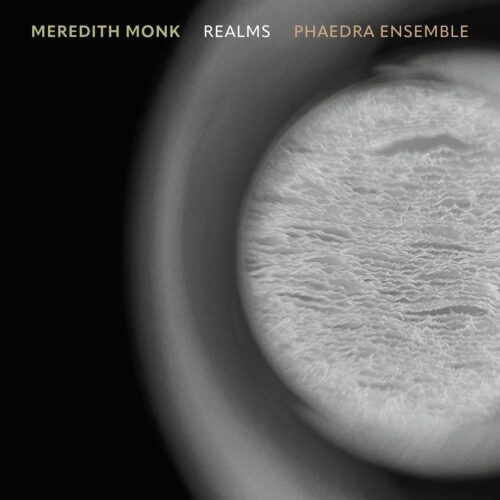
Realms by Meredith Monk and Phaedra Ensemble. Cantaloupe Music
I did not like this recording when I first heard it. Then I remembered that I did not like David Lynch’s Eraserhead when a college buddy showed it to me in the late ’80s. Something about it bothered me. It never left my mind. It haunted me. So I returned to it. It is now one of my favorite films.
So I listened to Realms, by Meredith Monk and Phaedra Ensemble, a second time. And I fell in love.
Before delving into the recording, I need to explain why.
“Absolute music” is a term used for classical music of a more abstract nature. Such terminology is limited. Richard Wagner applied the label to Beethoven’s Ninth Symphony two decades after it was composed. Although the Ninth can clearly be distinguished from music by Beethoven’s contemporaries in form and expression, few listeners today would call this masterpiece abstract. That is due, in large part, to a plethora of postmodern music more aptly characterized that way.
So I propose a new term: Musique Classique Abstraite. As a working definition, it is instrumental music that does not conform to the structures or strictures people typically associate with the term “classical music.” Max Reinhardt refers to this burgeoning genre as “exploratory contemporary classical music.”
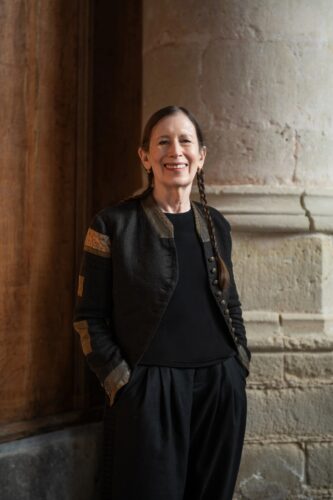
Meredith Monk. Photo: LNDWstudio
I say this by way of introduction because recent years have brought many offerings of such music. In this publication alone, I have reviewed the work of Junction Trio and Lei Liang; both are emblematic of this tendency. Phaedra Ensemble’s latest release, Realms—a recording of Meredith Monk’s instrumental music—epitomizes it.
Monk, hailed as a pioneer of “extended vocal technique” and “interdisciplinary performance,” has defined the texture of this form. She has said: “I’ve always thought that making music is about listening enough to let something that already exists in another dimension come through. Those moments of discovery are worth everything.” Realms is truly a portal into the soundscape of another sphere—a foray into Musique Classique Abstraite.
Five years in the making, Realms comprises three works by Monk: Stringsongs, Backlight, and Realm Variations. The pieces complement one another while retaining distinct characteristics. According to Cantaloupe Music’s press release, “Stringsongs touches the natural world, Backlight the distinctly human, and Realm Variations the more transcendently celestial.”
The quartet that opens the Stringsongs segment, “Stringsongs I. Cliff Light,” gives voice to a deep expanse—one that must be inhaled. It verges on atonality, intimating the unheard shriek of daybreak. Two violins, viola, and cello cry like ravens, never deviating from—yet excavating every expressive possibility within—an A-minor chord. It is a hot track. Meditative.
Fuller orchestration and more languid playing follow as “Stringsongs II. Tendrils” enfolds us in an eerily familiar web of imbalance, where we must rely on trust and a memory only dimly recalled. As I let the track wash over me, I could smell the words of T. S. Eliot:
Time and the bell have buried the day,
The black cloud carries the sun away.
Will the sunflower turn to us, will the clematis
Stray down, bend to us; tendril and spray
Clutch and cling?—“Burnt Norton,” IV
The strings weave together over braying lines, offering a succulent minor-key polyphony. As the track concludes—with what can only be described as a clarinet fluttering astride a high-strung dulcimer fed through an oscillator—I thought: “I will never really hear such instrumentation anywhere else.” Love it or hate it, it is original. Moreover, it was a demo of “Tendrils” that Phaedra Ensemble sent to Monk that initiated their collaboration.
A similar buzz carries us through the collection’s shortest track, “Stringsongs III. Obsidian Chorale.” Obsidian is volcanic glass. Pliny the Elder wrote about it, noting its use in arrowheads, jewelry, and mirrors. The point? Stringsongs is a word Monk created. Like obsidian, the utility, beauty, and reflective power of the music Monk composes are replete with undiscovered possibilities.
The Stringsongs section ends with an anticipatory exchange among the members of the chamber ensemble. It builds while shadowed by a lone, plaintive violin that meanders in and out of the conversation before rising to a pronounced conclusion.
The transition into the album’s second section, Backlight, is as contemplative as it is haunting. About halfway through the first movement, pianist Katherine Tinker offers a supplication that leaves ample room for a trio of reed instruments to enter the colloquy. The second movement is equally haunting; its structure and tone mirror the previous track. If, as the liner notes state, this music is “distinctly human,” an air of the mechanical melds with the organic. Thematically, it is delicate, though colored by the feeling that all is neither well nor complete.
The final movement proceeds in a deliberate pattern and is the most variegated of the three. Beginning in G minor and moving circularly through A-flat minor and F-sharp minor, it reflects a jazz-inflected motif, the piano forging an encounter with the woodwinds. The piece ends where it begins.
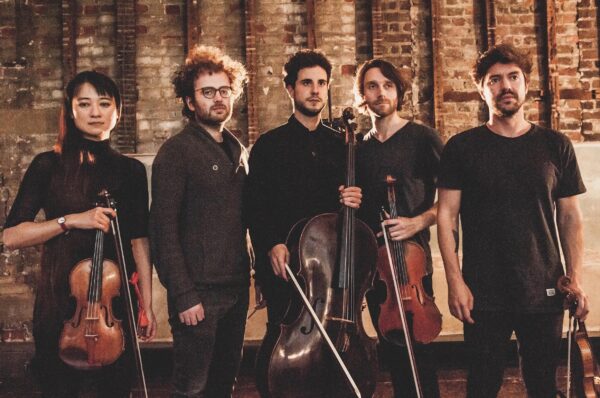
The Phaedra Ensemble. Photo: Sabrina Dallot-Seguro
The final track is the collection’s longest. Clocking in at nearly 20 minutes, Realm Variations is a transcendent, ethereal, postmodern symphony. The listener is ushered into the Pythagorean music of the spheres by way of a piercing solo flute, soon joined by languid, resonant vocal lines that intimate hypnotic plainchant. It is dreamlike. Listeners may find it difficult to escape its allure. This is minimalism conjoined to an ever-unfolding vocal assurance. The pattern bubbles to the surface through buoyant hums and articulations that settle on the ears—and the nerves—like a warm, comfortable coat, even if it does not fit quite right.
Just past the four-and-a-half-minute mark, Realm Variations changes direction. Wind instruments and voices, seemingly fueled by the same lungs, paint a landscape at once treacherous and serene, sacred and profane. That dialectic pervades the CD and is not foreign to Musique Classique Abstraite. Monk does not follow traditional forms here. She forges vistas by juxtaposing harmonies, keys, and time signatures in innovative ways—sometimes assuaging perennial musical sensibilities, sometimes annihilating them.
Realm Variations closes with the kind of music one might hear in a cathedral at an epiphanous moment: when the penitent comes to terms with the fact that life’s meaning is not what was expected, yet is still embraced as true.
Realms delivers what it promises: a vision of what music can be when we allow it to shatter our preconceived notions of structure and tonality. It is Musique Classique Abstraite at its finest—representative of a form without form.
John Tamilio III, Ph.D. is the Pastor of the Congregational Church of Canton, a professor of Philosophy at Salem State University, and a professional guitarist who plays solo acoustic and for the Boston-based classic rock band 3D. His playing has been applauded by David Brown (Simon & Garfunkel, Billy Joel), Jack Sonni (Dire Straits), and Carter Allen (WZLX). An aficionado of classical music, particularly the Baroque era, Tamilio’s publications are vast, covering not only music, philosophy, and theology, but the poetry of T.S. Eliot as well. He resides in Beverly with his wife Cynthia.
Tagged: "Realms", Cantaloupe Music, Katherine Tinker, Meredith Monk