
Film Reviews: My Provincetown Film Fest 2026 — Highs, Lows, and One Film I Loved
By Gerald Peary
From Anne Packard’s irresistible presence to a polarizing slasher homage and a breakout no-budget film, this year’s roundup offered plenty of satisfactions and some surprises.

A scene from Anne Packard: An Artist’s Resolve. Photo: Provincetown Film Festival
The 28th Provincetown Film Festival was a hometown celebration with sold-out Town Hall screenings of two documentaries about local P-Town women artists, Mary Oliver: Saved by the Beauty of the World and Anne Packard: An Artist’s Resolve. Though Oliver was antisocial and sometimes cranky (“private” is the polite term), that didn’t prevent a film about her from tilting toward the reverential. Poet after poet testifies in awe to her literary excellence and prominence, and Stephen Colbert, an unexpected guest presence, cries trying to read aloud one of her sublime poems. Only her friend John Waters is willing to say brazenly irreverent things about her, crashing Oliver to earth.
I liked the Mary Oliver documentary, ably directed by Sasha Waters. But I loved the film about Anne Packard, the 90-year-old painter who is a Provincetown institution. Compared to the Oliver tribute, this film is looser, warmer, more affectionate, and has a certainly more engaging and open protagonist. You can’t possibly do better with an on-screen presence than this lifetime Bohemian and total free spirit. Packard tells of her fascinating life, abandoned by her philanderer husband and left to raise five demanding children, with humor and candor and total lack of inhibition. For those not familiar with her: for decades, she’s run the Anne Packard Gallery in P-Town’s East Side, featuring her own artworks. If you’ve come to Cape Cod to purchase a souvenir picture of the oceanside, this is the place to shop for an iconic Cape view (an expensive one) painted by a true talent. “People love paintings of sailboats,” Packard explains. Though she sold work to an appreciative Robert Motherwell, she’s shrewd enough, materialist enough, to consider “the public” (her term) when doing her canvasses.
Did I say that Packard is frank and funny? She holds up to the camera the stump of her amputated leg and laughs about the fact that her grandchildren have drawn images on it. When filmmaker Arthur Egeli, also a P-Town gallery owner, asks Packard to evaluate his art, she answers immediately, “Arthur, I have never liked your paintings!” Mary Oliver: Saved by the Beauty of the World will play a limited theatrical run and then find a proper life on PBS’s American Masters. I also toast a robust future for Anne Packard: an Artist’s Resolve, my happiest viewing experience at this year’s Provincetown Fest.
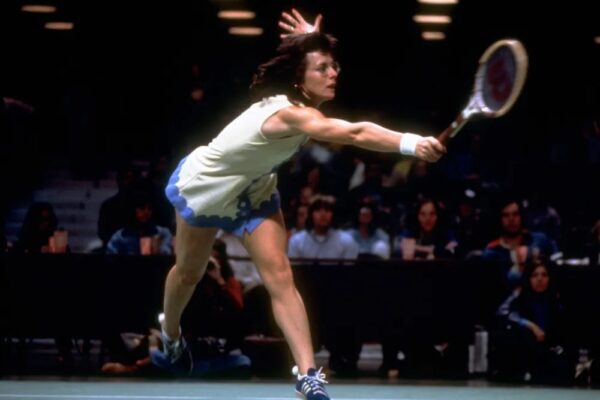
A scene from Give Me the Ball! Photo: Provincetown Film Festival
This was a P-Town year for excellent documentaries. Give Me the Ball! offers a winning portrait of Billie Jean King as a pioneering activist for women tennis players seeking equal pay and also as a slowly coming-out lesbian. Yes, there’s ample screen time for a deep look at her tennis match against vociferous sexist Bobby Riggs. The audience at Provincetown cheered on King in this 1973 court fight as if it were happening live in 2026. A far less upbeat film: Soul Patrol, showing a reunion of aged African-American war veterans who had, many decades ago, fought together as a Black-only squad in Vietnam. They mourn those friends lost in battle and who have died since, and those afflicted by PTSD. Soul Patrol offers a melancholy, touching elegy to a brave and honorable bunch of ex-soldiers, proud of what they did even if still conflicted about whether the Vietnam War was worth fighting.
A final documentary that I found delightful: My Uncle Roy, a sweet, caring portrait of ice-skating performer Roy Blakey made by his pal and adoring niece, Minneapolis filmmaker Keri Pickett. In the present, Blakey, at 93, is suffering from dementia and failing health. The film flashes back to Blakey’s gala career on ice, his somewhat closeted gay life, and to the fact that he’s kept an immense archive of all his accomplishments, including the work behind his pioneering photography book of male nudes. Before Blakey’s imminent death, can a depository be found to take in the immense pile of queer memorabilia that Blakey has stored — hoarded? — through the decades? Spoiler alert: there’s a VERY happy, satisfying ending, and Uncle Roy, now deceased, can rest easy in a gay-friendly heaven.
And one documentary that didn’t work for me: Summer Tour, which follows a boy-girl couple of gentle, peaceful Deadheads as they drive about the country showing up at concerts of Dead & Co. featuring Bob Weir, the last surviving member of the Grateful Dead. They freestyle dance, they smoke dope, they swim nude, they sell their hippie wares. And that’s about it — a film that has no compelling story, no dramatic arc, and which begins, middles, and ends in the same too-mellow place. And there’s not even an interview with Weir, who has died since the Summer Tour shooting.
And on to fiction…

A scene from Teenage Sex and Death at Camp Miasma. Photo: Mubi
I brought acclaimed trans filmmaker Jane Schoenbrun to speak at Boston University pre-Covid, before they had transitioned. Since, Schoenbrun, now working as “Jane,” has become a film sensation because of directing the instant cult classics We’re All Going to the World’s Fair and I Saw the TV Glow. At Provincetown, crowds were lined up, desperate for a ticket for Schoenbrun’s new film, Teenage Sex and Death at Camp Miasma, fresh from a triumphant screening at Cannes. When it opens theatrically, will this film join Obsession and Backrooms as Gen Z zeitgeist box-office sensations?
Teenage Sex and Death is a fan’s note to slasher movies, which Schoenbrun confessed at Provincetown that they watched and adored at a too early age. They also noted how often the killer in these films is of ambiguous sexuality, from Psycho’s Norman Bates to The Texas Chainsaw Massacre’s Leatherface. In homage, Schoenbrun’s psycho-in-residence, Little Death, is a Goth bi who, bullied for his sexuality, retreats to the bottom of a lake. From there, he swims to the surface for murders most foul and disgusting. The main story is of a queer filmmaker (Hacks’s Hannah Einbinder) who, hired to refresh a moribund slasher series, goes in search of the heroine of the original (Gillian Anderson), who lives a solitary life in the woods. Curiously, I was a bit bored by the talky exchanges between the women and felt that Anderson’s character, beyond a Norma Desmond vibe, is seriously underexplained. But I savored Schoenbrun’s smart, revisionist take on the slasher genre. And — a slightly guilty pleasure — I relished the inventive, creepy foray into extreme violence culminating in a lesbian lovefest bloodbath.
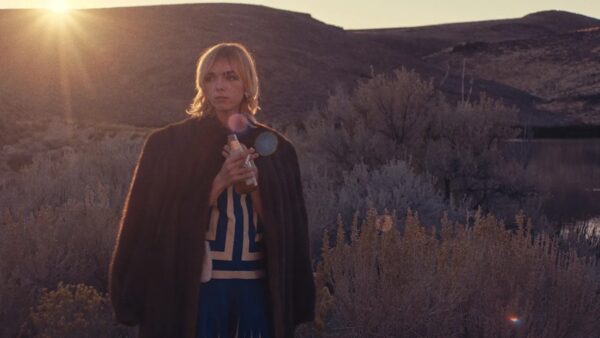
A scene from Sparks. Photo: Provincetown Film Festival
Finally, the fest’s nicest surprise, a narrative film which the P-Town programmers tracked down from its debut in March at SXSW: Sparks, a sparkling no-budget regionalist drama set in small-town Nevada about a bunch of outsider teens. It turned out, surprisingly, to be made by a coterie of enterprising Columbia University undergrads, including talented director Fergus Campbell. Not a Nevadan in the bunch. Anyway, it stars Eighth Grade star Elsie Fisher as a nervy, Godard-obsessed young woman who dares the other teens to join her traveling through a supposed time portal in the desert. Her objective: to arrive in 1960s Paris. Does she get there? Spoiler alert: the color movie turns to a Godardian black-and-white … and then?
Gerald Peary is a professor emeritus at Suffolk University, Boston; ex-curator of the Boston University Cinematheque. A critic for the late Boston Phoenix, he is the author of nine books on cinema; writer-director of the documentaries For the Love of Movies: The Story of American Film Criticism and Archie’s Betty; and a featured actor in the 2013 independent narrative Computer Chess. His last documentary, The Rabbi Goes West, co-directed by Amy Geller, played at film festivals around the world, and is available for free on YouTube. His 2024 book Mavericks: Interviews with the World’s Iconoclast Filmmakers, was published by the University Press of Kentucky. His newest book, A Reluctant Film Critic, a combined memoir and career interview, can be purchased here. With Geller, he is the co-creator and co-host of a seven-episode podcast, The Rabbis Go South, available wherever you listen to podcasts.
Tagged: "Anne Packard: an Artist’s Resolve", "Give Me the Ball!", "Mary Oliver: Saved by the Beauty of the World", "My Uncle Roy", "Soul Patrol", "Summer Tour", "Teenage Sex and Death at Camp Miasma", "Teenage Sex and Death", Ann Packard, Billie Jean King, Fergus Campbell, Gillian Anderson, Hannah Einbinder, Jane Schoenbrun, Sasha Waters
1 Comment
Leave a Comment
Thanks so much for mentioning my film UNCLE ROY. It was great to be at Provincetown Film and awesome to be mentioned in your review. I would like to correct one thing and that is that Roy Blakey collected memorabilia on the history of the great American touring ice shows and he did not collect queer memorabilia. The spoiler alert is correct in that his collection was donated (in the nick of time) to the largest collection of LGBTQ+ history at The Tretter Collection.