
Concert Review: At the Gardner, John Zorn’s New Masada Quartet Balances Edge and Elegance
By Paul Robicheau
Prolific avant-garde composer, saxophonist, arranger, producer, and improviser John Zorn led a sharply attuned band through knotty takes on his Masada songbook.
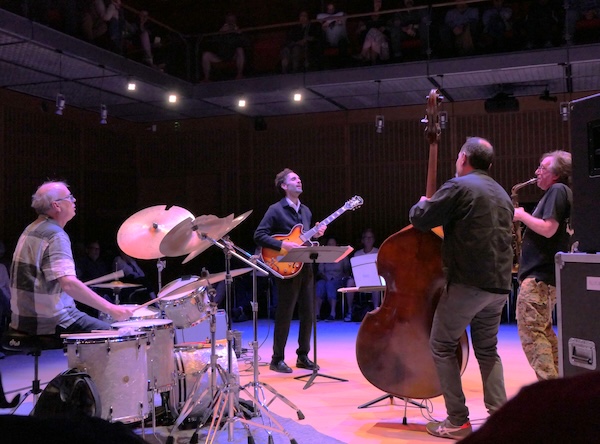
New Masada Quartet (Kenny Wollesen, Julian Lage, Jorge Roeder, John Zorn) at Calderwood Hall in the Gardner Museum. Photo: Paul Robicheau
Boston concerts by New York experimentalist John Zorn have tended to be rare. But the prolific composer/saxophonist seems to have found a reliable home at the Isabella Stewart Gardner Museum’s unique tiered-cube Calderwood Hall. That’s where his New Masada Quartet made another sold-out stop Thursday, its second in recent years, with a hint of an expected return in the near future.
The group draws its repertoire from the Masada songbook, a decades-long project amassing hundreds of Zorn’s compositions meant to reflect radical Jewish culture, rotated through various instrumental configurations. The original acoustic Masada — Zorn on alto sax, Dave Douglas on trumpet, Greg Cohen on bass, and Joey Baron on drums — particularly captured Zorn’s vision of “Ornette Coleman with Jewish scales” in its virtuoso mash of klezmer, jazz, Middle Eastern, and classical music.
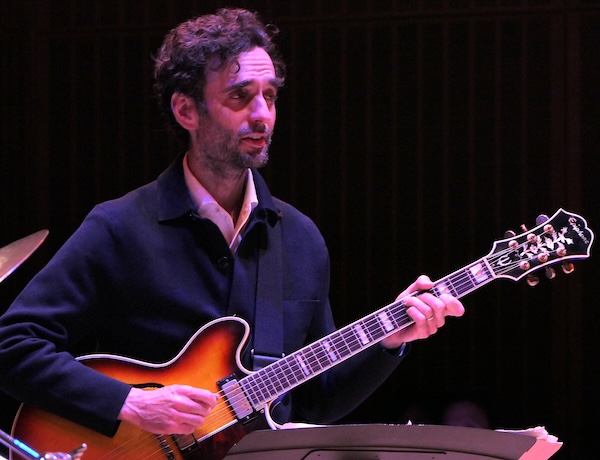
Julian Lage of New Masada Quartet at Calderwood Hall in the Gardner Museum. Photo: Paul Robicheau
That original quartet remains hard to match in pinpoint intensity, as evidenced by its March set in a Zorn-curated program at Tennessee’s Big Ears Festival. But his New Masada Quartet, with guitarist Julian Lage, bassist Jorge Roeder, and drummer Kenny Wollesen (all of whom appeared at Big Ears in Lage’s band, though not with Zorn as New Masada), levitated with its own focused communication at the Gardner. The energy and instrumentation — with electric guitar instead of a second horn — were different, but from the spiraling turns of opener “Karaim,” the players took little time to lock in with exceptional musicianship, bridging the accessible and avant-garde.
Wollesen drove that 15-minute opener with tribal mallet patterns across his toms as Zorn (sporting his signature camouflage pants) wove his alto sax like a snake charmer, tossing in a few trademark squawks and pops. Roeder established a brisk bass line, and Lage surfaced with feathery filigrees, pinched chords, and a ripping trill before Zorn reprised the melody, nodding for the guitarist to shadow him.
The follow-up “Hath-Arob” proved very Ornette-like in its free-darting turns, tightly wound with controlled punctuations. It dropped into a ghostly half-time attack, then stopped and returned to some curt wailing, the group’s playful interplay regularly blurring the line between composition and improvisation.
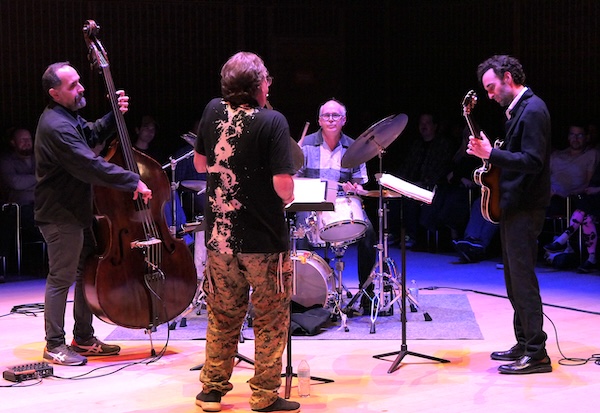
John Zorn, second from left, leads Jorge Roeder, Kenny Wollesen, and Julian Lage of New Masada Quartet at Calderwood Hall in the Gardner Museum. Photo: Paul Robicheau
Though Zorn established himself early with a pungent tone in steady spurts, the saxophonist seemed more intent on giving the other musicians space to flesh out the pieces throughout the set. Roeder began “Rahtiel” with a bass solo that included note slides and harmonic accents, while Wollesen anchored its ballad feel with brushes before Roeder laid down a chunkier line and the tune swelled into majestic crescendos. Lage opened “Sansanah” with a ripple into bluesy stabs and woozy phrases, his clean tone reflecting the absence of pedals at his feet (when he stomped his foot, it seemed comparatively out of character). The band nudged the song into a soul-jazz groove, and Zorn pointed to the various players to steer the piece’s direction before icing it with creamier sax. The Middle Eastern motif of the set closer “Dalquiel” featured Zorn lending brash retorts and circular breathing like a bullfrog in precise command before Wollesen capped the tune by bashing out a rhythm on his cymbals down to his hi-hat before switching to brushes.
A four-minute encore of “Mibi” put Zorn back in a conductor’s role — made easier by the musicians facing each other in a diamond formation near one corner of the Calderwood floor while near-300 fans watched from the hall’s four sides and levels. He gestured to each player for what he wanted while inserting harsh squiggles and muffling the horn’s bell against his raised knee amid the piece’s galloping stops and starts. Roeder added cross-handed slaps and bowing below the bridge, Lage slid into a hint of a cowboy tune, and Wollesen drummed for dear life, eyes fixed on the leader. Then, with one of Zorn’s pulled-fist cues, it was over.
The night’s only disappointment was the leader’s continued penchant for short sets. On Thursday, the group fit six tunes into just under an hour. For the band to make the trip to Boston, with a full house turning out, one would hope that Zorn might share a bit more from that sprawling Masada songbook. Maybe next time.
Paul Robicheau served more than 20 years as contributing editor for music at the Improper Bostonian, in addition to writing and photography for The Boston Globe, Rolling Stone, and many other publications. He was also the founding arts editor of Boston Metro.
1 Comment
Leave a Comment
Paul– good to meet you at this show– I agree about the length of set. The Knitting Factory live with Bill Frisell was 1996– https://www.youtube.com/watch?v=TMCBqBQzX_E (and also an hour…)