
June Short Fuses — Materia Critica
Complied by Arts Fuse Editor
Each month, our arts critics — music, book, theater, dance, television, film, and visual arts — fire off a few brief reviews.
Books
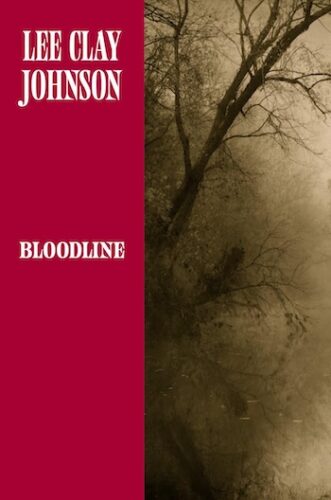 Bloodline, Lee Clay Johnson’s second novel, follows his award-winning debut Nitro Mountain. The new book centers on Winston Alcorn — who dubs himself “Wins-a-ton” — an outrageous and opportunistic hillbilly whose schemes drive the narrative. Unemployed, broke, and supporting two children, he stages a grotesque act of self-victimization by cutting off his own hand on his first day at a lumber mill. When it emerges that the owner, Miss Becka, a kindhearted widow, has allowed the mill’s insurance to lapse, Wins-a-ton seizes the opportunity, suing her for the mill, her home and land, and even a ferry — and winning it all.
Flush with his ill-gotten gains, Wins-a-ton builds a thriving weekly auction business. The novel tracks his rise alongside the lives of his two sons — one disturbingly warped, the other comparatively stable —a s well as Miss Becka and a young woman she takes under her wing. Reduced to living in a cabin and scraping by on tips from bartending and unpaid work at the local post office, Miss Becka spends much of the novel quietly plotting her revenge. Meanwhile, Wins-a-ton attracts a following among locals nostalgic for a resurgent South, eventually launching a political campaign centered on preserving a Confederate statue.
I was inclined to admire Bloodline at the outset. Johnson, a native of Appalachia, writes with an authenticity that feels grounded in lived experience — unlike more opportunistic portrayals of the region, such as the version offered by JD Vance. But the novel ultimately falters: Wins-a-ton becomes a ridiculous caricature, and the supporting characters are left underdeveloped. The result is a book that is worth reading, but difficult to recommend with much enthusiasm.
— Ed Meek
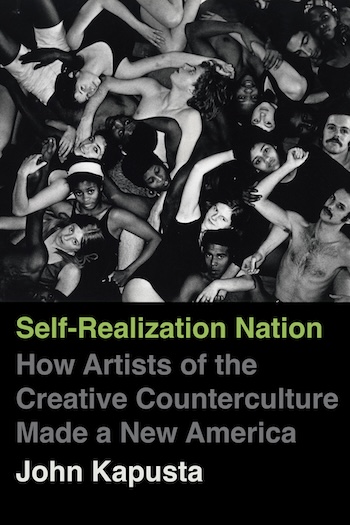
John Kapusta’s Self-Realization Nation traces the influence of Eastern spirituality, politics, and psychoanalytic theories of self-actualization on West Coast “creative counterculturalists” pursuing both personal and societal change. It presents a compelling, well-researched thesis, illuminating the spiritual and aesthetic quests of such figures as Sonny Rollins, John Cage, John and Alice Coltrane, Pauline Oliveros, and Anna Halprin.
Lesser-known artists — among them composer George Rochberg, movement teacher Kay Ortman, and dancer Al Huang — are also examined, with Kapusta refreshingly choosing to focus on process as an indispensable means of freeing and expanding artistic practice. Pertinent examples cited include Cage’s embrace of indeterminacy, particularly his use of chance in composition; Coltrane’s “energy music”; and Oliveros’s sonic meditations. The author also makes a compelling case that Halprin’s task-oriented movement improvisations were foundational to postmodern dance.
As for historical precursors, Kapusta draws on Transcendentalism, John Dewey’s philosophy of self-realization, and W.E.B. Du Bois’s call for Black Americans to pursue self-development. The Esalen Institute is cited as a central hub for many of these artists. Their aim was not only to realize their true selves but also to help others do the same. Kapusta quotes Cage’s civic goal as “not just self, but social realization.”
Kapusta is an academic, and Self-Realization Nation originated as a dissertation; 45 pages of notes and a 23-page bibliography underscore an impressive scholarly achievement. Still, however compelling the evidence for its premise, the book ultimately feels too narrowly focused. What is missing is a broader consideration of similar trends occurring across the country at the same time.
While it is important to highlight West Coast artists, Kapusta might also have addressed how yoga, Buddhism, and tai chi influenced New York–based figures such as Lou Reed, Laurie Anderson, Meredith Monk, Philip Glass, and Don Cherry, among others. They, too, were transformative “creative counterculturalists” and fit squarely within the book’s themes.
— John Killacky
 Gal Beckerman’s How to Be a Dissident is a laudable but ultimately mushy attempt to define the contours of a “universal” dissident sensibility. The book is made up of short chapters that probe specific requisite qualities — “Be Alone,” “Be Pessimistic,” “Be Reckless,” and “Be Loyal.” The volume has the undeniable merit of teaching lessons we need today, given our passivity in the face of authoritarian thuggery. Beckerman advises that would-be dissidents think to themselves, “I don’t worry about whether what I do will make an immediate difference. I act for its own sake, because it feels right, because I can’t live with myself otherwise.” His examples of those in the past who acted because it “felt right” lean heavily on the words and deeds of the customary pantheon of heroic naysayers: Osip Mandelstam, Ai Weiwei, Václav Havel, Albert Camus, Nelson Mandela, and others. There are few surprises in this geographically narrow lineup of dissenters.
This narrowness is also reflected in the definition Beckerman recommends. Near the end of the book, he lauds dissidents as “provocateurs, moral avatars, nervy tricksters,” but goes on to argue that beneath these personas there’s “a bottom-most layer” that matters most: they are “defenders of humanism.” To him, that amounts to treating others as you would wish to be treated. All well and good — but here the book’s emphasis on individual feelings (which feeds self-satisfaction), rather than on helping to build collective action (which works for change with no guarantees of success), falls short. Aside from mentioning the doctor who assembles a team to combat the title disease in Camus’s The Plague, the dissidents under discussion are envisioned as loners. What about people who organize for better working conditions by building unions, or who create political movements? Aren’t they dissidents? Also, Beckerman ducks confronting today’s most pressing issues: Israel’s treatment of Gaza, the war between Ukraine and Russia, and the antihumanism of AI. These concerns are mentioned at the end of How to Be a Dissident, but no dissidents are examined. Perhaps Beckerman was afraid of being too reckless.
— Bill Marx
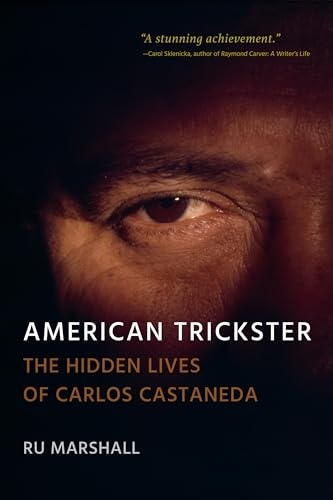 Back in the ’60s, anyone claiming to be cool would have been obliged to plow through Carlos Castaneda’s The Teachings of Don Juan: A Yaqui Way of Knowledge (1968). Claiming to be the acolyte of the mysterious title shaman, Castaneda convinced distinguished anthropologists of his credentials and won academic credibility. That book and its sequels were met with critical acclaim and inspired legions of followers, including many of the celebrities of the day.
It was all made up, the so-called Indigenous Yaqui wisdom a mishmash of Eastern and Western philosophy and New Age claptrap. Now Castaneda is largely forgotten or recognized as a fraud or a symptom of a decadent age.
Though no Manson, Castaneda’s malignancy did take its toll. In true-crime fashion, Ru Marshall’s American Trickster: The Hidden Lives of Carlos Castaneda opens with the discovery of a skeleton in Death Valley, identified years later as the remains of one of the cult leader’s many missing followers. These were mostly women whose names were repeatedly changed by their master, one of the classic methods of mind control Castaneda employed. It becomes confusing keeping track, and Marshall helpfully provides a glossary of the names of victims, accomplices, and useful idiots, and their various permutations. The list includes some people you would think should have known better, like Oliver Stone, Federico Fellini, and Irving Wallace.
With painstaking detail, they (Marshall identifies as nonbinary) cut through Castaneda’s lies to his true origins. Born Carlos Arana in 1925 (not 10 years later as he would later claim) in Cajamarca, Peru, he apparently was a descendant of Julio César Arana, a rubber baron whose treatment of the Indigenous people he enslaved makes Kurtz in Heart of Darkness look like Mother Teresa. Is that a clue into Castaneda’s own pathology, claiming as his own the wisdom of people whom his ancestor murdered and exploited?
Not until the end of the book does Marshall address the obvious connections with MAGA, concluding, reluctantly, that, unlike Castaneda’s movement, it does not fulfill the definition of a cult because it is not “sharply bounded.” As such it is something worse: by embracing the masses, it compounds the evil.
– Peter Keough
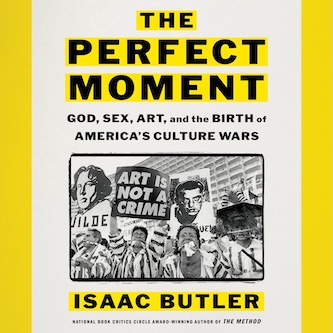
The fight is on between the United States government, Christian fundamentalists, and American artists in Isaac Butler’s powerful The Perfect Moment: God, Sex, Art, and the Birth of America’s Culture Wars. The ’80s and ’90s were difficult decades for provocative artists trying to obtain essential funding for their creative projects. Congressional holdovers from Ronald Reagan’s presidency, along with televangelists and political figures such as Jesse Helms, Pat Robertson, and Pat Buchanan, did their best to stop the National Endowment for the Arts and community grant-givers from providing money for undertakings that right-wing Republicans deemed blasphemous, scandalous, controversial, or perverse. Thus, artists like Andres Serrano, Robert Mapplethorpe, David Wojnarowicz, and Karen Finley were in constant legal battles to ensure their voices could be heard, and that their work — no matter how avant-garde, sexually explicit, or incendiary — could be experienced by audiences.
Butler writes about a moment when conservatism exerted significant control over capitalism, but his work is also an incisive commentary on the dangers of censorship in a nation that proclaims freedom of speech as a fundamental constitutional right. In his final chapter, he pointedly exposes the contradictions embedded in democratic notions of freedom, particularly how legal frameworks can be interpreted to advance political and religious agendas, whether nefarious or misinformed. He carefully traces the litigious pressures placed on imaginative innovators — restrictions aimed at artists who garnered both national acclaim and scrutiny for their confrontational films and photographs, paintings and sculptures, and incendiary installations.
Ultimately, Butler underlines what he sees as art’s indispensable value: “Art is the dream life of the self, the collective unconscious of our species. We come to it — and come to make it — to experience something both within and without us, a piece of ourselves that, only when it is separated from us and put into the world, can make us whole.” The Perfect Moment also underscores an urgent reality — that artists must find a way to sustain themselves through their work.
— Douglas C. MacLeod
Jazz
Created with GIMP
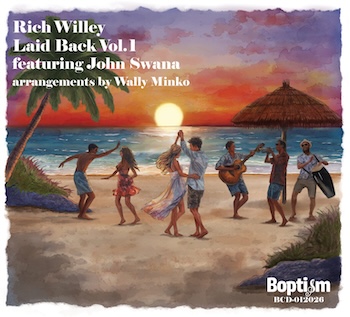
Trumpeter Rich Willey is old school. As he writes in the liner notes to Laid Back Vol. 1, “I strive to craft melodies that follow a fairly conventional form and structure, built on chord progressions that are interesting enough to inspire improvisers. I write what I like; if others happen to like it too, that’s a plus.” I happen to like Laid Back Vol. 1, and you probably will, too, if you’re not looking for anything too far out. I mean, dude, the title is Laid Back.
Willey plays a warm, straightforward line, mostly in the middle and lower range of the trumpet. His compositions lean on riff-based melodies, followed by more baroque, harmonized responses. He’s leading an 11-piece band here, about half the size of his Boptism Big Band, which put out two albums in 2019.
The album features John Swana, a master of the Electronic Valve Instrument since it showed up in the 1980s. It doesn’t do much that a keyboard couldn’t, but the synth sounds blend well with the other instruments and across multiple grooves. Swana and Willey trade solos and phrases back to back in several spots, emphasizing how similar their phrasing can be despite the very different sonorities.
This is sunny, light, borderline commercial music that still rewards paying attention. The first two tracks make a strong start: it opens with a bouncing reggae number full of shifting textures, then slides into a cool-headed fusion track with funky rhythm guitar, a solid EVI solo, and arranger Minko showing off a sharp ear for how to use the flute in all kinds of voicings.
If it needs a genre, call it Jazz for a Margarita Pool Party Where Your Hip Friends Would Drown You If You Played Kenny G.
— Allen Michie
Lately, I’ve noticed two new releases featuring a couple of young jazz or jazz-adjacent musicians with roots in Maine who are moving toward broader recognition.
Yvonne Rogers, who grew up in the town of Penobscot, takes inspiration from both nature and nurture (her influential artist mother) to spin out short solo piano pieces that combine lyricism with satisfying touches of complexity. A Pyroclastic Records release, The Button Jar stealthily engages, suggesting a nascent virtuosity.
Rogers’s influences are many, and they attest to her talent. I thought of Fred Hersch’s approach to melody and harmony; her playing also recalls Brad Mehldau’s rhythmic surge. At times, it can be a bit of a challenge to draw a bead on exactly what Rogers is after in her more abstract pieces. But a handful of performances here come from the heart — including “Luster,” “Cloud Chorale,” and “Puzzle Building” — and they are the most impressive.
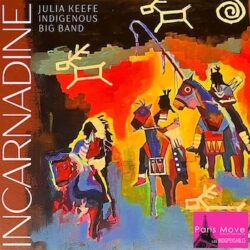
Raised in Farmington, bassist/guitarist/vocalist Mali Obomsawin has put out a handful of releases in both the folk and jazz genres. On Incarnadine, she is at the center of a big band celebration (with touches of social protest) under the leadership of vocalist Julia Keefe. Recorded at the College of the Holy Cross, the Julia Keefe Indigenous Big Band’s premiere recording attempts to reveal essential connections between orchestral jazz stylings and Native and Indigenous traditions. The tribal backgrounds of the musicians are noted in the album’s liner notes —for example, Julia Keefe (Nez Perce), pianist Marc Cary (Wampanoag), and trumpeters Quinn Carson (Apache/Kiowa) and Delbert Anderson (Diné).
“We are not culturally monolithic,” explains Keefe. “We each bring with us the cultural practices of our ancestors, and many of our compositions are derived from traditional melodies and stories. With Incarnadine, we dive deeper into improvisatory music from the Indigenous perspective.”
Obomsawin (Abenaki of Odanak) contributes solid bass playing throughout the session, and she takes the vocal lead on her own “Wawasint8da,” which is based on an Abenaki translation of a Catholic hymn. The song has been featured at Obomsawin’s concerts and on Sweet Tooth, her edgy sextet disc from a few years back. Here, the tune is given a swelling big band arrangement. An elegiac trumpet solo enhances music that has a pop feel, with Obomsawin’s gentle voice on top. It’s all quite lovely, the tune’s resonance deepening the longer you listen.
Anderson offers his “DDAT Suite,” a work that taps into historic Indigenous themes. Keefe’s sweet soprano vocal on her own “Sonnet,” based on a Pablo Neruda poem, blends beautifully into the assemblage. The band and its leader later take on “Rockin’ Chair,” an old Hoagy Carmichael tune that sits comfortably at the end of what is a very interesting release.
— Steve Feeney
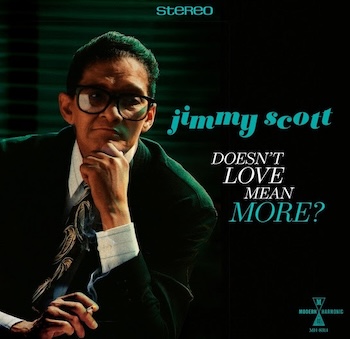 Vocalist Jimmy Scott had a difficult family background. Born in Cleveland in 1925, he lost his mother at 13, and his father deserted the family, leaving 10 children behind. Scott was born with Kallmann syndrome, a condition that causes delayed or absent puberty. He stood 4 feet 11 inches until the age of 37, and throughout his life his voice could easily be mistaken for that of a woman.
As a teenager, Scott worked as an usher at the Metropolitan Theater, where he heard major jazz acts including Cab Calloway, Count Basie, and Duke Ellington. He offered artists extra dressing room services, which led to a job as a valet for the vaudeville act Neal and Sims. They shared a bill with a group that included Ben Webster and Lester Young. Scott asked if he could sit in on a few songs, and they agreed. Shortly after he began to sing, he later recalled, the audience stopped dancing and gathered around the stage to listen.
His first recording was 1949’s “Everybody’s Somebody’s Fool” with Lionel Hampton, who dubbed him “Little Jimmy Scott,” a name that stuck for many years. The song became an R&B/jazz hit, but the music world was never quite sure what to do with him. He recorded for many labels during the 1950s and performed mainly in Harlem, Cleveland, and Newark. Although many of his peers regarded him as a groundbreaking singer, he still had to make a living through workaday jobs.
Scott’s life was a roller coaster, but he made a comeback in the 1980s and sustained a viable career until near his death in 2014.
This 1990 release, Doesn’t Love Mean More?(Modern Harmonic), consists mostly of ballads — his forte. If you are already familiar with his singing, you may find him slightly past his prime here. If you are not, it is hard to predict how you will respond. What can be said with certainty is that his music compels a reaction. With Jimmy Scott, there is no neutral.
— Steve Provizer
Alternative

The cover art for Bill Orcutt & Mabe Fratti’s Almost Waking.
Through Almost Waking (Tin Angel), guitarist Bill Orcutt and cellist Mabe Fratti exchange roles, creating a diverse array of moods with just their two instruments. The pair had never met — until Fratti cited one of Orcutt’s albums as a favorite in an interview, prompting him to reach out and suggest they work together. He began his career in the noise-punk band Harry Pussy, which quickly embraced free improvisation; Orcutt has since recorded prolifically, both solo and in various collaborative configurations.
Fratti’s albums spotlight her cello as the lead instrument, drawing on a style that integrates aspects of pop, rock, and classical music.
The songs on Almost Waking began as guitar solos written and performed by Orcutt. According to an article in The Quietus, Fratti then says she tried to “decipher the harmonic possibilities of Bill’s ideas and very carefully develop some good melodies that followed the guitar correctly.” The track “Forced and Forced and Forced” lands near rock. The cello is fed through a wall of distortion — it is still readily identifiable, though it takes on the tone of an electric guitar. Fratti bows as though she’s slamming the strings. “Steps on the Sun” finds her assuming the role of the bassist, contributing deep, percussive rumbles in the spaces left by Orcutt.
“The Heaven of Our Misery” is aptly named. Even without knowing the title, you can hear the ache in the music. Although more wistful than despairing, the title track sits in the same emotional register. Fratti sings on two songs, both in Spanish. “El inicio es cuestión de suerte” verges on dream pop, a stark exercise through which her voice echoes sweetly. Fittingly, the track was chosen to be the album’s first single.
Almost Waking captures a meeting of two minds, both defined by a restless intelligence. The music resists generic confines, yet remains readily accessible and immediately appealing.
— Steven Erickson
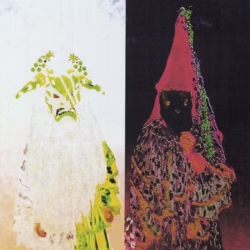
Cover art for Deafkids’ Cicatrizes do Futuro
Deafkids sound like a drum circle in hell. On their latest album, Cicatrizes do Futuro (Neurot), the Brazilian group fuses all kinds of heavy music — metal, hardcore, industrial — with Afro-Latin rhythms. Percussion takes the lead in Deafkids’ songs, with vocals, guitar, and samples layered over it. The result is fiercely tactile music, practically oozing sweat and grease.
Borrowing from the harsh vocal style of extreme metal, the voices function almost like another variety of electronic hum. Of course, for listeners who don’t speak Portuguese, the lyrics’ meaning is folded into the music’s overall mood. On “Advertencia,” metallic guitar grinds against congas. The drums on “Cicatrizes” follow a rhythm derived from Cuban rumba. “We’re going to explore the province of the mind,” says a mysterious voice at the start of “Profecia.”
Acoustic, electric, and electronic instruments swirl together, yet Cicatrizes do Futuro remains strikingly organic rather than a patchwork of hastily assembled loops. For all its harshness, the music feels alive, Douglas Leal’s cries rising like breath in cold air. The title — “scars of the future” — deepens that sense of vitality; after all, scars require a body
Deafkids have described Cicatrizes do Futuro as a “visceral diagnosis of a world intoxicated by its own fictions of power” and a “journey from apathy to traumatic perception.” The recording’s abrasive sonic force is intended as a form of healing rather than a source of easy answers. After invoking Frantz Fanon, the video for “Cicatrizes” pivots from a montage of military violence to a jubilant collage of performances by Black and Indigenous musicians. The closing trio of tracks — “Spell,” “Collective Possession,” and “In Trance” — suggest a ritual that extends far beyond heavy metal’s customary Satanic imagery. In this framing, the album proposes that only by confronting darkness can we begin to imagine brighter alternatives.
— Steven Erickson
Classical Music

A violin can sing, and that’s what it does — and more —in three recent concertos by three US-based composers: Scott Wheeler, Avner Dorman (originally from Israel), and Bright Sheng (from Shanghai).
The works are freely modeled on the traditional plan of three movements (with the middle one being slower), but the Dorman precedes the first of its fast movements with an extended “Adagio religioso.”
More basically, they are all composed in a kind of “conservative modernism,” analogous to works composed some 80 years ago by, say, Prokofiev or Samuel Barber. In a world where only the most extreme departures tend to get press coverage, this may seem like a bad strategy. But linking up so straightforwardly to the traditions of concert-hall music may pay off in the long run.
The title of Wheeler’s Birds of America surely refers to Audubon’s 1838 book. Whereas Messiaen tends to represent a bird by acrid chords that suggest its call’s piercing overtones, the calls here are purely melodic entities, often in a solo wind instrument (as in Beethoven’s “Pastoral”), or, for the woodpecker of movement 3, tapped by the player on his violin’s wooden body.
Dorman’s Nigunim (Violin Concerto No. 2) is the largest version of a piece that also exists in versions for violin and piano and for violin, piano, and string quartet. (A previous recording was released in 2019 by Lara St. John.) “Nigun,” in Hebrew or Yiddish, means a melody, often wordless, and Dorman here evokes, without actual quoting, the different kinds of tunes that Jewish communities — or their non-Jewish neighbors — might have used in Eastern Europe, North Africa, Macedonia, and Georgia.
Bright Sheng’s Let Fly (previously recorded by violinist Dan Zhu) was the one disappointment for me: little in the work grabbed my attention, much less held it.
But the Wheeler and Dorman are keepers, for sure!
— Ralph P. Locke

Cover art for Anzû Quartet’s Quartet for the End of Time.
Olivier Messiaen’s Quartet for the End of Time is such distinctive music with such a singular backstory — composed and premiered in a German prisoner-of-war camp where the composer had been interned after being captured during the Nazi invasion of France — that it’s no real surprise the work hasn’t spawned an abundance of copycat pieces. Nor have many standing ensembles grown up around its distinctive orchestration for clarinet, violin, cello, and piano.
The Anzû Quartet, though, is one of them. Formed in 2020, the collective — clarinetist Ken Thomson, violinist Olivia De Prato, cellist Ashley Bathgate, and pianist Karl Larson — is dedicated to growing the canon for this type of instrumentation. Their first recording, adjust, did that with works by Thomson and Anna Webber. Now their second (on Cantelope) takes on the French master’s eight-movement meditation on time and eternity.
It’s a bracing success.
The booklet suggests a desire to rediscover the novelty of Messiaen’s writing in the Quartet and to eschew performance practice traditions that have grown up these last 85 years. Accordingly, there’s a freshness and energy — tonal as well as rhythmic — to various sections. The “Intermède” is boisterous and folksy, while the “Danse de la fureur’s” syncopations snap jazzily.
The Anzû’s terrific ensemble — the “Danse’s” articulations are outstandingly unified — results in conspicuously lucid textures (the “Liturgie de cristal” sounds aptly crystalline). There are some surprising sonorities, too: unison violin and cello figurations of the “Vocalise” evoke an accordion.
But it’s the Quartet’s big, meditative moments that really carry the reading. In those — the meandering “Abîme de oiseaux,” hypnotic “Louange à l’Éternité de Jésus,” and ethereal “Louange à l’Immortalité de Jésus” — the Anzû tap deeply into the well of Messiaen’s Catholic (and catholic) spirituality, in the process making time not end but seem to stand still.
— Jonathan Blumhofer
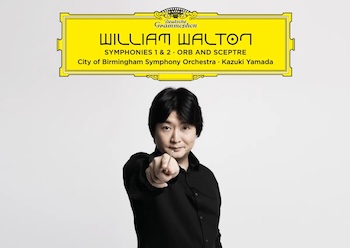
William Walton’s two symphonies don’t turn up in concert halls as often as they should, particularly on these shores. But they’ve fared respectably on disc, especially in the last decade or so.
The latest to offer a perspective on the pair is conductor Kazuki Yamada. While his traversal with the City of Birmingham Symphony Orchestra isn’t quite flawless, it’s very good; even when things go a little sideways interpretively, the ensemble’s playing is consistently excellent.
That quality carries Yamada’s reading of the First Symphony across the finish line. Completed in 1935, it scored the composer a major international success; given the strength of its thematic design, bold contrasts of character, and orchestration, it’s not hard to see why.
Though Yamada and the CBSO impressively bring out the last of these qualities, the first movement is spacious to a fault — its middle section, especially, ebbs in intensity — and the Presto, though plenty light on its feet and playful, is anything but malicious. The well-focused Andante and finale, however, fare better. Ultimately, this is an interpretation that crafts a distinctive atmosphere, just not one that showcases the larger work in the most flattering light. (For that, seek out Gardner’s and Karabits’s respective Walton Firsts.)
Yamada’s take on the Symphony No. 2, on the other hand, is utterly persuasive: taut, tightly rhythmic, blazingly focused, and abounding in little details. The outer movements’ sprays of Mediterranean color and hurly-burly are offset by a reading of the Lento that’s notable as much for its warm, glowing textures as for the orchestra’s command of the music’s sweeping lyricism.
Filling out the disc is a recording of Orb and Sceptre. Written for the coronation of Queen Elizabeth II in 1953, the CBSO’s is a performance of pomp and grandeur, especially in the noble trio sections.
—Jonathan Blumhofer
Tagged: "Almost Waking", "American Trickster: The Hidden Lives of Carlos Castaneda", "Bloodline", "Cicatrizes do Futuro", "Laid Back Vol. 1", "Premieres", "Self-Realization Nation", "The Button Jar", "The Perfect Moment", Avner Dorman, Bill Orcutt, Bright Sheng, City of Birmingham Symphony Orchestra, Deafkids, Issac Butler, John Kapusta, Julia Keefe, Julia Keefe Indigenous Big Band, Kazuki Yamada, Lee Clay Johnson, Mabe Fratti, Mali Obomsawin, Rich Willey, Ru Marshall, Scott Wheeler, The Orchestra Now
4 Comments
Leave a Comment
So Osip Mandelstam, Ai Weiwei, Václav Havel, Albert Camus, and Nelson Mandela are a “geographically narrow lineup of dissenters.” Soviet Russia, modern China, Czechoslovakia/Czech Republic, and South Africa? Please explain.
India, Philippines, Canada, Iran, Australia, Nigeria, France, Germany, Turkey, Spain, etc — it is a big world out there, with lots of very active dissenters (many doing their subversive work in the 21st century). My point is that the book is a little to content to serve up the greatest hits …rather than reach out to what is happening now …
….oh, I left out French Algeria (Camus). Whatever. “Greatest hits,” maybe, but yes, there are a lot of countries in the world. How much of a world survey are you looking for? …. And “what’s happening now.” Not Ai Weiwei… again! Chinese autocracy so so 1989! Anyway, I get it, the book focuses too much on individual “feelings” rather than political action. But historical context would seem to have some value. I have not read the book, so I can’t defend it, but I can understand your dissatisfaction.
I wasn’t looking for a global survey so much as for fresh names, off-the-beaten track countries, and concrete contemporary situations. I admire Ai Weiwei—as a side note, someone should stage Howard Brenton’s excellent drama The Arrest of Ai Weiwei—but there are also Uyghur writers in China who have been risking everything to document their lives and struggles. I’ve reviewed some of their work. Why not bring more of these marginalized voices and causes into view? Dissidents in Sudan, for example.
My deeper dissatisfaction, though, is less about the author’s preference for feeling over action than about how dissidence itself is framed. Here, it is centered on solitary figures rather than on those who organize others into collective action. Consider Chris Smalls and his recent book, When the Revolution Comes: A Fight for the Future of the Working Class. In 2021, Smalls helped organize Amazon workers at a Staten Island facility, initially ignored by politicians and established labor groups until his efforts succeeded. Comfortable liberals tend to celebrate individual heroism; they are far less at ease with leaders of movements who mobilize the disaffected into sustained action. At this moment, that dimension of dissent feels essential—and its absence is what ultimately left me dissatisfied with a book that is otherwise admirable in its call to defend humanism.