
Book Review: “The Making and Breaking of the American Constitution” — What’s the Domesday Book Got to Do with It?
By Daniel Lazare
Historian Mark Peterson’s book makes land the sole driver of American development—ignoring racism, morality, citizenship, and the heart of the Civil War.
The Making and Breaking of the American Constitution: A Thousand-Year History by Mark Peterson. Princeton Univ. Press, 408 pages, $29.95
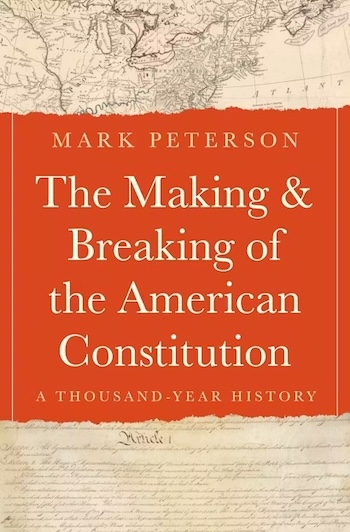 The Making and Breaking of the American Constitution is a textbook example of how not to write history. The Yale historian Mark Peterson starts out with a good idea, which is the role of westward expansion in the constitutional order that emerged in 1787-88. But his focus is so obsessive and one-dimensional that his book ends up bogging down in the mud.
Plainly, the author is onto something in zeroing in on land as a major issue of the revolutionary period. North America was vast, and while various powers controlled parts of it, no one controlled it all. So the goal was to get there “firstest with the mostest,” as Nathan Bedford Forrest would later put it, before the other powers – chiefly France, Britain, and Spain – crowded the new republic out. If Anglo-Americans succeeded, it was because they enjoyed key advantages. They were closer to the problem, they knew the terrain, their economy was burgeoning, and they contained thousands of land-hungry settlers in their ranks. Thanks to mass immigration, they would soon contain millions more.
But first they had to deal with an essential problem. This was how to encourage westward expansion while seeing to it that settlers didn’t break off into new republics of their own. Half a millennium earlier, Genghis Khan had solved it by offering an unusually generous share of booty to Turkic and Mongolic tribes that joined his Central Asian federation. The founding fathers did the same by offering generous terms as well, in this case say full equality in the federation that was just taking shape along the Atlantic seaboard.
The mechanism is set forth in Article IV, section three, which lays down three constitutional principles. These are that (1) Congress has power to “make all needful rules and regulations respecting the territory” under its sway, that (2) settlers could form themselves into states once they attained certain numbers, and that (3) Congress would then admit them to the union on the same basis as everyone else. Not only did settlers have nothing to lose in making their way west, but they actually stood to gain since they would enjoy equal representation in the Senate despite having far fewer people than older states like Pennsylvania and New York.
The same goes for the Electoral College where they would also be over-represented. The result was a political bonus for those helping to extend the new republic’s ambit. Peterson describes the Constitution as a “technology” for “acquiring Indigenous land, transforming the land into marketable real estate, moving settlers onto the land, and organizing landowning settlers into new states.” It enabled American settlers to leapfrog across the continent “with breathtaking efficiency,” reaching the Pacific by 1848, a mere 60 years after the Constitution went into effect. “Before the nineteenth century ended,” he continues, “the United States had added thirty-two new states to the original thirteen and increased the territory under statehood from 365,000 square miles … to 3.4 million,” nearly a tenfold increase. The Americans edged out France, forced Britain to retreat north of the Great Lakes and the 49th parallel, kicked Spain out of Florida, and deprived the Republic of Mexico of territories extending from Texas to California and as far north as Wyoming.
This was no small feat. As for the other power, i.e. Native American tribes in the interior, they wound up losing everything because they were not remotely in the same league as far as politico-economic development was concerned. Relatively speaking, they were a power vacuum that the US moved ruthlessly to fill.
Anglo-Americans thus constituted a neo-horde every bit as unstoppable as the original. But is this all they were? This is where The Making and Breaking of the American Constitution runs into trouble. Peterson’s concentration on land to the exclusion of all other factors leads him down strange paths, the most perplexing of which is the Domesday Book, a survey that William the Conqueror ordered taken of his new English domains two decades after crossing the channel in 1066.
The Domesday Book was indeed a remarkable document. An inventory not only of people but of economic assets right down to the number of sheep and cured hides, it demonstrated the extraordinary level of power and centralization that the new Norman kingdom had achieved. Medieval Europe would see nothing else like it. But in Peterson’s hands, the Domesday Book becomes not just a survey but a quasi-constitution that “spelled out in excruciating detail how the body of the English realm was constituted, what its parts consisted of, and how each related to the whole.” To be sure, he says it was not “an attempt to create a novus ordo seclorum, a new order of the ages, as the Great Seal of the United States would proclaim.” Nonetheless, he quotes the English legal historian F.W. Maitland as declaring, “Our whole constitutional law seems at times to be but an appendix to the law of real property,” and so concludes that the Domesday Book was a constitutional device after all.
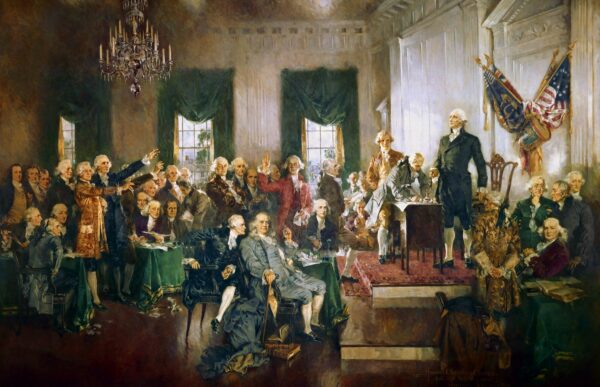
Howard Chandler Christy’s Scene at the Signing of the Constitution of the United States. Photo: Wikimedia
This leads to repeated references to the “Domesday Machine” as an instrument of American expansion. Because the Normans were all about land and assets, the US had to be too. Hence, Americans exterminated indigenous peoples not because of racism, but because they coveted the land they occupied. The crisis over slavery grew white hot not because free labor was under threat but because cotton cultivation was leading to rapid soil exhaustion, which led to demands for more land farther west. This led to a struggle for control of the Senate between free and slave states, which led to Bleeding Kansas, John Brown, secession, and so on.
Not that any of this is incorrect. But it is incomplete because the conflict was not only about land but a great deal more – morality, racial classification, the definition of citizenship, and democracy in general. There is not a word in Harriet Beecher Stowe’s Uncle Tom’s Cabin, written in 1852, about the land question but plenty about fairness and the system’s cruelty to slave women. For Marx and Engels, what was striking about the Civil War was its multidimensionality, the fact that it pitted not just free and slave states against one another but entire politico-economic systems based on industry versus agrarianism and competing forms of labor. Yet for Peterson, the only thing that counts is land.
This leads to further distortions. Did the new republic encourage westward expansion solely out of land hunger? Or did it do so for external reasons, which is to say the need to establish itself as a continental power? The 1823 Monroe Doctrine declaring hegemony over the entire western hemisphere certainly suggests the latter. Was 1776 about land or democracy? Peterson emphasizes one when the other was no less significant.
The same goes for the current constitutional crisis that is Peterson’s ultimate focus. In his view, the problem began in 1870s when expansion reached the arid west. All at once it became clear that offering settlers freedom and protection was not enough and that the federal government would have to take pro-active measures to develop such a difficult region on its own. Railroads were offered huge land grants as corporations bought up vast blocks of property. This was the opposite of a yeoman farming class that Jefferson and others had envisioned.

In this book, historian Mark Peterson starts out with a good idea, but ends up bogging down in the mud. Photo: PUP
The next step occurred in the 1890s when the Census Bureau declared the frontier to be closed and the United States began turning its energies outward. Victory over Spain in 1898 brought eight million Puerto Ricans and Filipinos under American control. These were people equivalent to 10 percent of the US population at the time. But because they were non-Anglo, Congress had no intention of turning them into states the way it had with territory taken from Mexico in 1848. Instead, they became colonies, a category unforeseen by the founders in 1787. World War I and the Depression brought a dramatic expansion of the executive branch that was also unforeseen. Yet no attempt was made to amend the Constitution to reflect new circumstances. Indeed, FDR declared in a radio address in 1937 that the amending clause set forth in Article V was now obsolete.
“It would take months or years to get substantial agreement upon the type and language of an amendment,” he said. “It would take months and years thereafter to get a two-thirds majority in favor of that amendment in both houses of the Congress.” Since Article V also calls for three-fourths approval by the states, he went on: “No amendment which any powerful economic interests or the leaders of any powerful political party have had reason to oppose has ever been ratified within anything like a reasonable time. And thirteen states which contain only five percent of the voting population can block ratification even though the 35 states with 95 percent of the population are in favor of it.”
Since it is impossible to use a broken amending process to fix a broken amending process, the response was to flow around it the way traffic flows around an accident. The executive branch took on more and more power as the Supreme Court set about interpreting the ancient document in ever more creative ways. “In effect,” Peterson says, “both the court and Congress seemed to acknowledge the truth of Franklin Roosevelt’s 1937 radio address. The formal process for amending the Constitution was obsolete in the era of permanent emergency first heralded by the worldwide economic depression and then sealed by the advent of the nuclear age.” Yet with Watergate and the 1987 Bicentennial, constitution-worship reached new heights of adoration. The Constitution is dead, long live the Constitution!
Peterson’s constitutional prognosis is grim. Since World War II:
“…the United States has been constitutionally adrift, lacking in purpose. Its overseas military ventures have been decidedly ineffective and difficult to justify to a skeptical public. Its internal politics have become bitterly divided…. Threats to the commitments to liberty and equality declared in the nation’s founding come from authoritarian sources that are as much internal to the national culture as they are ‘out there’ in a dangerous world. And the greatest planetary challenges all nations face – a rapidly warming climate, soil degradation, alarming rates of species extinction and loss of biodiversity, increasing threats of epidemic disease, and grotesque inequalities in the consumption of the world’s resources – are ignored by a sclerotic political system in which moneyed interests dominate.”
Peterson begins with a bang but ends with a whimper. “The skill set of a historian,” he says, “is not particularly conducive to predicting the future.” But he continues:
“I will lean on history to risk the assertion that a radical realignment of the American constitution is unlikely to happen in ‘constitutional’ fashion, by the mechanisms endorsed in the written instrument of 1787. This is in part an assessment of the historic weakness of the amendment process laid out in Article V. Franklin Roosevelt’s diagnosis of its futility as a tool for making major changes has not been contradicted by subsequent events.”
In plain English, what this means is that Article V must be overthrown so society can advance. It is a nightmare weighing on the brains of the living and must be expunged. But how will this occur? What will be the social forces driving such an explosive transformation? Peterson is silent because it’s not in his “skill set” to say. Perhaps if he took a broader view of history, he would be better prepared to deal with the complexities of American revolutionary development.
Daniel Lazare is the author of The Frozen Republic: How the Constitution Is Paralyzing Democracy (New York: Harcourt Brace, 1996).
Tagged: "The Making and Breaking of the American Constitution", Mark Peterson