Theater Review: Amid a Smokey Haze, Double Edge Theatre Delivers an Inspirational Warning
By Nicole Estvanik Taylor
The farm-dwelling company is reviving its 2015 roaming spectacle of ecological grief, political resistance, and communal art.
Once a Blue Moon/Cada Luna Azul. Created by the Double Edge Theatre ensemble, company, and collaborators. Story by Carlos Uriona and Stacy Klein and text by Jennifer Johnson (with inspiration from Isabel Allende and other writers). Directed by Stacy Klein. Staged in Ashfield, Massachusetts, through August 2.
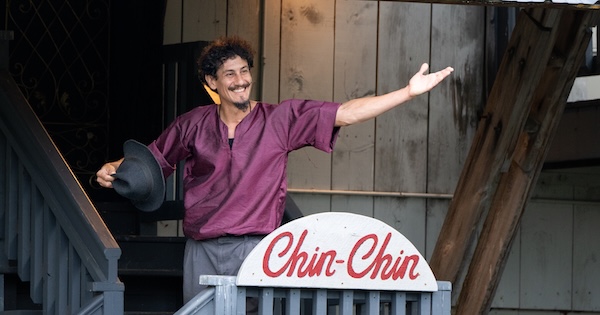
Manuel Uriona as young nightclub owner Aitor Aguada in Double Edge Theatre’s revival of Once a Blue Moon/Cada Luna Azul. Photo: David Weiland
My first and only previous visit to Double Edge Theatre in Ashfield, Massachusetts, was in 2011, for its rendition of the Odyssey. My sense memories from that experience were reactivated this summer the moment I turned my car off the rural road that leads to the company’s distinctive venue, pulling into a small dirt lot adjoining a greenhouse teeming with crops. Though 15 years had elapsed, I vividly recalled wandering this patch of land with fellow audience members — past a stream and pond, through groves and gardens, inside a converted hay barn — as the day’s light slowly faded and Odysseus made his way toward home.
Since 2002, the company has presented its roving, site-specific, and quick-to-sell-out Summer Spectacles on its 110-acre farm in the foothills of the Berkshires, where troupe members work together, coaxing food and theater from the same ground. This year, Double Edge has remounted a show it first devised and staged in 2015: Once a Blue Moon/Cada Luna Azul, inspired by co-creator Carlos Uriona’s experiences in Argentina under the military dictatorship that gripped the country in the 1970s and ’80s. During that time, Uriona was the founder of a puppet theatre in the suburbs of Buenos Aires; he also helped to organize artists in the use of street performance as a form of protest and cultural resistance. Photos and reviews from the original 2015 production suggest that the show has retained much of its visual and musical DNA while undergoing significant changes in story and cast.
On the July evening I attended, the typically fresh air of the farm held an ominous yellow haze — not, unfortunately, a theatrical effect. All day, the region had been blanketed by drifting smoke from the wildfires ravaging swathes of Canadian forest. It was an unsettling prelude to a show deeply concerned with environmental destruction.
The play begins among café tables in a courtyard, where cast members and musicians play and sing selections of Latin American music that will flavor the entire evening. Narrator Aitor Aguada (played by Uriona, wistful in a rumpled pinstripe suit) welcomes the audience into his memories of Agua Santa, his hometown on the edge of the rainforest, which he left behind long ago.
With palpable nostalgia for “a place filled with echoes, with fantasmas,” Aitor introduces the dramatis personae: the love of his life, Maria (Desiré Graham); their son, Zain, bursting with youthful energy and idealism (Travis Coe); flirtatious Rodolfo, “the best dancer in town” (Victor Rafael Figueroa); and his own younger self (Manuel Uriona). Young Aitor is focused on keeping the good times rolling at his nightclub; he cautions Zain to steer clear of politics, despite mounting evidence of the dire exploitation of Agua Santa’s workers and resources. Undeterred, Zain vows to protect the “Lunas”: nature spirits gracefully embodied by Mica Farias Gomez, Stephanie Reyes, and Cariel Klein, who hover on the periphery of the action, dancing among the tall wildflowers, dangling from branches, and wading in the stream.
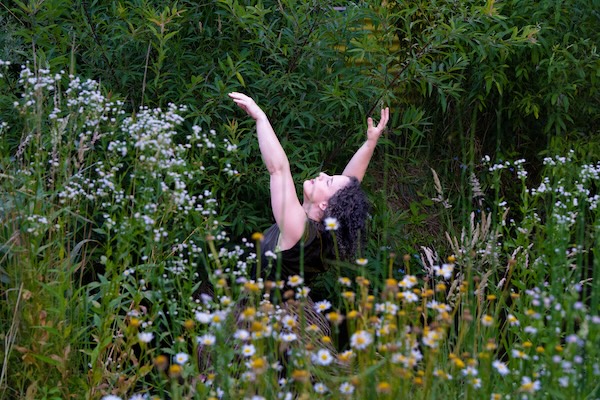
Cariel Klein as one of the three Lunas in Double Edge Theatre’s revival of Once a Blue Moon/Cada Luna Azul. Photo: David Weiland
During the middle portion of the performance, the company divides the audience into four groups and guides them through a rotation of four repeating scenes before reuniting in a procession back to the courtyard. I was impressed by how seamlessly the cast timed this splintering of the narrative. I didn’t mind that the sights and sounds of the other nearby scenes intruded on the edges of whichever one I was currently experiencing — this added to the sense that these are, indeed, only echoes from the past.
Other townspeople move through the vignettes: a Polish immigrant worker (Karol Matuszak); a German journalist (Hannah Jarrell); and a neighbor (Khadija Bangoura) who frets about the waters rising at the doorstep of her colorful hut (one of several structures charmingly constructed along the stream). Even if they were only fantasmas, I wished for a few details that would flesh the figures out — they might have made subsequent events hit harder on a personal as well as ecological level. Only Rodolfo has an arc that’s not entirely bound up in the fate of Agua Santa: a secret affair with a local general (Michael Valladares) and a glammed-up gig at Aitor’s nightclub. Ultimately, it’s the flustered general’s refusal to acknowledge their connection that Rodolfo is unable to forgive. Dramatically, it would have been compelling to see how Rodolfo grappled with the general’s military power and his role in oppressing the town.
The show’s description had primed me for brutal depictions of life under a dictatorship; I wasn’t anticipating comic relief in the form of American logging magnate Ernestine Von Badger III (Jennifer Johnson, also the author of the text) and her obsequious factotum (Robert Carlton). Stomping about in safari cosplay, martini glass in hand, pointing out all the trees she can’t wait to cut down and spouting old chestnuts like “I’m not running a charity here!” Johnson’s villain elicits more chuckles than chills. Then again, one of the lessons of the decade that has passed since Blue Moon’s previous production is not to underestimate the amount of harm that ridiculous people can cause.
The tone takes a somber turn in the story’s late chapters, after Zain convinces the townspeople to parade to the plaza for a musical display of solidarity. Having squirmed through my share of productions in which celebratory dance numbers fall flat, I appreciated this ensemble’s genuine exuberance; most of the audience was moving, clapping, and singing along by the time we reached our destination. And there, emerging from the hills above us, was the representation of totalitarianism I’d been expecting, all humor stripped away: a lockstep row of larger-than-life, faceless soldier puppets, designed to unnerving effect by Dan Castelli. We retreated into the barn to take refuge in the revelry of Aitor’s club, only to witness the deforestation-triggered flood that causes him to flee Agua Santa, a scene executed with rippling silks, aerial choreography, and a potent sense of panic.
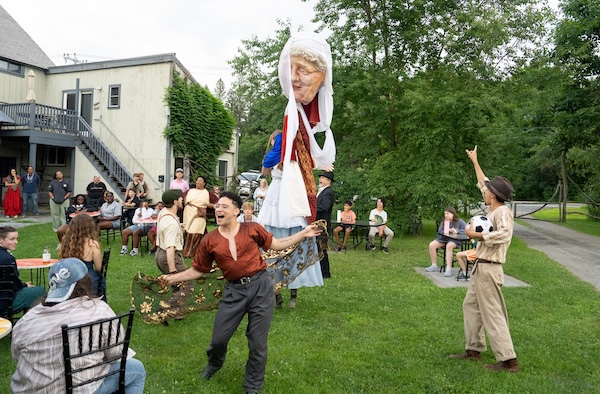
The Double Edge ensemble, including Victor Rafael Figueroa (center) and Travis Coe (right), welcome the audience to Agua Santa in Double Edge Theatre’s revival of Once a Blue Moon/Cada Luna Azul. Photo: David Weiland
The play’s final sequence of wreckage plays out at dusk at the edge of a pond among flickering torchlight and rushing water. This is the epitome of director Stacy Klein and her team’s skill at transforming the farm’s landmarks into immersive tableaux that could linger in minds of theatergoers for 15 years and more. While I’ve always taken pleasure in the creative strategies designers use to evoke the elements on conventional stages, there’s something truly breathtaking in transitioning from a deluge rendered in fabric to watching characters plunge into a real body of water or skim across its surface in a boat.
Near the close of the show, present-day Aitor repeats words he first uttered when the soldiers appeared in the plaza. “Can the light of justice shine on a struggling people, and will the world see itself in this brilliant light anew?” Carlos Uriona delivered the question with the theatrical emphasis of a takeaway, so I did my dutiful best to mull it over on my long, dark, and winding drive back to Boston. I pulled back into my own driveway still unsure what the production has to say about justice, apart from confirming that the world could use more of it.
A passage from earlier in the show, borrowed in translation from Uruguayan poet Mario Benedetti, was more unshakable:
In the streets locking elbows we are much more than just us two…
Your eyes are my magic spell against the terrible days.
I love you because your gaze when looking starts sowing the future.
Once a Blue Moon/Cada Luna Azul left me reflecting on art’s many uses. It is not only an escape into moments of beauty, or the “intimacy under dim lights” prized by the young club owner Aitor Aguada—though that kind of magic can help keep our heads above water in terrible times. Nor is it confined to the work of processing grief and loss, as Aitor the narrator so urgently needs to do. Instead, from lived history Uriona and his collaborators draw a vision of art as pragmatic: a force that gathers singing crowds in plazas, refuses acquiescence and disappearance, and dares to fix our collective gaze on the futures we might yet bring into being.
Nicole Estvanik Taylor is a freelance writer and editor based in the Boston area. The former managing editor of American Theatre magazine as well as former content director of the MIT Alumni Association, she has written about the arts, culture, science, and other topics for publications including NPR, the Boston Globe, Science Friday, Edible Boston, TheatreForum, Theatre World, and the alumni magazines of several universities.
Tagged: "Once a Blue Moon/Cada Luna Azul", Carlos Uriona, Double Edge Theatre, Jennifer Johnson