Book Review: A Turn Toward the Slight by Daniel Mason
By Clea Simon
Daniel Mason’s latest novel trades the ambition of North Woods for a lighter, self-satisfied satire of intellectual life.
Country People by Daniel Mason. Random House, 320 pp., $30
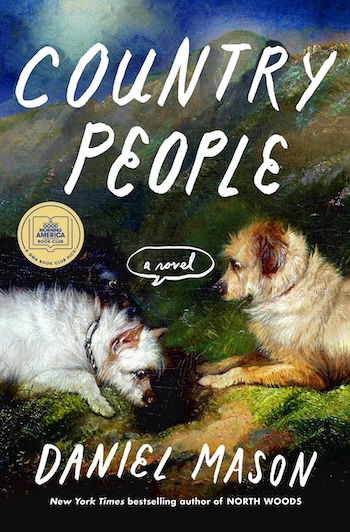
Daniel Mason’s North Woods was a revelation, a novel with a place as a protagonist, with stories about that New England site — which ranged from wilderness to suburban orchard and back again — nestled together. Like David Mitchell’s Cloud Atlas, if somewhat less fussy, the bestseller managed to convey the unchanging nature of human behavior over millennia, as well as the unchanging nature of, well, nature.
Mason’s new follow-up, Country People, could be seen as the human side of that story, focusing as it does on one blocked academic and his family sojourning in the same kind of New England setting that featured in North Woods. But where the previous novel explored the sins and illusions that drive us, Country People seems set on exploring our trivialities, with the expected pleasant but disappointing results.
The family at the center of Country People is spectacularly mismatched. Kate, wife of Miles and mother of Olive and Wesley, is a hugely successful academic — the kind of professor whose classes on Milton and Blake are always full, despite their lack of pandering tie-ins to academic trends or Taylor Swift. She is also, as the book opens, in remission from multiple sclerosis, a disease that has made her, if anything, more focused on teaching and academic success. Miles, her husband, is the opposite: a dilettante and master procrastinator who has been working on his doctoral thesis for 14 years. Enabled in part by his time as Kate’s caregiver, he has perfected the habit of jumping thesis topics, haring off in slightly new directions with each new enthusiasm.
The book centers on their time in Southern Vermont, where Kate has been invited to teach at a prestigious college. Having abandoned Rabelais, French fairy tales, Chekhov, and Tolstoy (among other topics) to immerse himself in Russian folk tales, Miles tells himself that this sojourn will allow him to “gain a better understanding of country people and country life” and, thus, finally finish the thesis currently sitting on his computer as RussianFolktalePeasant17.
What follows is a lightly amusing tale of one man in search of himself. In a world of super-competent women (including Kate’s friend Miranda), Miles looks for meaning in the kind of stories where a king is “tricked by a peasant into trading his daughter for a salmon, or the disasters caused by Emelya the Simpleton.” What he should soon realize, but doesn’t quite, is that reality is much more mundane — although it has mysteries enough of its own, as transcripts from a local radio advice show, “The Miscellaneous Minute,” and chats with the neighbors reveal.
Those mysteries motivate the plot, what there is of it, when Miles latches onto a local legend that promises as much intrigue as any of his Russian folktales. To add a minor bit of spice, there are also other predictable digressions, as when attractive locals test Kate and Miles’s bond.
Mason, a 2021 Pulitzer finalist for the short story collection A Registry of My Passage Upon the Earth, is a deft stylist, and this comic novel is larded with jokes about the affectations of intellectual life. Most mentions of Miranda, for example, cite her papers, which carry such ridiculous titles as “Little House on the Big Internet” (for the “Journal of Marriage and the Family”), while a performance art piece entitled “Modern Humiliations” has the artist “engaging in public acts of modern capitalism, such as trying to dispute an insurance charge, reverse an error at a credit bureau, or understand a cellphone contract.”
Miles is the butt of many of these jokes, his self-absorption making him an easy target. When he finally learns to ski, for example, he prides himself on his skill, noting, “[s]oon, he would keep up with the children.” And when Kate, worried about his isolation, tries to set him up with a male friend, the problems accrue. Andrei, we learn, is another “marooned academic,” a “lapsed biochemist” who has found a new calling in his apple orchard and sweeps Miles up in his enthusiasm, which includes scything like one of those Russian peasants Miles so hopes to connect with. Predictably, we soon learn that Andrei’s all-natural approach is anything but, as yet another wife fabricates an elaborate deception to coddle her husband to the point of infantilizing him — possibly endangering their children along the way.
The result is a smug wink-and-a-nod, reassuring the reader that we are superior to these egocentric academics. When we’re finally asked to respect their bonds, therefore, it’s a difficult switch. While some critics have drawn a comparison between Mason’s latest and Nabokov’s academic comic novel Pnin, to this reader the result is more Gary Shteyngart light: amusing in a self-satisfied way, and very far from down to earth.
Clea Simon is the Somerville-based author most recently of “The Cat’s Eye Charm.”