
Book Review: “Death of the Soccer God” — A Life Replayed at Gunpoint
By Kai Maristed
Dimitry Elias Léger’s glorious novel turns a final moment into a sweeping meditation on love, history, and the Beautiful Game.
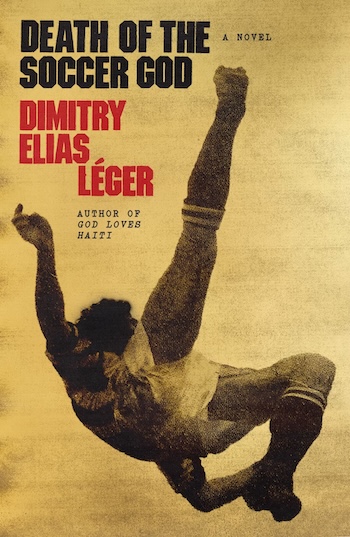
Death of the Soccer God by Dimitry Elias Léger. Farrar, Straus, and Giroux, 24o pages, $27
 “Depend upon it, sir, when a man knows he is to be hanged in a fortnight, it concentrates his mind wonderfully.” So goes Samuel Johnson’s insight, oft-quoted since 1777. (It was a diarist’s musing; Johnson was not in danger of dangling.) How much more concentrated must be the mind, then, of a blindfolded young man facing Papa Doc Duvalier’s Haitian firing squad, during the moment following the barked command, “Ready…” ?
It’s no hyperbole to say that Death of the Soccer God opens with a bang. Or rather, a near-bang. A bang-to-come (or not?) whose hovering over 220 pages, in defiance of the laws of physics and time, creates inescapable narrative tension. (How did he get into this fix? WHAT NEXT?) The helpless concentration that grips the protagonist grips the reader equally and unifies a novel constructed largely, like a block castle, from set scenes, vignettes, diatribes, and occasional spurts of moral lecturing. In other words, diversions and time-outs, drives and penalty kicks, head-butts and lucky shots, games won or lost. I speak mostly metaphorically, because although there is plenty of the real thing here, enough to satisfy fanatics of The Beautiful Game, the sparks from the past that fly through the mind of Gilbert Chevalier at faster-than-lightning speed are ignited primarily by beautiful, sexy women, the history of Haiti, irresistibly sexy women, fascinating, if ugly, family constellations, dangerous women, the wondrous historical rise of Negritude, memories of Aurèlie, the woman of his life, who got away—or did she?—and the search for and fear of a God.
“I’m talking to You, our Lord and Saviour […] You hate my arrogance, right? I’m among the most arrogant people You ever created. All professional athletes and artists are. Don’t you see how stubborn we have to be, to make our dreams and talents come true?
“Gil …[…] was a lousy atheist. He wasn’t much better at being a Catholic, either. He was a lapsed Catholic. In other words, he was like just about every Catholic in two thousand years, ever since the first Catholics moved out of their parents’ houses and stopped going to mass on Sundays.”
Gil’s life story tracks, and not so loosely, that of Joe Gaetjens, born in 1924 into a well-to-do family living in an upscale neighborhood of Port-au-Prince. Like Gil, Joe is light-skinned with ‘bulbous’ features and those uniquely Haitian green eyes. Like Gil, Joe scored the decisive 1-0 goal in 1950, in Brazil, for the laughable-loser U.S. team against the soccer behemoth Great Britain, a global upset for underdogs and brown-skinned players around the world, as Léger paints in thrilling detail. The scenes of carnivalesque days and nights of rejoicing in Belo Horizonte may have you swaying to the beat. “Belo had no beaches. It’s an inland metropolis. Creating inward-looking tendencies, like binge drinking.”
I will not enter here into the hot, never-ending debate about whether to call the game soccer or football—except to say that I vote with my ‘ Fut.’
Like Gil, Joe had previously studied accounting for a year at Columbia, where both men were discovered by the U.S. soccer talent scouts, and where the fictional Gil has the opportunity to room with Miles Davis, fall for the music of Trane, and suffer mightily from the awful cold. These New York chapters, with their hard-to-swallow coincidences and dithyrambic descriptions of music, feel stiff compared to those set in Haiti or Brazil. Maybe it’s the cold.
None of this biographical shadowing, however interesting, could bring a book alive without Soccer God’s two wrenching passions: for The Game, and for Love itself, embodied in the wildly improbable but somehow believable amour of Gil and Amèlie.

Author Dimitry Elias Léger. Photo: courtesy of the artist
One of the idiosyncrasies of Léger’s craft is the use of a dual narrative voice. Third person and first person shift places from one paragraph to the next without a signal. Granted, an omniscient narrator is a necessity if, say, you want to spy on the ex-pat Nazi parents conniving to have their daughter Elizabeth marry the well-to-do Haitian lad just long enough to restore their own fortunes. But the fluid structure (or refusal of structure) betrays an author who wrote the book HE wanted to write, conventions be damned. Dimitry Elias Léger, a former advisor to the U.N. whose first book, God Loves Haiti, was a PEN Open Book Award finalist, is no naïve storyteller. He knows the rules of contemporary fiction, and how to bend them.
Another rule-defying quirk of Death of the Soccer God is its generous sprinkling of French in dialogue, with some outright Kreyòl thrown in, and no translation. Either you dust off your high school French, cher lecteur, or ditto a dictionary. Our author made an exception, fortunately, for one revelatory phrase involving an elevator and a gallows!
He is also, simply, a damn good writer, with a Raymond Chandler-esque eye for detail. Here, his stepbrother’s mom: “She hugged me, her first time doing that. Then she took my bag from the trunk. Its weight stretched the biceps of her skinny arms.” Here, Aurèlie drives her Peugeot up to Duvalier’s presidential palace. “It was late afternoon. The sun looked nervous.”
How does a writer put so much good humor and sly wit into a book that reveals itself, progressing with the hero’s maturity, to be agonizingly serious? How does a novelist deliver a country’s essential history, and the high spirits of a glorious game, and the trajectory of a coddled upper-class métis’s life from superficial light to throat-tightening dark, in relatively few pages? It’s a number that would leave Tolstoy or Henry James still clearing their throats, no offense to those titans of the art.
Dimitry Elias Léger succeeds by being… quintessentially a certain type of Haitian. Meaning, a person in the habit of weaving deft sarcasm with a more innocent playfulness, with a recognition of the worst of human nature, all the while keeping a corner of the heart open for the possibility of salvation, whether by a god or gods or human love. One doesn’t have to be an artist to see/think/talk this way (although it is surprising how many Haitians are artists, even on one meal a day). But you will find something similar in the work of writers like Gary Victor and Dany Laferrière. Léger is younger than they, and more boisterous. He lives up to his name.
Questions? Quibbles? Yes—some odd employment of English words that seemed to ask for editing. Lack of agreement in one French passage, but hey, that really is a quibble, along with a date or two that seemed a bit off. (‘Critic, is that all you got?’) No—more importantly, I kept wondering, where is Vodou, so interwoven in Haitian culture then and now, in this portrait of a country? Omitted, for fear of arousing ignorant prejudice? There is one cleansing ceremony, at a waterfall, which if you know it you know, but the V word occurs only once, on page 134.
I also concede that the ‘envelope’ structure of a protagonist reliving her/his life in its presumptively final seconds is hardly new. (By the way, speaking of envelopes—a shout-out here for the cover design, gorgeous and original as its content.) However, another element that sets Soccer God apart from the crowd is its narrative rhythm. Even the slower passages, the preachy bits and travelogues, exert a pull, a shared urgency, like long Caribbean waves. The overall momentum gathers to make this unlikely entry into the best-seller sweepstakes a page-turner, at one point practically a page-ripper. And yet there is no all too explicit sex, definitely no unicorns or aliens or witches. Only a naïve protagonist from a tiny country most Americans can’t find on a map, and yet…
Granted, there is the Beautiful Game to draw mass attention. But it’s no crowd-rousing big-time soccer match that had me repeatedly holding my breath through the final whipsawing chapters of this novel. Read Death of the Soccer God and weep. For the unexpected sadness. For the eruption of joy. Goal, Elias! Olé!
Kai Maristed’s writing has appeared in Agni, Ploughshares, Five Points, and elsewhere. Her books include Broken Ground, praised by John Coetzee, and Belong to Me, starred by Publishers Weekly. A production of her play Paul and Émile earned standing ovations last fall. Preorder Kai’s new, prize-winning book, The Age of Migration: A Novella and Stories, at your favorite bookseller or online. Note—the novella is set in Haiti, where Kai worked as a volunteer in a rural hospital.