Book Review: “The Yahoo Boys” — Love for Sale
By Bill Littlefield
“The Yahoo Boys” dissects a global grift fueled by digital intimacy, economic despair, and willful belief.
The Yahoo Boys: Love, Deception, and the Real Lives of Nigeria’s Romance Scammers, by Carlos Barragán. Farrar, Straus and Giroux, 287 pages.
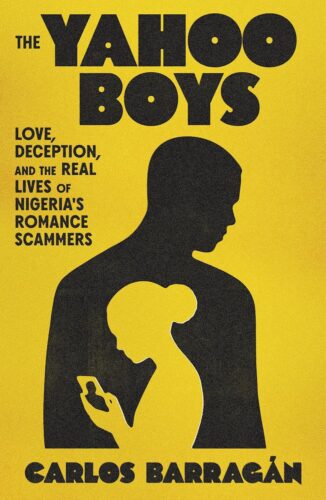 Carlos Barragán went to Nigeria to find the man who’d been stealing money from his mother.
Barragán, a reporter for the New York Times who lives in Madrid, was not successful in locating the crook he was seeking but, over a period of years and several visits to Nigeria, he did learn a good deal about the racket operated by the Yahoo Boys, which is what the scammers called themselves. How did Barragán gain access to the fraudsters and manage to not only gain their confidence but also interview a number of them at length? That reportorial arrangement remains mysterious — until an “author’s note” at the end of the book. In it, Barragán explains that during each of his multiple visits he employed a Nigerian “fixer” named Bukola, who early on disappears from the narrative with a case of malaria. This explains how a man from Madrid, who didn’t know Yoruba, could have learned so much from and about a collection of young men, and one young woman, whose English was sketchy at best. When he ran out of money to pay Bukola, Barragán offered his fixer a portion of whatever his book earned, so somewhere back in Nigeria, Bukola is hoping for a best-seller.
Barragán didn’t track down the Yahoo boy who ripped off his mother, but he did interview a lot of others who practiced the same con. His book focuses on four of them, whom he calls Biggy, Chibuike, Richie, and Azeez. Names have been changed to protect the guilty.
The scam itself has young and not-so-young Nigerians pretending via social media to be lonely men or beautiful women living in London or Malibu or Perth, depending on where the victim resides and what he or she requires to be gulled. The scammer provides a sympathetic ear. He tells his victim what he or she wants to hear. Perhaps, most significantly, he fills up time that would otherwise be empty. He promises to visit if the victim will send the funds the scammer’s phony identity needs to clear up some debts, to renew a passport, or to purchase a ticket. According to Barragán, the racket has resulted in the theft of billions of dollars from people who either believe they’re in a relationship that isn’t real or choose to act as if they believe it because the alternative is intolerable loneliness.
In Nigeria, Barragán finds people who are ashamed of the Yahoo Boys because their scams have reinforced the country’s reputation as a hopelessly corrupt state. He also finds officials who shrug off the grift. They argue that, as long as Nigeria’s economy is depressed, many young men can find no alternative to scamming. What’s more, “the perception that the Yahoo Boys are contributing to the economy is very real on the street.” Barragán writes that “some Nigerians justify the actions of Yahoo Boys by pointing to the pervasive inequality and systematic corruption in the country.” In fact, he reports that just about every time he went anywhere in a car in Lagos or the vicinity, he was stopped by police, who solicited bribes. Meanwhile, some of the Yahoo Boys tell Barragán that they are only recouping the wealth that was extracted from Nigeria by white people during the days when their country was a colony. They insist that what they are doing is justified, perhaps even patriotic, heroic.
The most successful scammers Barragán meets “cash out” in spectacular fashion when one of their victims comes through with a significant donation. As long as the money lasts, they stay in the city’s finest hotels, buy liquor and drugs for themselves and their friends, and pay local singers to write and perform songs about them in the bars. That means that “drugs and nightlife siphon off most of the Yahoo money,” and “clubs, bars, dealers — all know how to prey on a boy with too many digits in his account.” Just as there are no happy endings for the victims of the rip-off, there are none for the Yahoo Boys themselves, at least as far as Barragán could determine.
Not quite all of The Yahoo Boys transpires in Nigeria. At one point, Barragán travels to Kentucky to search for a woman who has been a victim of one of the swindlers. In a desperate attempt to end their “relationship,” “Theresa” has had a relative send Chibuike, her Yahoo Boy scammer, who claims to be a professional wrestler, a photo of a coffin with a message: “She’s dead. Don’t call back.” “Theresa” agreed to be interviewed by Barragán, who learns that her life has been a series of bitter disappointments. She was, in short, a perfect target for an energetic and imaginative Yahoo Boy. When Barragán talked to her, she had lost her money, her house, and the trust of her husband.
According to Barragán, the Yahoo Boys and their victims have one thing in common: “they lived online.” He posits that the industry of “romance scamming” has been made possible – if not inevitable by “the depth of loneliness in our own societies, and the cages of isolation that tech companies have built, and monetized, with astonishing success.” There’s validity in assigning blame for the scammers’ criminal enterprise to the unregulated, profit-mad “tech companies.” But there are readers of The Yahoo Boys likely to come away from the book shaking their heads at the gullibility — as well as the depths of desperation — of the people who’ve fallen victim to these schemers.
Bill Littlefield’s most recent books are Who Taught That Mouse To Write? and Mercy.