Book Review: Unreliable, Unapologetic, Unforgettable — “Murder Bimbo” Cuts Deep
By Clea Simon
Rebecca Novack’s debut blends murder mystery and social satire in a sly, shape-shifting narrative driven by a sex worker who may be telling us exactly what we want to hear.
Murder Bimbo by Rebecca Novack. Avid Reader, 224 pp., $28.99
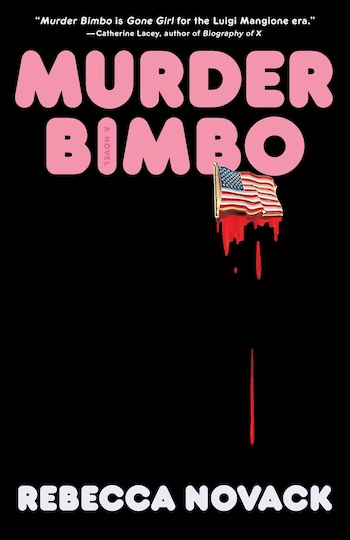 A 32-year-old queer sex worker has been duped by a supposed government agency into killing a rising politician/sexual predator. Realizing she’s been set up to take the fall, she goes into hiding and, in a series of emails, attempts to explain how she got here — and win our sympathy along the way.
That’s the provocative setup of Rebecca Novack’s bracingly sharp debut Murder Bimbo, a first-person novel evidently (according to her acknowledgments) written largely on the author’s cell phone. Our nameless protagonist would have us trust her. And why wouldn’t we? She’s brutally honest about herself and her work, getting “fucked by fifty-year-old dudes on long lunch breaks,” and even more so about her clients, such as the one “with the face of a rat and the outfit of a professional paintball player.”
However, as she herself points out, her success is built around creating a fiction for her clients. Are we clients? Friends? Do we even exist or are we hearing an internal monologue?
It’s not like the politician didn’t need killing. Although much has been made of the Luigi Mangione parallels, the victim in Murder Bimbo is actually much more Trump-like. A charismatic politician, whose every nefarious misstep only seems to endear him further to his followers, “Meat Neck” is a selfish, brutish man who may have hurt our protagonist during an earlier encounter.
I write “may” because, like so much of this book, the victim’s past crimes are, if not hazy, then subjective, molded to win sympathy, support, and even love.
Not that we realize this at first. The book opens when our protagonist is already on the run. She’s discovered certain truths about those who hired her and she has some very scary suspicions about their long-term plans for her. She’s writing emails to a popular podcast, “Justice for Bimbos” (hence her assumed name and the book’s title), pitching her story as one of a quasi-feminist underdog, a bit naïve but well intentioned, ready to take one (or take one down) for the team.
But once she makes her case, it becomes clear that this is just one possible argument — and that our “murder bimbo” has other audiences to please, including the ex who hooked her on social justice in the first place. As this Rashomon-style mystery unfolds, dropping hints about what may approach objective truth and how each intended audience is supposed to respond, the mystery only grows deeper and darker, tying together not only right-wing conspiracy theorists but also the most selfish — or should we say self-protective? — of motives.
Novack’s story-within-a-story succeeds because of her language. Though her characterizations are thin, they’re electric — gesture drawings that instantly project the types she must deal with, from obsessed stalker to clueless tech bro. Fast, furious, and flush with contemporary slang, this shorthand pulls us along as she works the boys by “negging” them back, playing on their “line-cook energy” even as she struggles to balance clients and her erstwhile untrustworthy colleagues.
“It wasn’t just his profession that made him a creep, or that he stalked me, or his rat face,” she muses about one collaborator. “I could just see him back in the cabin palpating raw meat.”
With her ex, she’s more vulnerable — a repentant lover seeking a second chance even as she struggles to come to terms with what went wrong. By the third iteration of her story, some dichotomies resolve while others remain, shedding light on greater truths.
In addition to its flip, fun appeal, the book rides on its emotional honesty. Our wonderfully untrustworthy narrator has no illusions about the world. She realizes, a beat too late, that she’s been chosen because, as a sex worker, she’s disposable. Throughout, she notes the play of gender roles — expectations she exploits when she can, gaming a system rigged from the start. Can we blame her for wanting to survive? Can we blame her for anything?
“I had to be hot, funny, adult, healed, and alone-as-fuck without being slutty, depressed, embittered, or lonely,” she explains. “I had to dangle just enough story…
“I knew I could figure it out.”
Part murder mystery, part social satire, Novack’s whip-smart narrative goes deeper with each thrust, exhilarating and surprising.
Clea Simon is the Somerville-based author most recently of Bad Boy Beat.