Dance Review: The Akram Khan Company — Remembering, Selectively
By Debra Cash
In Thikra: Night of Remembering, Akram Khan’s searing imagery of female ritual and sacrifice is shadowed by what the work chooses not to confront.
Thikra: Night of Remembering by Akram Khan Company in collaboration with Manal AlDowayan at Jacob’s Pillow Ted Shawn Theatre, Becket, through July 12.
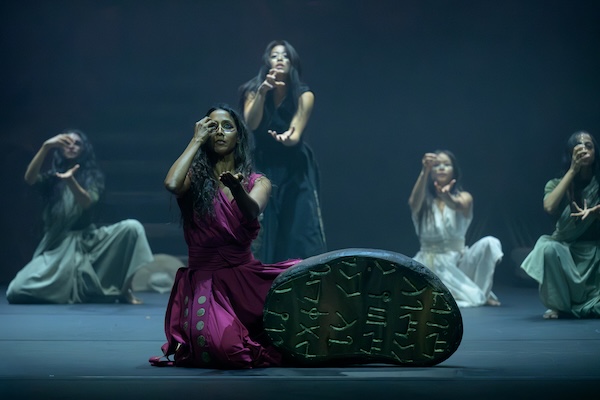
Mythili Prakash in Thikra: Night of Remembering at Jacob’s Pillow Dance Festival 2026. Photo: Grace Copeland
The filtering light on the stage of Jacob’s Pillow’s Ted Shawn Theatre is dim, with wisps of haze rising from the stage floor as audiences enter. The cleft in iron-oxide colored walls that could be in Petra or part of an underground cave is bordered by a hewn stone staircase. Saudi artist Manal AlDowayan originally created a site-specific set for choreographer Akram Khan’s Thikra: Night of Remembering on the desert sand in the Saudi Arabian desert for an arts festival at Wadi AlFann. It’s apparent that she intended to convey that this dance would be a piece that belonged, and somehow paid tribute to, its craggy landscape.
Reimagined for a theatrical setting – and a world tour that will be the final one for Akram Khan’s permanent company after a 25-year run — the environment still reads as ancient, hidden, and mythic. As the sound score of twittering birds gives way to ram’s horns, grinding electronica and ululating women’s voices, a crowned priestess-like figure (Mythili Prakash) appears on a high ledge. London, where Khan and AlDowayan both reside, could be on an entirely other planet.
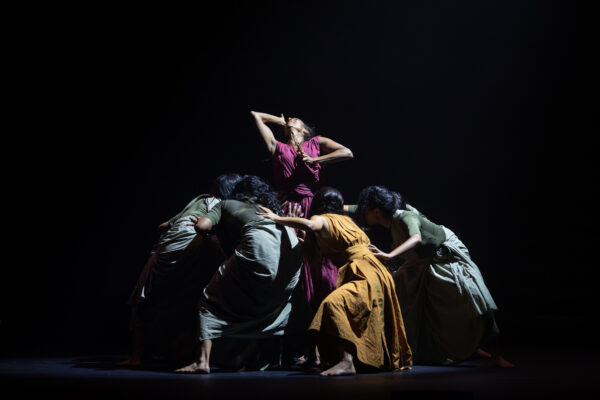
Akram Khan Company in Thikra: Night of Remembering at Jacob’s Pillow Dance Festival 2026. Photo: Jamie Kraus.
Thikra, which is Arabic for memory, unfolds in episodes. A deft figure in white (Ching-Ying Chien) lifts a rock and explores the cuneiform beneath it with her hand as if trying to read — or perhaps relearn – archaic instructions. Later she will approach a group of masked figures who clamp a bonneted mask over her head as if to extinguish her individuality. Another woman (Elpida Skourou) is laid on a row of stones and her agency is destroyed, too, until she lies jerking like a marionette to the commands of a shaman-like figure (Lani Yamanaka) in black.
Throughout, to Aditya Prakash’s pulsing score where carnatic singing is juxtaposed to the sounds of a Balkan women’s chorus, the women’s long, unbound hair whips around them. It hides their faces, sweeps the floor, and is groomed and stroked in gestures of ambiguous — and possibly deceitful — tenderness. The elegant, curlicue details of Bharatanatyam hand gestures may or may not be telling a story, but some images, such as the dancers miming removing their eyeballs to place them in their waiting palms seem sui generis. Khan’s choreographic structure is firm: the dancing through this hour-long ceremony feels inexorable.
You can’t say Khan and his collaborators don’t range widely. Thematically, Thikra is kin to Sacre Du Printemps, depicting the sacrificial dance of one –here two –young women (whether you prefer the original/reconstructed Ballets Russes version, Pina Bausch’s rolling-in-the-mud presentation , or some other variation); the fury of Giselle’s ghost brides, or wilis; with a dollop of the long-hair-as-prop element of Bronislava Nijinska’s Les Noces. In her preshow talk, Pillow Scholar Maura Keefe pointed to the Martha Graham Company’s centennial, which is being celebrated with an exhibit and upcoming Pillow performances August 12-16. There’s more than a hint of Graham in Thika too, with a powerful central woman inspiring a troupe of female acolytes into ritual behaviors, however incomprehensible those rituals might be.
Khan’s classical Indian dance elements fold smoothly into the distinctive contemporary movement language that has been so memorable at the Pillow with Kaash in 2003 (which I loved), and the Boston Ballet’s production of Vertical Road in 2023. The company dancers hail from different dance traditions and training, but as an ensemble, they seem as if they have danced together, egging each other on to ever-increasing intensity, eternally.
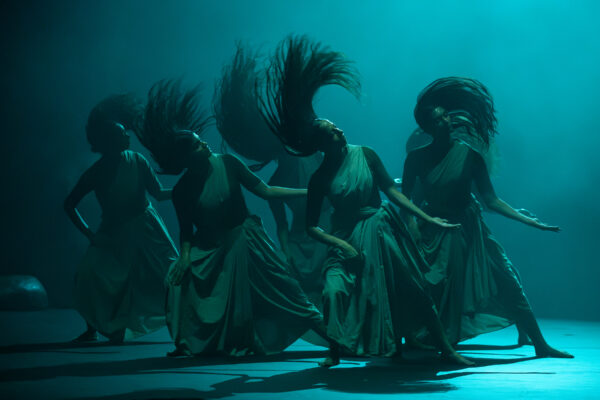
Akram Khan Company in Thikra: Night of Remembering at Jacob’s Pillow Dance Festival 2026. Photo: Grace Copeland
Yet despite the sustained intensity and technical excellence of the Akram Khan Company’s dancing, my mind kept drifting back to the premiere of this work. According to Human Rights Watch, recent advancements in Saudi Arabia remain window dressing in a society that continues to be deeply patriarchal. Thika’s rituals take place in a world without men, sidestepping any issue of gender subordination.
Khan and AlDowayan are serious, world-class artists. I can only hope that the images in Thikra arose out of their unconscious rather than from an overt attempt to titillate and flatter their Saudi hosts. The Pillow presentation of Thikra was, for me, a night of remembering and considering how the past influences the present and shapes the unknowable future. I don’t think it was the kind of remembering the Akram Khan Company had in mind.
Debra Cash is a Founding Contributing Writer at the Arts Fuse and a member of its Board. She has been a Scholar in Residence at Jacob’s Pillow. This is the second in a series of reviews covering the Pillow’s 94th festival season.