Tribeca Film Festival, Part Two: Addicts on Chelsea (MA) Streets, Love and Death at Sea, and Micronations
By David D’Arcy
At the Tribeca Film Festival, two dramas stood out among the narrative films—stark, street-level tales of addiction and a wintry queer love story turned murder mystery set on a Canadian ship.
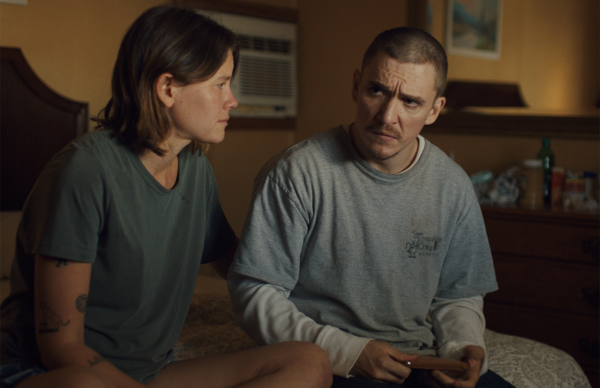
A scene from Cotton Fever. Photo: Tribeca Film Festival
In Cotton Fever, James (Kyle Gallner) is being registered for treatment for heroin addiction when the health worker signing him in runs off to calm a patient who’s going berserk. James looks around, grabs some pills, and dashes out of the treatment center onto the Chelsea, MA streets.
The man who wanted to get off drugs then arranges for a drug deal and hides out where his pregnant girlfriend is sleeping. They need money for a deposit on an apartment for their first child. Life for this addict is complicated.
As the couple and other addicts move from craving to crisis, they collide with each other. Sam and Manny, young women living off a legal settlement that’s drying up, steal from whomever they can. They rob James when they see the dealer has cash, putting a knife to his throat. They also rob relatives.
Cotton Fever is written and directed by Daniel Blake Schwartz, a former addict, with cinematography by Tom Acton Fitzgerald. In the film, the pair captures the arrhythmia of characters who are desperately chasing a fix — a hunger that stops time until the chase for the next one starts. Shot mostly on the streets of Chelsea, Cotton Fever has the feel of a documentary: it compresses lives of constant craving into an interplay of subplots. Like a doc, the narrative seems more reported and distilled than scripted. There’s not much conversation, and no memorable lines. These are addicts, after all, not slackers with hours to talk. They share drugs and fight when they run out of them.
Schwartz manages to inject a few laughs into his drama. James is stopped, searched by cops, handcuffed, and placed in a car. Once the cops turn around, he somehow opens the car door and runs. In a long, dark, worn-out hoodie — that could have been merch from another movie — he’s a shadowy silhouette avoiding capture. After that, he’s wearning cuffs for much of the rest of the film, scrambling to find a way to remove them—an apt metaphor for life as an addict.
Cotton Fever will remind you of earlier bare-boned films about addicts surviving on the street — Panic in Needle Park, etc. — until its characters pull you into their own urgent world. One remarkably similar film that came to mind for me was Laws of Gravity (1992), directed by Nick Gomez and shot by the prodigious Jean de Segonzac — a first feature about small-time young criminals outrunning cops and debt collectors. The camera races to keep up with the action.
As powerful as Schwartz’s feature debut is, it’s hard to imagine Chelsea hosting the theatrical premiere. Let’s hope I’m wrong in assuming that.

A scene from Labrador: Autopsy of Silence. Photo: Tribeca Film Festival
In Labrador: Autopsy of Silence, directed by Rodrigue Jean in French, English, and Inuktitut, the crew of a freighter carrying provisions for Indigenous communities in Canada’s far north. They live in close quarters; at the risk of making an obvious point, it’s too close for comfort.
Outside the sky is grey and vast, with weather flaring up in sudden bursts and then calming to reveal serene, infinite seascapes.
Alupa (Christopher Angatookalook), an Inuit mechanic with traditional markings on his face, has taken up with Alex (Alexandre Landry), the ship’s cook. If this is a love boat, the coupling here isn’t always consensual. Alex has also caught the eye of the bullying First Officer Michelle (Gabrielle Poulin B.), a tough blonde who demands sex from him when she lets her hair down and knocks on the door of his cabin. She does not tolerate anyone questioning her authority.
Tension builds as the ship moves through rough waters and ice. Eventually Alex turns up dead in his cabin, stabbed in the throat. Alupa is seen as a culprit. So is a Sri Lankan kitchen worker whom he befriended.
An investigation, with all the civility of a rush to judgment, suggests that Alupa is the prime suspect. He’s pressured to reveal information because there is no little evidence. Angatookalook plays a resolute man who reveals little; the officers in charge are impatient with an Indigenous technician who dares not give them the answers they want.
Rodrigue Jean scrambles the sequence of events in his script, starting with a gruesome seal hunt through the ice in Alupa’s home town – a place worth escaping — as well as focusing on the discreet bond between the two young men. On trial from the beginning : the mistreatment of the Indigenous people and the rigid chain of command that enables an officer to demand sex from a cook the way others order food.
Framed against cramped quarters and an indifferent majestic sky, Alupa, who struggled at home, faces obstacles that could well frame him for a murder on the ship that carried him away. He could face far worse punishment if he reveals that he and the murder victim were gay.
Labrador won Tribeca’s prize for best international film and for cinematography. Angatookalook won for best performance in an international narrative feature. We’ll be seeing more of him.
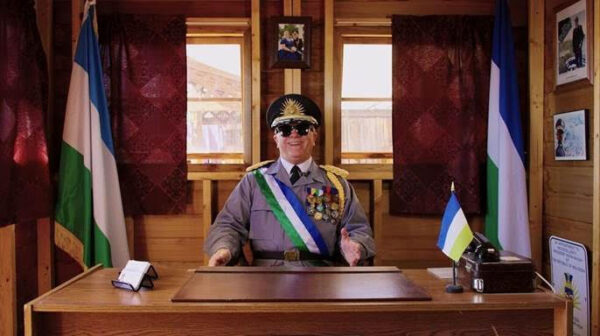
A scene from Micronations. Photo: Tribeca Film Festival
Among the documentaries, Micronations impressed me as a collection of dress-up fictions. Each fiction is a tiny country, or is imagined as one.
The idea is, if you’re dissatisfied with your country, or with the way its leaders dress, you can always create your own, or dream of a different one.
Directed by Joe Kowalski, the film is a trip through costumed versions of wholesome utopias, possible alternatives to what our president calls “sh__hole countries.”
Molossia has been in northern Nevada since 1998. Its leader, President Kevin Baugh, speaking in uniform, founded the nation under a different name. His wife, whom he met on Myspace, had one question before joining: “Can I wear a tiara?” She wears one now, along with the title of First Lady. The country’s navy is made up entirely of inflatable kayaks. Jack Black has so far been their most distinguished visitor.
“I think ultimately the reason for existing is to explore the idea of what makes a country, and where we can go with that,” says Baugh. That can accommodate almost anything.
Sometimes there is a more practical reason for a micronation to be formed. The First Lady of Ladonia, Carolyn Shelby, from Joliet, Illinois, suggested that her micro-state, located in southern Sweden, could annex additional territory in rundown Gary, Indiana. Gary has an airport with a runway longer than any at O’Hare she says, and an international seaport. The city’s steel mills are running at 10 per cent capacity, if that. A reasonable plan, perhaps, though the Gary scheme remains on the drawing board.
Ladonia came to be when authorities in Sweden noticed — and banned — sculpted structures of drift wood that rose to the height of nine stories along the coast. Frederick, a Swede who is Ladonia’s minister of art, explained that the builders, led by the artist Lars Vilks, were told to stop. They refused. A small fine was paid and Ladonia was born.
“It’s obvious that Sweden has no authority over this land, so we can claim it and we can start a micronation,” says Frederick. A tour of Ladonia’s territory shows a “country” defined by its local “architecture.”
Sometimes the micronation is pure satire, or almost pure, as in the case of Conch Nation, a fanciful imaginary city-state in Key West, Florida, where locals who like to dress up or dress down have time on their hands — along with a destination to promote — and plenty of stiff drinks for sale to move the process along.
The residents’ movement for “independence” began when police, searching for marijuana shippers, put a roadblock on US 1, which slowed down traffic and cost local businesses money. “Pirates” from Conch Nation protested by boarding a ship and then throwing food at a US Coast Guard vessel. The rebellious band then retreated. The nautical battle became a creation myth that is now reenacted every year.
One thing that a micronation (whether it is Conch Nation or Molossia) can produce — in fact, must produce for reasons of self-definition — is costumes. Attire leans towards a colorful mock-military look for men and gowns with tiaras for women.
In the case of Dignity Village, a colony for the homeless alongside the airport in Portland, Oregon, ceremonial dress is scant. This now-permanent, rule-bound settlement, has been accepted by the city government. It is more of a local community than a nation.
Leaders of micronations report in the film that they are contacted constantly by people who hear of them and want to join up, somehow. They have to turn most of those interested down. Given how so many have to endure life in unenlightened realms, the appeal makes sense. The First Lady of one of the micronations explains, as she wears her imagined country’s crown, that she survived the horrors of the Khmer Rouge massacres in Cambodia.
The catchy, subject-appropriate song played over the doc’s credits is, aptly, “When I Rule the World,” written and performed (and featuring a saxophone solo) by Brad Goodall, who is an ensemble of one. How much more micro can you get?
David D’Arcy lives in New York. For years, he was a programmer for the Haifa International Film Festival in Israel. He writes about art for many publications, including the Art Newspaper. He produced and co-wrote the documentary Portrait of Wally (2012), about the fight over a Nazi-looted painting found at the Museum of Modern Art in Manhattan.
Tagged: "Cotton Fever", "Labrador: Autopsy of Silence", "Micronations", Daniel Blake Schwartz, Joe Kowalski, Rodrigue Jean