Book Review: A Forceful History of America’s Unfinished Reckoning
By Roberta Silman
In a sweeping account of the nation’s anniversary milestones, Eddie Glaude Jr. shows how whitewashing and racial exclusion have shaped America’s self-image from 1826 to 2026.
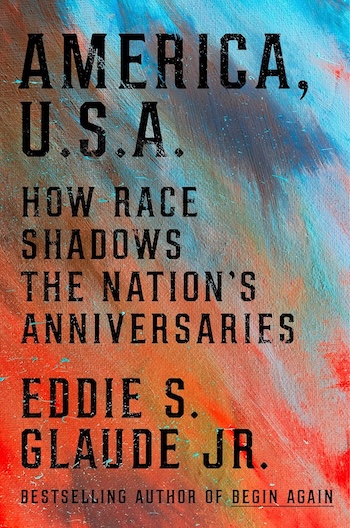
America, U.S.A.: How Race Shadows the Nation’s Anniversaries, by Eddie Glaude, Jr., Crown, 270 pages, $31
 To get to the book under review, I must first go back to an earlier 2020 book by Eddie Glaude. It is Begin Again, James Baldwin’s America and Its Urgent Lessons for Our Own. In it are two paragraphs that etched themselves in my mind when I read them only a few months ago and remain strikingly relevant today:
We are told every day not to believe what we see happening all around us…. We are told, for example, that Trumpism is exceptional, a unique threat to our democracy. This view that Trump, and Trump alone, stresses the fabric of the country lets us off the hook. It feeds into the lie that Baldwin spent the majority of his life trying to convince us to confront. It attempts to explain away as isolated events what today’s cellphone footage exposes as part of our everyday experience. Exceptionalizing Trump deforms our attention (it becomes difficult to see what is happening in front of us) and secures our self-understanding from anything he might actually represent. If anything, Trump represents a reassertion of the belief that America is, and always will be, a white nation.
Today, our task remains the same, no matter its difficulty or the magnitude of the challenge. Some of us must become poets, but we all must bear witness. Make the suffering real and force the world to pay attention to it, and not place that suffering all at the feet of Donald Trump, but understand it as the inevitable outcome in a country that continues to lie to itself.
Eddie Glaude Jr. was born in 1968 in Moss Point, Mississippi, and earned his bachelor’s degree from Morehouse College and his graduate degrees from Princeton University, where he is now the James S. McDonnell Distinguished University Professor of African American Studies. He is the author of nine earlier books, only one of which I have read and quoted from above. But he is also gaining fame because he is an MS NOW analyst — which is how I “know” him. He is a handsome, charming man who wears blue-framed glasses and whose piercing intelligence directs him to the core of the matter quickly and accessibly. But what I love most about him is his capacity for anger. Unlike so many commentators who are normalizing what is happening in this country, Glaude understands that only anger on the part of all Americans — white, Black, brown, yellow — will help us to realize where we are and why we need to change.
And now, as we approach the 250th anniversary of the Declaration of Independence, Glaude has given us a new, equally penetrating, and timely book that further explores how the shadow of racism still looms over the forthcoming celebrations. He uses details from a selection of 50-year celebrations — 1826, 1876, 1926, 1976, and now 2026 — to examine the history of what he calls the “doubleness” that has plagued us since “the founders made a tragic choice that corrupted the American soul, and [which] Americans have been bound by … ever since.” He delves into the ways that Black people dealt with the whitewashing that accompanied those celebrations, and addresses the fundamental problem clearly and bluntly: that a portion of this country has never accepted the idea of true equality for Black people, and that this same percentage has felt, and continues to feel, that freedom is their gift to give — if and when they choose.
The idea that freedom is transactional, a commodity owned by one segment of our population, is at the heart of this book. Glaude’s examination of that dehumanizing belief will force you to reassess certain assumptions you thought were inviolable, only to discover that they — and even you — are part of the lie itself.
Just as we are learning — from such commentators as Rachel Maddow — that in World War II America there were fascists who helped create a through line to our present difficulties, we can learn from Glaude how, for example, the hatred that propelled the Ku Klux Klan affected the 1926 Sesquicentennial Exposition. That at the time President Coolidge bought into the notion of the superiority of American Protestantism, which in turn led the Klan to embrace the simpler racial system of “white and not white,” which then led to a stunted immigration policy and assaults on Jews by such figures as Father Coughlin. And how all of these actions are connected to our present dilemma. Glaude concludes:
With the mania of MAGA and Donald Trump in the White House, the Klan’s and Coolidge’s version of Americanism still shadows our days. Immigration, questions of American identity, how we ought to view American history, and who can lay claim to our country drive our current politics. As do the fear and the mass of lies. On the 250th anniversary of the nation, the country drowns in lies.
No book review can do justice to the volume of detail that Glaude gives us as evidence of those lies and the various solutions proposed to help us rid ourselves of them. Or to his deep understanding of Black American history. I will simply pick out one thread that I found fascinating, especially because it wound its way to a groundbreaking event during the Biden presidency that was not covered as widely as it should have been. And that it signifies the best solution of all.
It starts in 1967 with a sociologist named Robert Bellah and his important essay “Civil Religion in America.” In it, Bellah postulated that “Civil religion at its best is a general apprehension of universal and transcendent religious reality as seen in or … as revealed through the experience of the American people.” In Bellah’s view, we Americans had a unique goodness and shared a vision that, as Glaude interprets it, “provided the basis for a background consensus that could hold off the chaos, which resulted from the doubleness that rested at the nation’s heart.” I did not know of Bellah or his essay, but I can attest that the basic premise of his essay was widespread in the ’50s and early ’60s.
However, after the Orangeburg Massacre and the assassinations of Martin Luther King Jr. and Bobby Kennedy in 1968, the lack of trust in Nixon and the Vietnam War, and as Glaude describes it, “the unbridled greed and selfishness overrunning every other value,” things began to change; “.. .a deeper cynicism took root as if the darker angels of the country had won the battle of the soul of America.”
I remember it well — in my memory it was the worst time I had lived through, including World War II, the McCarthy era, and JFK’s assassination. So it is easy to understand how those years forced Bellah to question the ideas in his 1967 essay. Eight years later, in 1975, a year before the 200th celebration of our founding, Bellah wrote The Broken Covenant in which “he refused the safety and comfort of the lie.” But how to go on? On this important point, Glaude says:
Unlike Huey Newton, Bellah did not look at the past and find only lies and ruin, or simply toss the past aside for what awaits in a future made possible by revolution. Instead he reached for those who had tried to live up to the covenant; who, even in the face of betrayal left “genuine achievement behind.” Slavery was no more. Women had the right to vote. Still, the moral principles underlying the sacred documents of the nation had to become more than words on parchment — they needed to be inscribed on the hearts of American men and women…. But greed, hatred, and selfishness kept getting in the way….
America would have to confront its ugly underbelly, grapple honestly and earnestly with “its experience of loss” and its defeats. Then he quotes Bellah: “If we are to free ourselves for the future we must remember what we would rather forget.”
Bellah’s story and his influence on the 1976 centennial are an example of Glaude’s evenhandedness and superb research. That continues into more recent times when Joe Biden was our president. As Glaude points out, “One of the fascinating features of Biden’s presidency involved the way he embraced Black history quite differently from Presidents Clinton and Obama in his effort to tell a different story about America. In certain moments, Biden sought to do exactly what Bellah urged the country to do in The Broken Covenant.” He goes on:
Biden’s remarks at the 100th anniversary of the Tulsa Race Massacre in June 2021 closely approximated what Bellah called for. He was the first president to come to Tulsa, Oklahoma, and acknowledge the evil done on the day that left nearly three hundred Black people dead…
Biden’s unadorned sentences offered a straightforward description of hate-motivated rage…. “As soon as it happened,” Biden reminded the audience, “there was a clear effort to erase it from our memory—our collective memories— …
For Biden the broad democratic crisis the country faced was steeped in the history the nation actively avoided. Hatred and grievance had the country by the throat. Double consciousness had driven us all mad. Picking and choosing what to learn and what to know, and leaving aside the direr elements of the past, would only seal the country’s fate. “The only way to build common ground,” the president suggested, “is to truly repair and to rebuild. I come here to help fill the silence, because in silence, wounds deepen…. For too long we’ve allowed a narrowed, cramped view of the promise of this nation to fester — the view that America is a zero sum game where there is only one winner.” …
[Thus] Biden stood apart: he sought to leave behind American innocence. The story of Tulsa refused and refuted the lie.
June 2021 seems a lot longer than five years ago. Biden’s greatness has begun to fade, erased by the fact that he couldn’t let go of the presidency when he should have. History will correct that in time. For now, we are a country suffering far more than we anticipated when Trump was elected to a second term in 2024. That is why Glaude’s book is so important. As you read, you come to see the fuller picture: that there are tools at our disposal, and that we can call on them to become a people who live up to the original covenant — but only if we force ourselves to confront our unvarnished history and follow Joe Biden’s example. Perhaps then we can face the 250th anniversary with the necessary knowledge, the essential compassion, and the strengthened resolve to cast aside the lies, the whitewashing, and the delusions — and emerge into a new era, bolstered by truth.
Roberta Silman is the author of five novels, two short story collections, and two children’s books. Her second collection of stories, called Heart-work, was just published. Her most recent novels, Secrets and Shadows and Summer Lightning, are available on Amazon in paperback and ebook and as audio books from Alison Larkin Presents. Secrets and Shadows (Arts Fuse review) is in its second printing and was chosen as one of the best Indie Books of 2018 by Kirkus. A recipient of fellowships from the Guggenheim Foundation and the National Endowment for the Arts, she has reviewed for The New York Times and Boston Globe, and writes regularly for The Arts Fuse. More about her can be found at robertasilman.com, and she can also be reached at [email protected].
Tagged: "America U.S.A How Race Shadows The Nation’s Anniversaries", Eddie Glaude