
Concert Review: Virtuosity and Volatility — Tigran Hamasyan’s High-Wire Fusion at Berklee
By Paul Robicheau
An evening where music steeped in Armenian culture was often outweighed by the acrobatic complexities of prog rock and jazz fusion.
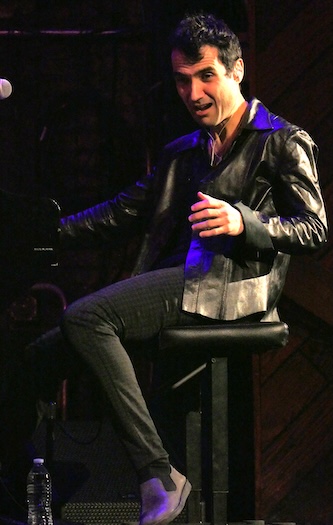
Tigran Hamasyan at Berklee. Photo: Paul Robicheau
Armenian folk, prog metal, and jazz fusion seem like an unusual mix of primary building blocks. But that’s what you get with pianist/composer Tigran Hamasyan, whose band brought his knotty architecture to life at the Berklee Performance Center on Saturday, a concert presented by Global Arts Live.
Hamasyan constructs music that’s alternately dark and delicate, dense and spacious, and wrapped in tightly wound grooves. It’s largely stark and serious fare, though the night began with a frisky fake-out. As band members walked onstage, their sound engineer sat down at the Yamaha grand to unspool a few lines before Hamasyan emerged in a leather jacket to playfully shoo him away and take over.
The 85-minute set showcased several pieces from the Armenian-born pianist’s new album Manifeste, and that dictated the concert’s jazz/rock side. In the opening title track, he stacked jagged blocks of heavy chords broken by twinkling asides and sang a wordless melody that echoed Yessai Karapetian’s synth voicings.
Karapetian blew a wooden Armenian flute (blul) to slip into “Ultradance,” before that number kicked in with Hamasyan’s dizzying circular sprays of notes evoking prog-rock icon Keith Emerson. Drummer Arman Mnatsakanyan topped his pulsing bass drum with precise punctuations in lurching syncopations with Hamasyan, a cat-and-mouse game that continued through the night. Seasoned Berklee graduate Evan Marien (the quartet’s sole non-Armenian member) provided the fulcrum on his five-string bass, shifting from weighty ballast to guitaristic breaks.
Hamasyan dipped the dynamics to greet “Yerevan Sunrise,” supplying child-like filigrees over an atmospheric wash of synthesizer. Yet, even in that song, the pianist surged into his favorite gambit, working the light upper keys of the keyboard only to whip both hands to rumbling low notes at the other end.
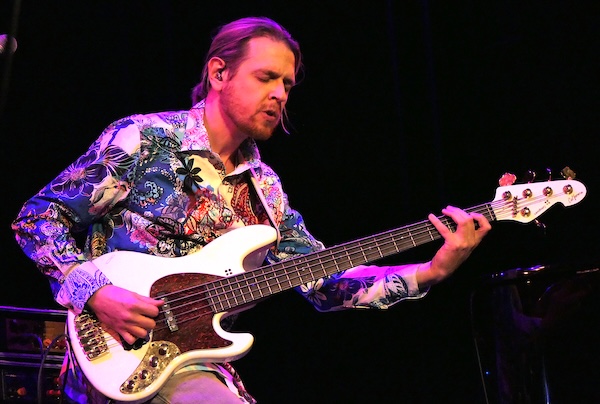
Evan Marien at Berklee. Photo Paul Robicheau
Everything loosened up nonetheless in a spectacular “War Time Poem,” which became the concert’s 20-minute centerpiece. Rounds of deep chords cut to Hamasyan’s mournful humming over pensive piano before the rhythm section completed a jazz trio for an intense improvised stretch. Hamasyan built eddies of tonal clusters, excitedly bouncing off his bench as he played, before the explosive excursion briefly resolved into fragile piano iced by Karapetian’s synth and end-blown flute.
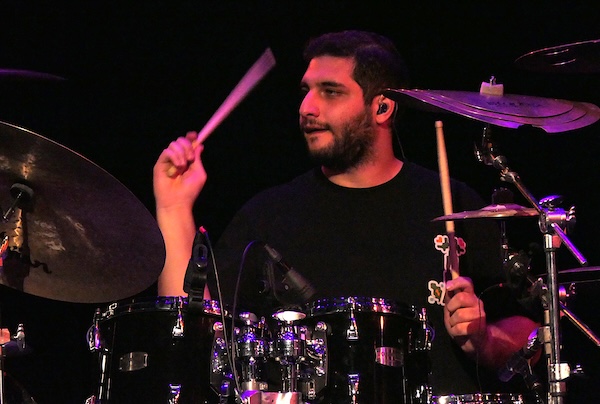
Arman Mnatsakanyan at Berklee. Photo: Paul Robicheau
Hamasyan offered one more trick in the home stretch with “One Body, One Blood,” manipulating the sound of low notes by reaching into his piano with his left hand to muffle the strings. Karapetian countered with similar timbres on synth in sync with Hamasyan’s piano in “Dardahan” (where vocal flights recalled late 1980s Pat Metheny Group), framed around a Mnatsakanyan drum solo.
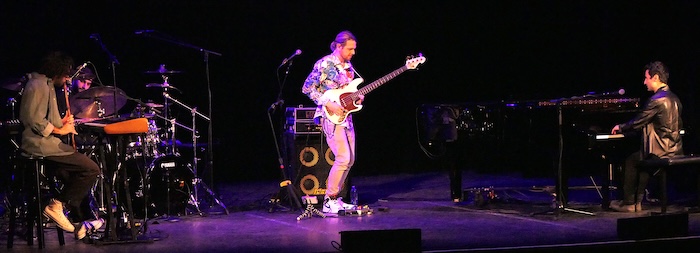
Tigran Hamasyan and his band at Berklee. Photo: Paul Robicheau
But, virtuosic flair aside, by the set’s closer, “The Digital Leviathan” (with its brisk interplay and crashing resolutions suggestive of a whale’s lumbering hulk), the music began to sound like variations on similar patterns. An encore of “National Repentance Anthem” — as a somber piano duet by Hamasyan and Karapetian on their respective acoustic and electronic keyboards — helped provide some relief to an evening where music steeped in Armenian culture was often outweighed by the acrobatic complexities of prog rock and jazz fusion.
Paul Robicheau served more than 20 years as contributing editor for music at the Improper Bostonian in addition to writing and photography for The Boston Globe, Rolling Stone, and many other publications. He was also the founding arts editor of Boston Metro.
Tagged: Arman Mnatsakanyan, Armenian folk, Global Arts Live, jazz fusion, prog metal