
Book Review: Toxic Completism — Rescuing Jazz from the Algorithm in “Listening to Prestige”
By Jon Garelick
Listening to Prestige can be read as a kind of postliterate anti-Spotify. And, lo and behold, it’s true jazz history.
Listening to Prestige: Chronicling Its Classic Jazz Recordings, 1949-1972, by Tad Richards, Excelsior Editions/SUNY Press, 266 pages, $24.95 (paper).
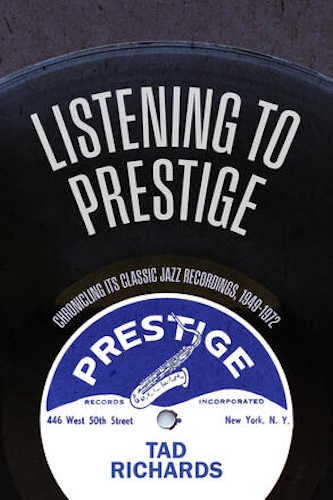 On the face of it, Listening to Prestige is the kind of jazz book I would avoid. The subtitle, “Chronicling Its Classic Jazz Recordings, 1949-1972,” suggests history as discography. Personnel, dates, and lists of recording sessions are readily available in liner notes and on Wiki. Why would I want to read a whole book full? It’s the kind of data dump that also makes me leery of musical biographies and memoirs as well — dates and tour itineraries, with maybe a spare anecdote along the way. It’s not the too-muchness that turns me off (I happen to be a fan of Leon Edel’s five-volume biography of Henry James) — it’s the whatness. Names and dates and endless paragraphs of musical detritus devoid of meaningful context or engaging narrative, not to mention literary flair. It’s the kind of music-fan obsessiveness that fuels a lot of record collecting — especially these days in the hunt for “rare vinyl.” In jazz, it’s exemplified by the kind of person who collects early Blue Note recordings not by artist, or even year, but by catalogue number. (I did once meet such a person.) As a friend of mine who took issue with this practice said at the time, “I don’t collect records. I collect the music on them.”
But these days, most often, all that’s left is the music — the pure media of the algorithm. Sounds come out of the air and we track them by Shazam. If we’re lucky, we catch the name of the artist and the title of the tune — forget where or when or even who wrote the tune, if there is indeed a writer and not an AI phantom. It’s music divorced from the context of history or anything else.
So there’s a bit more urgency these days for a book like Listening to Prestige. Tad Richards is the man for the job. As he points out, in his preface, he was a ’50s-era jazz and pop music obsessive who “knew all the flip sides” on hit 45s. He and a collector friend liked to challenge each other “to list, from memory, all the jazz artists who recorded for Capitol or EmArcy, or all the musicians who were still alive who had played with Bird.” When Spotify came along, he debated getting a subscription because it gave you access to “an unheard-of catalog of great and obscure jazz records.” Except for the catch: “[T]hey didn’t give the personnel on each cut.”
So even though the above might make me want to avoid a long train ride with Richards, such obsessiveness can be useful. Listening to Prestige can be read as a kind of postliterate anti-Spotify. And, lo and behold, it’s true jazz history. There’s no question that Prestige is worth the ink. One of the reasons Richards cites for digging into the label is that, of the two big-deal independent jazz labels based in his hometown of New York, Blue Note — which is still going strong — has already been documented extensively. Not so, Prestige. Prestige was also the home of the first three jazz albums Richards bought (by John Coltrane, Mose Allison, and King Pleasure with Annie Ross). He began a blog in 2014, “Listening to Prestige,” that continues (the latest entry, from January 28, focuses on Carmel Jones). And that led to this book.
No question Prestige was at the white-hot center of the ’50s New York jazz scene. Label founder Bob Weinstock, another jazz obsessive, started by trading and selling discs out of his parents’ West Side apartment. That led to a record store in the Time Square area, which became a favorite hang for musicians gigging at the nearby Metropole Café. Hence, the record label, born as New Jazz Record Company.
There’s a lot of overlap between the Blue Note and Prestige musicians as well as the use of legendary pioneering jazz recording engineer Rudy Van Gelder and, later, cover designer Reid Miles. (For more on Prestige’s cover designs, see my Arts Fuse review of WAIL: The Visual Language of Prestige Records.) Still later, R&B label Atlantic would move into jazz with some of the same artists.
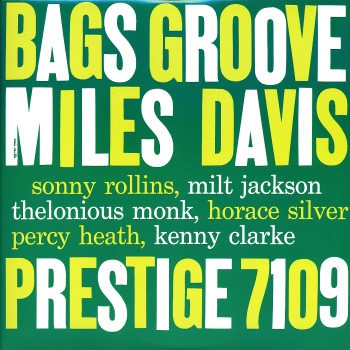
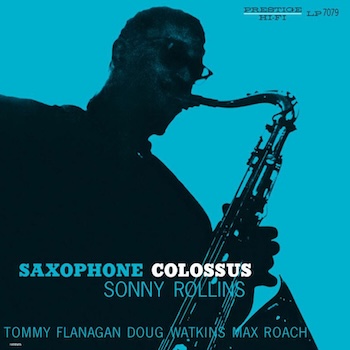 But the number of essential artists recording for Prestige throughout the ’50s was staggering. The Big Four of post-bop modern jazz — Coltrane, Miles Davis, Thelonious Monk, and Sonny Rollins — were recording some of their most formative music for the label. The now-classic titles from the era include Walkin’ (Miles, ’57), Saxophone Colossus (Rollins, ’57), Soultrane (Coltrane, ’58), and any number of collaborations featuring Monk, including the Bags’ Groove and Miles Davis and the Modern Jazz Giants session (’57 and ’59). The names go on and on: Stan Getz, Gerry Mulligan, Coleman Hawkins, Gene Ammons, Red Garland, Milt Jackson, and the first album under the name of the Modern Jazz Quartet, featuring Jackson, with John Lewis’s indelible title track, Django (1956). And that’s just scratching the surface of the ’50s roster.
What did I say about discographies? You get the idea. As a curtain raiser to Richards’s sessionography is the first disc on Weinstock’s new label, led by a blind pianist named Lennie Tristano, someone whose reputation “was at its zenith among musicians” in 1949, as Richards recounts, but zilch with the general “record-buying, radio-listening public.” The record — which paired Tristano with Lee Konitz, who had recommended him to Weinstock — became a minor smash, and the label was off.
When Richards gets into the nitty-gritty of individual sessions, there’s some well-trod ground, such as the famous grousing between Miles and Monk at that Bags’ Groove/Jazz Giants session, and discussion of who was most smacked out at which session. (Prestige got a bad rep as “the junkie label” due its practice of paying, however cheaply, in cash and immediately.) And there is an extensive, chapter-long recounting of Miles Davis’s “Contractual Marathon” of May and October 1956, the purpose of which was to fulfill Miles’s contract with Prestige before he moved on to his new agreement with major label Columbia. It produced Cookin’, Workin’, and Steamin’, the troika of the Davis classic “First Quintet” albums, with Coltrane, Garland, Paul Chambers, and Philly Joe Jones.
I’m not sure how much will be new to jazzheads who are well read in Milesiana (including Miles: The Autobiography), but Richards has synthesized the information well.
 The book also has a value common to most well-researched histories: debunking conventional wisdom. Certainly the reverence afforded albums like Saxophone Colossus and Soultrane tend to give the impression that their respective geniuses were delivered fully formed (and widely acclaimed) from the head of Zeus. But it helps to go back in time and to see present-at-the-Creation chroniclers like Nat Hentoff and Ira Gitler disagreeing sharply over the development of someone like Rollins. Hentoff had been critical of Rollins’s recorded work with Art Farmer and called his contributions to the Miles Bags’ Groove sessions “no particular asset,” including Rollins’s compositions, which Hentoff found not “exactly memorable.” Those forgettable tunes were “Airegin,” “Doxy,” and “Oleo,” all now standard jazz repertoire, with hundreds of recordings. Gitler — then Prestige’s in-house liner-note writer as well as producer — shot back at critics who were “a bit slow” to appreciate greatness, followed by yet another riposte from Hentoff. (Hentoff later joined Team Sonny.)
As the book moves along, Richards’s analysis grows deeper while remaining plainspoken and unpretentious. He’s a jazz fan talking to other jazz fans. And his idiosyncratic takes on shifts in the history of the music offer pleasing headscratchers. After initial resistance, he became a fan of organ jazz — a core element of the Prestige discography throughout its existence, from Brother Jack McDuff to Richard “Groove” Holmes and Larry Young. (Originally, Richards associated organ with “the sound of church and roller rink and radio soap operas.”) The bluesy, greasy grooves of jazz organ bleed into “soul jazz.” For Richards’s money, jazz and R&B are indistinguishable. His disquisition on tenor saxophonist Willis “Gator” Jackson’s recordings with McDuff leads him to conclude, “The main difference between jazz and rhythm and blues is basically the difference between the jukebox and the jazz radio broadcast, between the 45 rpm record and the LP.” Really? But Richards puts his finger on the music-crit third rail of genre classification, and how terms like “R&B” and even “jazz” are more commercial than musical. And his comment is probably going to send me back to saxophonist Ike Quebec’s The Complete Blue Note 45 Sessions and one of Sun Ra’s “Singles” collections. After all, wasn’t Ray Charles originally a jazz instrumentalist?
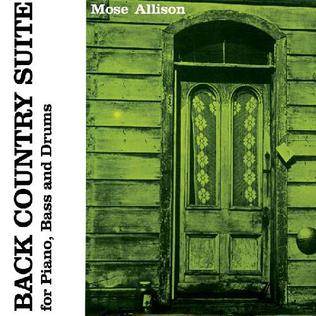
Elsewhere Richards takes a close look at Mose Allison as a sui generis outlier. “Back Country Suite (1957) bears about the same relationship to the hard bop of its era that, just over a decade later, the Band’s first album was to have to the rock of its era.” Like Music from Big Pink, its “down-home simplicity was balanced by a sophistication of a different order from Allison’s contemporaries.” Richards sees in it “a picture of the Delta of [Allison’s] boyhood and youth with melodies that are direct, recognizable, and bluesy but with subtle overtones of Flannery O’Connor or Harper Lee — bringing together the somehow not contradictory sides of Mose Allison — the country boy from Tippo, Mississippi, and the literature and philosophy major from LSU.” Remarkably, this is before Allison became known as a vocalist. The suite includes only two vocals, one of which, the 1:36 “Blues,” later became known as “Young Man Blues,” covered by the Who. The album’s full title was Back Country Suite for Piano, Bass, and Drums.
 Richards also offers insightful commentary on the many jazz tributaries that issued from Miles’s Birth of the Cool sessions (recorded for Capitol) and its varied personnel, including Konitz, Mulligan, John Lewis, J.J. Johnson, and Max Roach. There’s a whole lot more: ’60s recordings by Yusef Lateef, Eric Dolphy, Booker Ervin, Jaki Byard, and Rahsaan Roland Kirk. There’s Dorothy Ashby and Shirley Scott, Booker Little and Freddie Hubbard, and, yes, Moondog. In all of these pieces we hear about how the music was received as it was happening, in real time, and the full musical-historical context, with Dolphy’s Out There as a kind of alternative to the more out there Ornette Coleman.
The book isn’t perfect. I wish the sidebars on specific recording sessions (drawn from Richards’s blog) were clearer about what album titles issued from them. (I’d love to hunt down the Farmer session with Rollins.) The index is a bit spotty (Moondog isn’t even in it, nor the many writers, like Gitler, Hentoff, and Martin Williams, who are mentioned in the text.) And the sidebars are also marred by frequent typographical anomalies, like random boldface fonts. It’s not the kind of reader-discouraging mess you’d expect to see in a book published by a university press.
That said, I did find Listening to Prestige engrossing, pretty much beginning to end, as I checked off titles or sessions (like the Farmer/Rollins) that I want to hunt down. And like the poor souls implied as fellow readers of books like this, I find that I do occasionally succumb to the obsessiveness of the collector (sometimes a euphemism for “hoarder”). I want to hear the music as it was issued, not on the broken-up compilations that have come down to us through the popular budget “twofers” of the vinyl era or umpteen CD boxes or, God forbid, the almighty algorithm. So I find myself rereading Brett Milano’s Vinyl Junkies or ordering, in some caffeine fueled euphoria of commodity fetishism, Miles Davis: The Complete Prestige 10-Inch LP Collection. Like someone who’s spent a too-long train ride with Tad Richards, or a victim of toxic completism, I want the records as much as the music that’s on them.
Jon Garelick is a retired staff member staff member of the Boston Globe opinion pages and a former arts editor at the Boston Phoenix. He can be reached at [email protected].
1 Comment
Leave a Comment

Hey, if you took a long train ride with me, I can talk about baseball too.