Film Review: “Late Fame” — The Art of the Second Act
By David Stewart
Director Kent Jones explores aging, ego, and New York’s literary ghosts in a wry, performance-driven drama led by Willem Dafoe.
Late Fame, directed by Kent Jones
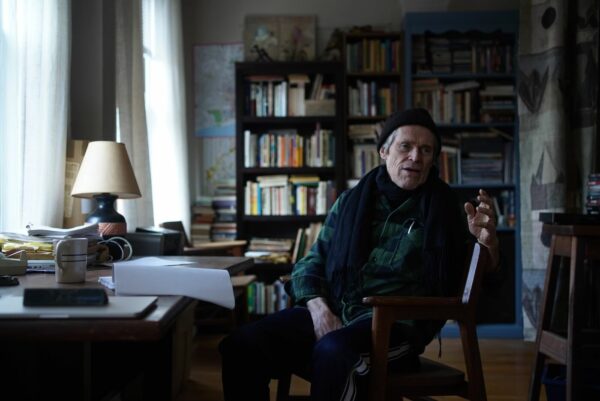
Willem Dafoe in a scene from Late Fame. Photo: IFFBoston
Does creativity remain fertile as one reaches the end of their life? From In a Lonely Place (1950) to The Wonder Boys (2000), a number of films have probed the internal insecurities of the world-weary, burnt-out writer. Directed by respected film critic, former NYFF programmer, and documentarian Kent Jones, Late Fame is a cerebrally warm but satirically stark exploration of the theme, focusing on how the influence of celebrity can upend creativity. Inspired by Arthur Schnitzler’s posthumously titular novella, screenwriter Samy Burch (May December) deliberately discards the dour setting of Schnitzler’s 1920s Vienna for the livelier atmosphere of New York City’s modern-day Lower East Side.
Willem Dafoe plays Ed Saxberger, a postal worker and once-published poet who hasn’t written anything in nearly four decades. His daily grind is comfortably monotonous until Meyers (Edmund Donovan), a young overenthusiastic fan of his, shows up outside his apartment. After persistent wheedling, Meyers introduces Ed to a café salon of various writers who dream of their big break. In reality, the group is made up of pretentious rich boys who haven’t the slightest idea what artists of Ed’s generation went through to be published. Meyers and his wealthy cohorts sit on the far end of the café, away from the social media influencers, as they profess hypocritical Luddite-based principles while taking calls on their cell phones. But these coffee sessions fuel Ed’s once-depleted ego and rekindle his affection for Gloria (Greta Lee), an actress and chanteuse struggling to make her mark. Ed finds himself cajoled by Meyers into writing new material and a memoir as part of a campaign to revive his career by making him the keynote speaker at a public reading. Panic sets in: Ed’s days are spent looking at a blank page as he listens to audiotapes of the poets of his generation, such as Anne Waldman and William Carlos Williams, attempting to foil his writer’s block.
Late Fame is Jones’ reverential (and earnest) love letter to creativity and New York City. The director grew up in the Berkshires before moving to NYC in the ’80s to work on Martin Scorsese’s documentaries. His lens affectionately embraces the eccentric characters in Burch’s script, the remnants of the city’s bygone literary era. His quasi-verité approach to filming the salons hums with a verve reminiscent of Jim Jarmusch’s Stranger Than Paradise (1984) as well as John Cassavetes’ Shadows (1959) and Opening Night (1977). As in Jones’ first narrative feature, Diane (2018), the director finds a transcendent resonance in Ed’s life of self-induced loneliness. He hides his cell phone — only to end up hearing voicemails from his estranged family as he toils in the service of adoring strangers. Meanwhile, Ed has to deal with his social life, his blue-collar postal worker buddies putting down his literary dreams in a dive bar worthy of a visit from Charles Bukowski.
Dafoe is a consistently engaging actor. His composed presence here is not unlike Jack Nicholson’s David Staebler in Bob Rafelson’s The King of Marvin Gardens (1972). He is reluctant to go along with the insane plans of those around him; we know this because we hear him reflect on his plight during nightly walks around the city. Dafoe started his career in the late ’70s as a member of the experimental theatre company the Wooster Group, and his reenactment of Ed’s spirited youthful performances evokes an edgy energy. Greta Lee taps into Sally Bowles–styled stamina; she lights up Ed’s life, serenading him as she sings Kurt Weill numbers in a downtown cabaret. (The film that inspired Jones to become a critic and director was Bob Fosse’s Cabaret (1972).) Edmund Donovan’s hyperactive performance as Meyers lampoons those who are oblivious to the barriers posed by class and unable to separate the rewards of creativity from those of instant gratification. Late Fame has its creative limitations: Ed’s past as an alcoholic and Gloria’s psychological conflicts are underexplored. Still, the depth of Dafoe and Lee’s performances makes up for these weaknesses; the pair help amplify the suspense that holds the film’s third act together.
The film’s visuals are a tactile plus. The handheld camerawork of Wyatt Garfield, who shot Jones’ previous film along with Beasts of the Southern Wild (2012), underscores the morbidity of Ed’s isolation and the reverie of his newfound friends. Editor Mike Selemon has cut the snappy wit and pathos in Burch’s script with a sharp eye. Don Fleming’s bluesy guitar score evokes the sounds of John Lurie and other No Wave musicians who were a big part of the downtown New York scene of the late ’70s, when Ed established his career.
In his preface to The Picture of Dorian Gray, Oscar Wilde wrote that “to reveal art and conceal the artist is art’s aim. The critic is he who can translate into another manner or a new material his impression of beautiful things.” Jones, no doubt drawing on his critical sensibility, successfully conveys the complexities of making art, regardless of age, and shares them beautifully in Late Fame.
David Stewart currently teaches at Emerson College, Plymouth State University, and Southern New Hampshire University. His first book, 2025’s There’s No Going Back: The Life and Work of Jonathan Demme, was published by the University of Kentucky Press.