Jazz Concert Reviews: Jamie Baum Quintet and Miguel Zenón Quartet
By Jon Garelick
Reviews of live performances by bands led by flutist and composer Jamie Baum and saxophonist Miguel Zenón.
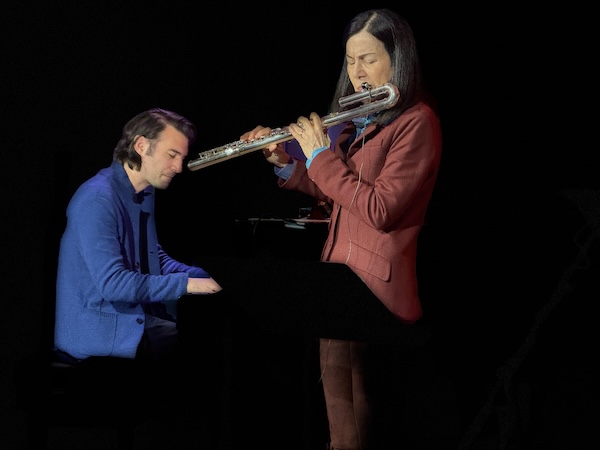
Jamie Baum on alto flute, with pianist Julian Shore at Scullers. Photo: Sue Auclair
When virtuoso players take their time — putting their fancy chops in the service of the greater good of a group enterprise — it can feel like a gift to the listener. But that’s par for the course with the music of Jamie Baum. Baum, a long-ago New England Conservatory student as well as teacher at Berklee, has long been recognized as one of the music’s premier flutists. But it’s her writing that has assured her place in the first rank of essential jazz musicians. When one of her bands is really cooking, it’s hard to tell what’s improvised and what’s written.
That was the case at Scullers on March 7, when New York resident Baum made her first Boston appearance in about a decade (by her estimate), joined by alto saxophonist Jaleel Shaw, pianist Julian Shore, bassist Sam Minaie, and drummer Jeff Hirshfield. This was a scaled down version of her Septet+, whose albums In This Life (2013) and What Times Are These (2024, both on Sunnyside) made my best jazz albums lists for their respective years. The first explored the melodies and rhythms of South Asia (specifically that of Pakistani singer Nusrat Fateh Ali Khan). The latter was Baum’s Covid album, documenting her immersion in poetry during that dark time. Both were examples of sterling ensemble writing: accessible forms, full of rich melodies, but also shot through with tricky meters and unexpected twists and turns, all serving continually unfolding musical narratives. In What Times Are These, Baum also took on the added challenge of setting texts by the likes of Adrienne Rich, Marge Piercy, and Tracy K. Smith.
The quintet format at Scullers necessarily scaled back the expansive orchestration of the Septet +, but it also exposed the structures of Baum’s compositions and arrangements and gave each player room to stretch. Opener “Contrary to the Facts” — with its bright unison line for the horns — shifted its rhythmic pulse in and out of a fast walk, with the players adjusting as one to savor the changes. “Deep Five” started with a slow bass vamp for piano and bass, with Baum on the darker-toned and heftier-bodied alto flute. Here, both Baum and Shaw settled into the relaxed tempo, shifting the texture of their lines with the form. The Beatles’ “With a Little Help from My Friends” was given the twist of a reharmonization that brought a different flavor of melancholy to the original.
The ballad tempo “Song Without Words” (from 2018’s Bridges, another South Asian-inspired work) was one of those elusive forms that gave everyone a chance to shine. Shaw in particular waded into the tune with a hint of Johnny Hodges glissando, interspersing bent notes with upward runs and long-breathed phrases. Baum lavished the dusky lower register of the alto flute in contrasting passages with long-toned high-lying lyrical phrases. Here was one of those places where the solos were so beautifully shaped, it was hard to believe they hadn’t been written.
The long, continuous line seems to be a thing for Baum, of a piece with her sense of narrative. Tunes occasionally segued without pause, the transitions guided by a bass or piano solo. Minaie’s bass was in the pocket all night, laying out or marking a chord or cadence with one perfectly placed note or driving along with Shore and Hirshfield into the next underlying rhythmic twist. (He also played a bravura solo during one of those transitions.) Shore uncorked one surprise after another, unexpected moments of frenzy in the treble clef or a beautiful extended line that seemed to come out of nowhere — or maybe he was just under the spell of the enchanted forest of those tunes. The veteran Hirshfield was just as tactful, allowing a simple cymbal hit or splash to do a lot of work.
Most of the night’s music floated along in relaxed tempos, but in the closing medley of two pieces by Geri Allen (“LWB’s House” and “Skin”), the band let it rip, especially on the latter, with its fast-riffing phrases and rhythmic hurdles.
Let’s hope Boston audiences don’t have to wait another decade to hear Baum and one of her bands in concert again.
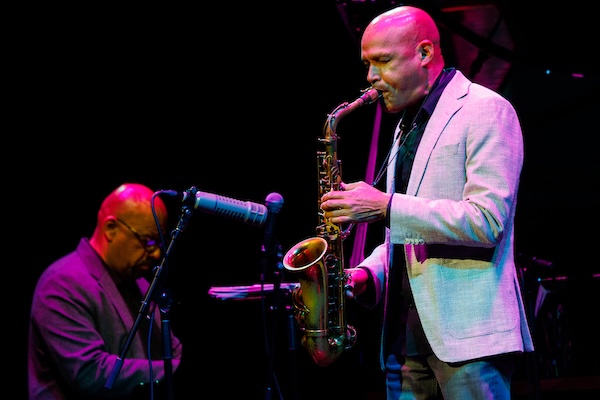
Pianist Luis Perdomo and saxophonist Miguel Zenón at Arrow Street Arts. Photo: Robert Torres
I was surprised not to be knocked out by the Miguel Zenón Quartet at Arrow Street Arts on March 5, the first of two sets by the band that night in Vivo Performing Arts’ “Jazz Festival 2026.” Zenón, 49, has been a star — and an important ingredient in the jazzosphere — almost since the get-go, racking up multiple Grammy nominations (including one win, for 2023’s El Arte del Bolero, Vol. 2), topping various polls as an alto saxophonist, and producing albums that regularly show up on critics’ year-end lists, including mine. Oh, and he’s received fellowships from both the Guggenheim and MacArthur foundations (the latter’s coveted “genius” grant).
So what was not to like? The band was top-notch: pianist Luis Perdomo and drummer Henry Cole have been with the quartet for years, and the more recent addition, bassist Matt Penman, has a long résumé that includes work with Zenón in the SFJazz Collective.
Zenón started the roughly hour-long performance a cappella — his golden-toned alto slipping and sliding before landing on a repeated motive that led the band into “Abre Cuto Güiri Mambo,” Zenón’s tribute to Cuban mambo progenitor Arsenio Rodriguez, taken at a super-fast tempo before settling into a rolling 6/8. Good to go.
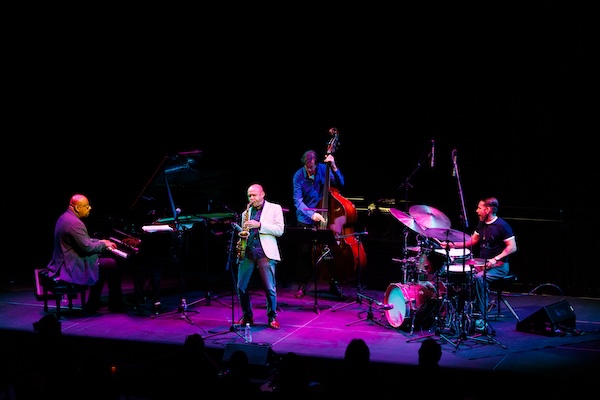
The Miguel Zenón Quartet at Arrow Street Arts. Photo: Robert Torres
Salsa was a touchstone of the evening, showing up in pieces associated with Willie Colón and Héctor Lavoe, Ismael Rivera, Jorge Luis Piloto, and Gilberto Santa Rosa. But even with the underlying grooves, much of the music never took off for me. Listening to Zenón’s game interpretation of “El Día de Mi Suerte,” it wasn’t hard to imagine Colón and Lavoe’s hit, with its blaring trombone front line, arsenal of percussion, and declamatory vocal call and response. Despite the band’s commitment, this was nonetheless a concert-jazz arrangement — dance music with the dance taken out. Its subdued coda even had an elegiac cast — suggesting Zenón’s memory of this music from his days as a high school student playing in salsa bands and listening with his friends to Colón and Lavoe records.
And there were some wonderful moments — especially in the juxtaposition of lyrical delicacy and impassioned fire in Zenón’s playing, as in his original “Vita,” dedicated to his grandmother. Perdomo was particularly eloquent in his solo on “Colobó” (from Zenón’s album of Rivera’s music), with short repeated percussive phrases generating long arcing lines. A lot of this music is on the band’s very fine album from last year, Vanguardia Subterránea (on Zenón’s Miel Music, recorded live at the Village Vanguard), which included several more of Zenón’s originals, with their twisty interpolations of Puerto Rican rhythms (he’s been playing all manner of the island’s music since Bad Bunny — whom he admires — was in short pants).
It’s still a mystery why I didn’t feel more strongly about the set as a whole. Maybe the dry acoustics of Arrow Street threw a blanket on some of the band’s luster. Who knows? Sorry I couldn’t hang around for that second set.
Jon Garelick is a retired staff member of the Boston Globe opinion pages and a former arts editor at the Boston Phoenix. He can be reached at [email protected].
Tagged: Jaleel Shaw, Jamie Baum, Jamie Baum Quintet, Jeff Hirshfield, Julian Shore, Luis Perdomo, Miguel Zenon Quartet