
Book Review: Richard Hell’s “Godlike” — Punk Passion and the Gospel of Damnation
By Michael Londra
Richard Hell is the only New York artist of the past 50 years to give Lou Reed and Patti Smith a run for their money.
Godlike by Richard Hell. NYRB Classics, 168 pp, $15.95
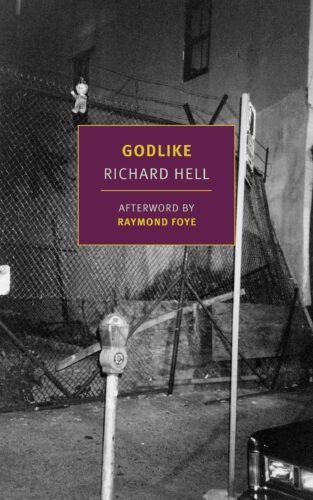 Today everybody’s horny for Rimbaud. Synonymous with rebellion and brilliant writing, the notorious French wordsmith who quit the poetry racket at age 20 is now respected the world over as the definitive bad boy literary genius. It wasn’t always like that. Only after Delmore Schwartz translated A Season in Hell into English in 1939 did Symbolist prodigy Arthur Rimbaud (1854-1891) graduate from obscurity to eventual canonization. Critics at the time, however, despised Schwartz’s hallucinogenic interpretation. The volume went out of print. Subsequent translations soon found champions — fanboys Bob Dylan and Jim Morrison were among those leading the charge. Rimbaud’s pop culture takeover was finally realized when Patti Smith performed her legendary 1974 “Rock N Rimbaud” concerts, confirming his status as the patron saint of downtown Manhattan’s burgeoning punk movement.
Richard Hell’s second novel Godlike revisits a libertine period in New York City’s bohemian past. Ostensibly retelling the disastrous romance between Rimbaud and fellow poète maudit Paul Verlaine — imbuing 19th‑century events with a sexy mid‑’70s vibe — Godlike instead reads like a heretical rewrite of A Season in Hell. Rimbaud considered his book‑length memoir‑in‑verse, partly based on his liaison with Verlaine, to be an ecstatic “diary of the damned.” Embracing a similar anarchic mindset, Godlike unfolds as a fractured, time‑shifting narrative authored from dueling points of view. Alternating between close third‑person omniscience and introspective first‑person description, Hell sprinkles in letters, poems, journal entries, and essay fragments. Superficially experimental, Godlike conjures a noir momentum reminiscent of the fiction of Dorothy B. Hughes or Jean‑Patrick Manchette, Hell’s list‑mates at NYRB Classics.
Meeting cute at scuzzy Lower East Side dive bar Raw’s Drink, “a debris of battered tables and cluttered walls,” established 20-something poet Paul Vaughn encounters 17-year-old Randall Terence Wode. The newbie passes around “hand-copied examples of a new poem” as he outrageously announces to folks in the audience that “they should suck his cock for $20.” Vaughn is smitten. He watches spellbound as Wode trashes an esteemed elder poet: “I read your latest book and all I can say is that your only virtue is its own punishment.” Another writer is denounced for ruining “frivolity for a generation.” It’s lust at first sight. Vaughn begs Wode (whom he calls T.) to leave with him. Later at Vaughn’s apartment — shared with his pregnant wife, who departs once T. vomits on the floor —the poets have sex: “in the morning the sun found them out on the floor of the little parlor entangled and gritty … [their] bodies God’s idle graffito.”
For a time, Vaughn and T. are happy wandering the city as indigents, absorbing reality as it unfolds. Godlike overflows with the pair’s polished aphorisms on aging, memory, creativity, sex, and mortality. A few examples: “To kiss is to share the world most completely”; “The odor of the room was like vaporized headache”; “How close is the imagination to philosophy? Close enough: even reality is not like reality. That’s why poetry beats philosophy”; “Acid in his pocket. It made him feel like he’d just come into an inheritance.” Given its admiration for anti-academic poetry, it is not surprising that Godlike thrums with shout-outs to bygone counterculture heroes: R. Crumb, Rene Ricard, James Schuyler. St. Mark’s Poetry Project luminary Ted Berrigan stands out in a scene-stealing cameo.
Godlike is also an O.G. Bowery Baedeker. Readers are given a nostalgic tour of now-shuttered Gotham landmarks: egg cream mecca Gem Spa; tobacconist Village Cigars; and the venue Max’s Kansas City, where The Velvet Underground served as house band. Our protagonists, martyrs to self-sabotage, drum up unhinged incidents wherever they go. Inside Max’s, for example, “scumbag” T. pisses in a champagne glass, tossing it in someone’s face. Vaughn excuses T.’s behavior: “to give offense was his mission, his meaning.”
Notably, Godlike reverses the standard mentor-protégé dynamic. T. is the dom in this S&M kink-fest, which includes bringing in women for threesomes. Vaughn, the “subservient older wiseguy of a sidekick,” pays a high price for his sybaritic education. In it for the booze and LSD, T. “loses interest” once the moolah evaporates: “the worst thing was … him talking to me as if I was a fool.” In a jealous rage, Vaughn fires a pistol, barely grazing his tormentor. A divorced Vaughn goes up the river for 18 months — he never sees T. again.
Until decades later. Vaughn is hospitalized in 1997 for psychiatric observation. After scribbling the story we just read — “I may be in the looney bin but I am not an unreliable narrator” — Vaughn discovers T. is dead. Much like Delmore Schwartz, whose body went unclaimed after he died of a heart attack, T. is abandoned in the morgue of the same hospital where Vaughn is receiving treatment. He bids adieu to the love of his life: “The corpse, eyes closed, looked very brave.”
Hell is the only New York artist of the past 50 years to give Lou Reed and Patti Smith a run for their money. While each transcended the rock idiom — excelling on the page as well as the stage — neither conquered the novel. In fact, Reed failed to launch himself as a poet after resigning from The Velvet Underground, unlike Hell. Progenitor of punk’s aesthetic, Hell shook the world with his ripped up, safety-pinned shirts and spiked hair, and composed punk’s international anthem, “Blank Generation.” Doing what Reed never could, Hell is Rimbaud’s true heir — he penned the novel Go Now (1996), the autobiography I Dreamed I Was a Very Clean Tramp (2013), Massive Pissed Love: Nonfiction 2001–2014 (2015), and the poetry collection What Just Happened (2023), among others.
Godlike is Hell’s best book. Love fucks us up — but who cares. How else are we to touch eternity? “Most of the time we are only a little alive, like a book in an obscure language. But because of those of us who can read us … we are brought to life, and we love them for realizing us.” Despite persuasively envisioning nihilism as an ethical stance, Godlike’s gospel according to Hell ultimately sets the heart against the void. We admire T.’s freedom. But Vaughn speaks for us all: “there are things I know more than he did. I know that love is real.”
Michael Londra — poet, fiction writer, critic — talks New York writers in YouTube indie doc Only the Dead Know Brooklyn (dir. Barbara Glasser, 2022). His poetry has been translated into Chinese by poet-scholar Yongbo Ma. Two of his Asian Review of Books contributions were named among its Highlights of the Year for 2024 and 2025. “Life in a State of Sparkle—The Writings of David Shapiro” from The Arts Fuse was selected for the Best American Poetry blog. “Time is the Fire,” the prologue to his soon-completed Delmore&Lou: A Novel of Delmore Schwartz and Lou Reed appears in DarkWinter Literary Magazine. He can also be found in Restless Messengers, The Fortnightly Review, Cha: An Asian Literary Journal, spoKe, and The Blue Mountain Review, among others. Born in New York City, he lives in Manhattan.
1 Comment
Leave a Comment
Rimbaud may not have been much in favor in academia, but he was already a hero in the 1940’s for the cohort that would become tagged (or mis-tagged) as the “Beats;” the roots of later “underground” waves.