
Book Review: Saints, Oysters, and the Weight of Melancholy in Nancy Lemann’s New Orleans
By Matt Hanson
I was surprised by how smoothly each book went down, with a little tingle of acidic satire lingering on the palate.
The Lives of the Saints (208 pages, $16.95) and The Oyster Diaries (240 pages, $17.95) by Nancy Lemann. New York Review Books
The Ritz of the Bayou by Nancy Lemann. Hub City Press, 184 pages, $24.
 Whatever other fantasies they might have, any humble scribbler’s greatest dream must be to see their work rediscovered. Who wouldn’t long to see their work reprinted in handsome new editions from esteemed publishing houses with admiring introductions? Nancy Lemann (pronounced “lemon”) is enjoying such a renaissance. Her debut novel, 1985’s The Lives of the Saints, and her new novel, The Oyster Diaries, have both been republished in NYRB editions (the literary version of a movie entering The Criterion Collection), while 1987’s The Ritz of the Bayou, a novella-length piece of long-form journalism, is being republished by Hub City Press. Lemann is a born and raised New Orleanian who has since lived all over the country—New York City, California, and currently in Maryland—but, a little like Joyce’s relationship to Dublin, Lemann’s mind is never far from the eccentricities of the crescent city.
Some people refer to New Orleans, where I have happily lived for years, as “The Big Easy,” but this is a goofy tourist cliché. Despite the admittedly slow pace of life in the heavy heat, centuries of tragic history, routine top-down corruption, violent crime, economic inequality, and manic weather patterns have made living in New Orleans anything but easy. Lemann’s bona fides as a knowing local are unimpeachable. Still, after reading these three books (roughly half her total published work), a misbalance is hard to miss: the humid, gloomy, acute sense of the city’s moral and social lethargy is almost all-pervasive, overshadowing the place’s joie de vivre.
The Lives of the Saints is a gently comic novel about life amid Nola’s “wastrel youth contingent.” It establishes a distinctly Lemann mood. Her prose drifts like a hazy summer breeze: the pages pass easily and quickly. This is a writer whose attitude to narrative structure is, “I guess I’ll have to go back and put in some plot.” I was surprised by how smoothly each book went down, with a little tingle of acidic satire lingering on the palate. You can tell the plots are lightly fictionalized; there’s an intimacy with an accumulation of eccentric, privileged, charmingly louche people which must have come from firsthand experience. The Collier family lives in “violently pretty” Uptown splendor in a grand old house which has been in the family for generations. They don’t seem to do anything other than drink, talk about drinking, have lunch in the back rooms of glittering restaurants, and practice odd hobbies.
Mr. Collier’s seersucker suits are “always wrinkled and looked as though they had come from someone else’s closet in a prep school in 1920.” He amiably putters around his overgrown garden all day, with a radio blasting opera arias clipped to his belt, and then repairs to his study to devour ancient Greek and Latin, memorizing Homeric stanzas which are of interest only to him. He’s the kind of man who (everyone is introduced as “the kind of man who…”) lights half a dozen cigars in a row, gives each a studied puff, and then snuffs out all but one and places the rest delicately into the ashtray in his library “because it’s Sunday.” If this sounds a bit daffy, that’s kind of the point: “when you ask him Why, the true eccentric does not know. He does not know why he does it. He just does it.”
Claude is his charismatic son who makes the narrator’s heart “break into a million pieces on the floor.” Kissing him is apparently “like conducting conversations with angels in Heaven,” which seems to be overstating the case. He does come off as attractive, with his boyish good looks and sprezzatura and the readiness to head to the nearest fizzy Uptown party at all hours of the day and night. Claude “did not have one ounce of vanity—the worst of the vices, worse than any of his, in my opinion,” which seems true enough. What Claude does have in abundance is mounting gambling debts, and the cops are onto him for some lucrative mischief, and even he can’t seem to schmooze his way out. We last see him getting a disturbing phone call at a fancy French Quarter restaurant; he methodically shreds pieces of tissue paper, and heads out into the rain. Pulling his collar up Claude tells the distraught narrator that he will work it all out but to remember not to put him on a pedestal. Too late for that.
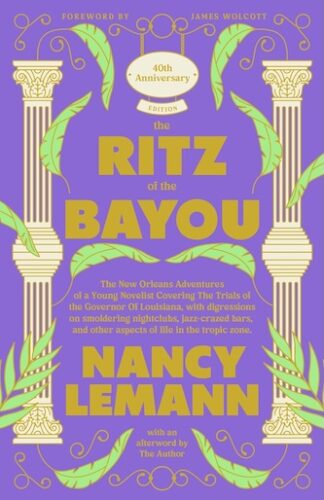
The Ritz of the Bayou, arguably the strongest of the trio, is the full-length version of a 1985 piece commissioned by Vanity Fair to cover the trial of Governor Edwin Edwards for racketeering, bribery, and mail fraud. In his introduction, James Wolcott admiringly describes how irate editor Tina Brown became when she read the draft and saw that there wasn’t any of the usual journalistic imperatives of explaining the who/what/when/where/how/why of events. It takes a certain kind of guts as a writer to trust in one’s own aesthetic instincts that much.
Her account of the seemingly endless trial is all atmosphere, a kind of tone poem of charismatic corruption. It’s all smoke-filled back rooms, the gilded ceilings of the Capitol building, everyone taking long boozy lunches and getting sozzled in the insidious heat. The defense team cracks jokes while dressed to the nines and doesn’t seem a bit worried that Edwards is actually guilty or not. Born of humble origins with a gift of the gab and a saucy energy that people seemed to dig, Edwards might well be guilty, though his goose isn’t cooked quite yet. Lemann puts it like this: “there is a recklessness, a vitality, if fearful and gauche, in this manner of man and it is bred in the South…there is not really a fine line between eccentric and corrupt.” This may be true of the South, but it’s been proven accurate in the years since. As long as he isn’t boring, an ambitious fellow can get away with quite a bit in America. Lemann dryly reminds us that “politics is not the place to look for saints.”
Edwards had at that point won every election he’s ever been in, even once going head-to-head with none other than the vile David Duke, winning that election for lieutenant governor, along the way firing off two hilarious witticisms which tell you a lot about who Edwards was and the world that he thrived in. “The only thing David Duke and I have in common is that we’ve both been a wizard under the sheets,” being the first zinger, and the second can still be seen on bumper stickers on the walls of older cars, imploring people to “vote for the crook; it’s important.” A motto keeps floating in and out of Lemann’s narratives like a recurring motif: the two things a New Orleanian can’t stand are “boredom and a lack of style.” There’s some clear-eyed political realism for you.
I rolled my eyes a little when I first read the line in Saul Bellow’s novel Ravelstein that “anyone who wants to govern the country has to entertain it.” Now it sure seems like a solid-gold truth. The question is, what kind of entertainment? The fact that Edwards was eventually convicted and ended up starring in a short-lived reality show with his fifty-years-younger wife isn’t mentioned in the book, but would have fit in just fine. Lemann’s afterword makes it clear that a rascal like Edwards would run circles around our current mentally and physically plodding President. At least Edwards made his way in the world coming from nowhere, which made “his shenanigans more embarrassing than demonically destructive.”

That’s where The Oyster Diaries, her latest novel, starts to be a bit of a buzzkill. Lemann is something like a Joan Didion of the Crescent City, from her diminutive stature and self‑deprecations to her spare, elegant, acidulous prose: “for even the roots of the oak trees in Audubon Park make strange music to me, of my childhood in a town which is gentle to the bottom of its bones and which is far from peril.”
When her topic is robustly sketchy potentates and gentle eccentrics, it’s fun to peek in on these lubricious wastrels’ lives. When she’s talking about her own personal dread‑filled anhedonia, the narrative loses my interest. I have respect for the melancholy Dane, but quoting Kierkegaard feels out of place in the world she’s created.
There’s a moment when the narrator hears the distinctive clamor of a Mardi Gras parade boogeying down St. Charles Avenue. She knows it’s beautiful, but inexplicably doesn’t go out to join in the fun. Lemann definitely knows more about the city than I ever will, but focusing on hopelessness and anxiety isn’t the right attitude when writing about a city that is dedicated above all to taking pleasure in life. Claude Collier certainly would.
Lemann has been through plenty of Mardi Gras seasons in her time, so I can understand sitting it out to some extent. But why on earth would you not want to put down the Kierkegaard and get out in the streets and start cutting a rug? There will be plenty of “fear and trembling” available when you’re hung over afterwards.
If this city knows anything in its bones, it’s how to counter despair with resilience. Dancing at funerals, living to party, partying to live—it’s all part of the same continuum. Much as Didion has been accused of making California’s hippie side look more ominous than it really was, Lemann misses out on the essential joy of her hometown.
One of her characters neurotically catalogues in his titular ledger his daily intake of oysters, ranging from the succulent to the inedible. It’s not a bad metaphor for life. But if you’d eaten that many bad shellfish, you might want to try something else on the menu. Why miss the oyster for the shell?
Matt Hanson is a contributing editor at The Arts Fuse whose work has also appeared in The American Interest, The Baffler, The Guardian, The Millions, The New Yorker, The Smart Set, and elsewhere. A longtime resident of Boston, he now lives in New Orleans.
Tagged: "The Lives of the Saints", "The Oyster Diaries", "The Ritz of the Bayou"
3 Comments
Leave a Comment

A wonderful piece of writing, Matt, about a discovered and rediscovered New Orleans writer. I am still waiting and hoping that you discover and rediscover Shirley Ann Grau, another NOLA writer of brilliance. THE BLACK PRINCE AND OTHER STORIES is one of the finest short story collections I have ever read. She was a favorite of Flannery O’Connor, as a white writer who could penetrate the African-American mind with knowledge and respect.
Interesting…I was a student at Tulane,and was deeply involved with all the writings, past and present, about that wonderful city, Nobody remembers George Washington Cable, or Lyle Saxon , or Lilian Hellman and Peter Feibleman, or Andrei Codrescu, to select a few at random, any more. Add to the list: the recently published memoir by Nicholas Lemann. The list goes on…
Always appreciated, Gerry. I know you’ve mentioned her a few times now and I promise I have not forgotten, I think the collection is out of print? Someone needs to have the effrontery to try and compile a list of white writers who have gotten Black people right, and I’d like to see who Black writers and critics would choose.