Poetry Review: William Lessard’s “/face” Maps the Human in a Digital Mirror
By Michael Londra
In /face, William Lessard examines how technology fragments identity, transforming our faces into data and design.
/face by William Lessard. Kernpunkt Press, 100 pp, $18.
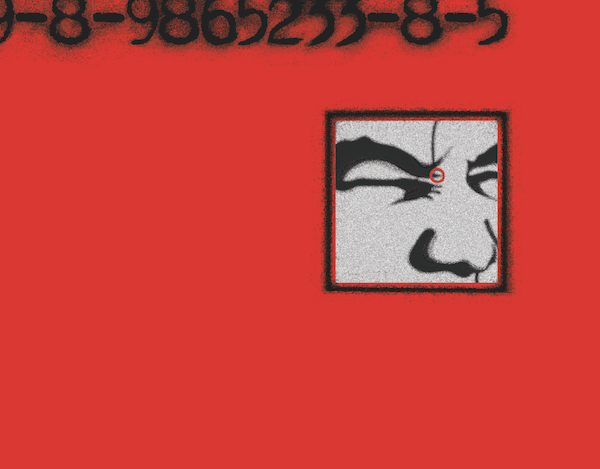
Cover art for William Lessard’s /face
Recently I saw Patti Smith perform her album Horses at the Beacon Theater in Manhattan. Filing in, a sign alerted me to the following: “Attention Customers: biometric identification information, which includes facial recognition collected at this location, is used to protect the safety and security of our patrons and employees.” Suddenly, I had a decision to make. Either allow my face to be scanned or miss out. As usual with me, FOMO won. This was, of course, coercion disguised as choice. What happens when resistance is relinquished because freedom is too inconvenient?
One answer can be found in William Lessard’s debut poetry collection /face. As suggested by the lowercase title preceded by a forward slash—punctuation integral to URL coding for web addresses and HTML formats—Lessard’s style repurposes 21st century accoutrements: redacted documents, social media layouts, and corporate surveillance templates. Eschewing the influence of mainstream literary artists, Lessard prefers subversive creatives like Karel Martens, Don Mee Choi, Marguerite Duras, and Alejandra Pizarnik. In fact, in his dedication, after acknowledging his wife, Lessard states that his volume is also for “readers and poets that know what this century is.”
Predictably, that makes it difficult to convey the full radical nature of this volume. Readers interested in original, risk-taking aesthetic pursuits will not be disappointed. An aggressively hybrid work, /face incorporates decontextualized visual material from Google Patents. Like Robert Rauschenberg digging up junk for his next project, Lessard recycles extracted digital detritus into compelling lyric artifacts. On almost every page, Lessard writes over and around illustrations of a squinting man’s eyes and nose, a fashion influencer applying an eyebrow pencil, as well as assorted charts and columns of numerical metadata. The normal borders between language and graphic design are gleefully elided. For example, nearly every poem’s title is stamped with a four digit code—the same markings that appear in patent records.
/face is split into three parts: “techniques for creating facial animation using a face mesh,” “do we have a plan b,” and “head template.” Over these sections, Lessard riffs on the ways our faces organize meaning into identity. Like “[0313] Kibisis,” inspired by the sack Perseus lugged Medusa’s severed head in. Here the face paralyzes you with the Real: “Medusa teaches us we all have a face—a face beneath our outward visage—capable of killing anyone who gazes upon it.” In this sense, the face is a Halloween mask destabilizing subjectivity: “The face has become a troubled asset” (“[0078] Consensus Trance”); and it is inevitably tied to violence: “the face we brought with us—a fist twisted between knots of skin” (“[0038] Rupture”).
As we age, things become worse: the “face is the person we are disappointed to see…We want the face that greets us to match the face inside” (“[2915] Terrible Faces”). Moreover, advances in technology alter how we regard our faces, offering unanticipated challenges: “The devices of our age have brought new efficiencies to what has breathed for centuries. The mirror was the beveled line. Before it, people were blurred allegories. It was only when they thumbed the imperfections of their faces they realized how joyfully doomed they were” (“November 24, 1922”). The net result: “The face they woke with. / They want to give back” (“[006]”).
For Lessard, therefore, the face has always been a hystericized site of anxiety. But now it’s a “hyperobject,” something that “occupies no place except everyplace…Every time users raise their cell cameras to their nose, they affirm the face as hyperobject…A copy of each photo is dispatched to a machine chilled to the temperature of meat” (“[0031 Hyperobject]”). This may be disturbing, but Big Tech invites us to plug into “augmented reality”—an online animated environment that combines virtual reality with AI—where we can invent our own “face mesh.” Lessard humorously parses the implications: “When designing our mesh, we consider the face’s desire to vacation across the skull of another. For users missing their face while it resides at a different address, a substitute is offered.”

New York City-based writer, visual artist, and editor William Lessard, known for experimental poetry and hybrid forms that critique contemporary technology, capitalism, and empathy in the digital age. Photo: courtesy of the artist
Yet, just as face mesh tech maps and inevitably manipulates the contours of the face, Lessard shows how Andy Warhol did the same with his paintings. “[7213] Digital Marilyn” pays tribute to the eponymous icon of American glamor, elegizing the commodification of her likeness as the harbinger of our current bot-colonized existential crisis: “Once there was a face skimmed from paper. Once there were eyes and nose and mouth pinned to a yawned opening…All these expressions…sold as meat we can never chew…Call the girl you once were and tell her the face you painted over hers is peeling.”
What authenticity is left? Maybe only the fetish. In “[0222] Warhol’s Wig 1986,” Lessard takes the artist’s hairpiece as a remnant of the human, a little piece of truth paradoxically capable of turning mortality inside out, allowing us to reframe our dilemma, and thus escape its clutches: “in late photos, it attained a tropical effulgence / silver fronds blossoming / each pronging a different direction…in his final self-portraits, / we see the face abraded by human weather / exposed / at the surface / it is the face that grows all our lives, / the one that only emerges the closer we get to the skull.”
Smuggled among his typographical inventions are rectangular “Subject Comment” boxes that scan like cloaked first-hand autobiographical experience, like this moving re-telling of a grandmother’s last breath: “My face begins to fail. Each line, a new failure…Like the scoring of claws…The latest is at my lip: March 18, 1992, 1:35 p.m…the day after St. Patrick’s, her favorite holiday…My grandmother’s lips curl the same ocean-blue as her feet, her legs, her hands, her shoulders…The chest grabs all the air it can grab, and when it unclenches—a word, a confection of syllables in a language she waited all her life to speak.”
I still don’t feel comfortable that I had to give up my face to see Patti Smith. But art exacts a price. Will our species survive AI’s cyborg-oriented economy, imposed and ruled over by what I’d call “sick burn fascism”? Unclear, but it is a sure thing that conventionally understood definitions of art and art-making are currently disintegrating. /face is a moody lament for the way things used to be that at the same time “faces forward,” offering escape strategies from the death spiral. Techno-reality is constantly innovating newfangled cages. To combat its false dichotomies, poetry will be forced to relinquish beloved, centuries-old analog forms. In these lines from “[0222] Warhol’s Wig 1986,” Lessard offers flickers of hope. Let’s not give up on each other. Every exit is a homecoming: “in the final silkscreens, / Warhol’s wig bled / in colored wavelength // red, blue / gesture toward departure, / toward arrival.”
Michael Londra—poet, critic, fiction writer—recently introduced the Poets Confront AI and Surveillance Capitalism event at Poets House. He talks New York writers in the YouTube indie doc Only the Dead Know Brooklyn (dir. Barbara Glasser, 2022). His poetry was translated into Chinese by scholar-poet Yongbo Ma. Two of his Asian Review of Books contributions were named Highlights of the Year for 2024 and 2025. “Life in a State of Sparkle—The Writings of David Shapiro” from The Arts Fuse was selected for the Best American Poetry blog. “Time is the Fire,” the prologue to his soon-completed novel of Delmore Schwartz and Lou Reed appears in DarkWinter Literary Magazine. He can also be found or is forthcoming in Lana Turner: A Journal of Poetry & Opinion, Restless Messengers, The Fortnightly Review, spoKe, Cha: An Asian Literary Journal, and The Blue Mountain Review, among others. He added six essays and the introduction to New Studies in Delmore Schwartz, coming next year. Born in New York City, he lives in Manhattan.