
Album Review/Commentary: John Scofield and Dave Holland — “Memories of Home,” and a Scofield Retrospective
By Steve Elman
If it is possible for people to express a deep personal regard for one another through musical collaboration, that is exactly what happens between Scofield and Holland in their upcoming release. Don’t be fooled: this is intimate music, but it remains rich with detail and depth. And it caps a decade in which John Scofield’s body of work reflects his full maturity as an artist.
 I’m a sucker for the duet. One of my first deep musical dives was into the ethereal interplay of Bill Evans and Jim Hall on Undercurrent (United Artists, 1962). Whenever one of my favorite artists engages in this kind of intimate dialogue, I’m there with both ears.
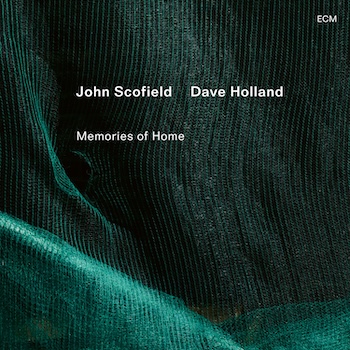
So it was a special pleasure in April 2022 when I was in San Francisco, in the beautiful SFJAZZ Center, intently listening to a recital by guitarist John Scofield and bassist Dave Holland. And now that pleasure has been permanently preserved in a new CD on ECM, recorded in 2024 and due for release on November 21, where Scofield and Holland revisit some of the tunes they played live two years before.
Their pairing in the new record is even better than I remembered.
Memories of Home, which takes its name from one of the Holland originals in this set, has ECM’s usual impeccable attention to detail in the recording, and in this case that care has done a service for the ages. Holland is one of the world’s masters of the bass, with a matchless ear for pitch and timbre, and his sound has rarely been captured so beautifully, even on his own records for ECM. Scofield’s voice on his instrument is well-established by now, recorded in all kinds of contexts, often very well. Here every nuance of his most intimate playing is captured, and he shines.
If it is possible for people to express a deep personal regard for one another through musical collaboration, that is what happens here. I could see when I witnessed the duo in person how much pleasure they took in one another’s playing, but I don’t think it’s my imagination when I say I can hear that in many moments on the new CD.
An example: the duo’s utterly wonderful rescue of a 1992 Scofield tune, “Easy for You,” previously recorded on Scofield’s What We Do (Blue Note, 1992), with Joe Lovano. This is one of Sco’s most attractive lines, with a great sweet-sad feeling in it, emotionally like “Everything Happens to Me” or “It’s Easy to Remember.” The guitarist opens solo, mostly out of tempo, but hinting at a slow swing. Holland enters and immediately establishes a flexible foundation. After they state the melody, Scofield has a short solo, and then Holland goes deep into the heart of the tune with one of his best solos on the disc. Scofield responds with a second solo, sounding inspired by what Holland has just played. The theme recap is short, with a honeyed out-of-tempo solo guitar passage and a few bass notes.
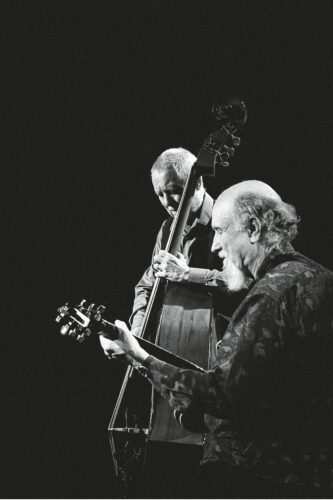
John Scofield and Dave Holland. Photo: Roberto Cifarelli/ECM Records
Like this one, each of the other performances leaves the listener with a feeling of completeness. The tunes are explored in depth (not at length – only with as many notes as are necessary), and each player gets his personal say. After the improvs, when the themes return, it is as if the three of you (Scofield, Holland, and the listener) have been on a lovely excursion to an aesthetic port of call.
All the tunes here, except Sco’s “Mine Are Blues,” which I think dates to the duo’s first work together before the pandemic, are reconsiderations of originals that were first given life in other contexts on previous Scofield and Holland releases. Comparing the duet versions with the first recordings not only provides insight into these new interpretations, but also doubles your pleasure, because each of the first versions is also well worth hearing. (To make this easier for you, I have provided a guide to the originals in “More” below.)
Unlike many duet records, this is a celebration of unity in diversity. Each track has a distinctive character. And yet, common themes emerge.
Three are in triple time (Scofield”s “Meant to Be” and “Memorette”, and Holland’s “Memories of Home”). Two are vintage items from each artist’s catalog (“Meant to Be” from 1991 and Holland’s “You I Love” from 1984).
Two are contrafacts – “You I Love” is obvious, based on Cole Porter’s “I Love You,” but Scofield’s “Icons at the Fair” is a horse of several different colors. As I listened, the changes nagged at me; where had I heard them before? Finally, I gave up and asked Scofield. He obliged with this: “It’s written over Herbie Hancock changes to ‘Scarborough Fair’… the Paul Simon tune [that is, Simon’s interpretation of the traditional English ballad, heard on Simon and Garfunkel: Parsley, Sage. Rosemary and Thyme (Columbia, 1966)] … When I played with Herbie on his album The New Standard [Verve, 1996, with Holland playing bass and Michael Brecker on tenor sax], we did that, and so I wrote another melody to those nice chords.”
As always, Scofield underpromises and over delivers here. He takes a cue from Hancock, and delivers a “player’s tune” – with changes set up for comfortable soloing. Hancock implied modality in his rubato piano introduction in his “Scarborough” recording, but Scofield makes the modality explicit, with an even longer rubato duet at the top, and several modal moments within it. Once Scofield and Holland establish the rhythm, the tune has the same bright tempo as on Hancock’s tune, but the soloing is less extrovert and more penetrating. The duet also hints more strongly at the folk roots; “Scarborough Fair” peeks out from time to time if you know how to listen for it.
And two of the tunes in this album are rethinkings of (sort of) traditional material – “Icons at the Fair” and Holland’s “Memories of Home.” The Holland tune, though unlike nearly anything else on the new disc, nonetheless has a rich resonance that speaks to both musicians’ fondness for traditional country. The original of this one comes from Vassar Clements / John Hartford / Dave Holland (Rounder, 1988), essentially a jazz-grass session. In the duet version, Sco bends his notes a bit more than he usually does, and Holland’s solo has more than a little fond remembrance of Charlie Haden, a country boy to his soul who nevertheless became one of the preeminent bassists of jazz. The result is a sincere expression of pure sentiment. No wonder they decided to make this the title tune.
There is more to point to, of course. Listen to the beautiful groove they get on what is possibly the disc’s best-known tune, Holland’s “Not for Nothin’.” Holland’s tribute to bass icon Ray Brown, “Mr. B.,” is far from the bluesy mainstreamer you might expect; it even hints at the down-homey partnerships of Brown and Herb Ellis or Brown and Barney Kessel. Scofield’s “Meant to Be” is a welcome revisit to one of his loveliest ballads, a multi-dimensional tune that hints at melancholy without going over the edge. And the ingenuity of Scofield’s “Mine Are Blues” belies its punny title.
It will be all too easy for some to listen to this gorgeous recording as merely lovely background music, which to me is a bit sad. Every note of Memories of Home ought to be heard with both ears, and savored.
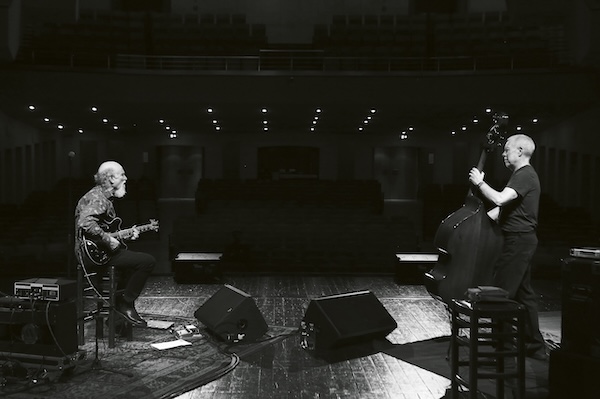
John Scofield and Dave Holland. Photo: Roberto Cifarelli/ECM Records
More:
Source material for Memories of Home:
“Icons at the Fair” (Scofield), as noted above, is based on Herbie Hancock’s arrangement of “Scarborough Fair” from Hancock’s The New Standard (Verve, 1996), with Scofield, Holland, Michael Brecker, ts, and Jack DeJohnette, dm. It was previously recorded on Scofield’s Combo 66 (Verve, 2018) w. Gerald Clayton, kb; Vicente Archer, b; Bill Stewart, dm
“Meant to Be” (Scofield) was previously recorded on Scofield’s Meant to Be (Blue Note, 1991) w. Joe Lovano, ts; Marc Johnson, b; Bill Stewart, dm
“Mine Are Blues” (Scofield) has not been previously recorded.
“Memorette” (Scofield) was previously recorded on Scofield’s This Meets That (Universal / Sco Biz, 2007) w. Bill Frisell, g; Steve Swallow, e-b; Bill Stewart, dm
“Mr. B” (Holland), dedicated to Ray Brown (1926 – 2002), was previously recorded on Holland’s Points of View (ECM, 1998) w. Steve Wilson, as; Robin Eubanks, tb; Steve Nelson, vib; Billy Kilson, dm
“Not for Nothin’” (Holland) was previously recorded on Holland’s Not for Nothin’ (ECM, 2001) w. Chris Potter, as; Robin Eubanks, tb; Steve Nelson, vib; Billy Kilson, dm
“Easy for You” (Scofield) was previously recorded on Scofield’s What We Do (Blue Note, 1992) w. Joe Lovano, ts; Dennis Irwin, b; Bill Stewart, dm
“You I Love” (Holland), based on “I Love You” (Cole Porter), was previously recorded on Holland’s Jumpin’ In (ECM, 1984) w. Kenny Wheeler, tp; Steve Coleman, as; Julian Priester, tb; Steve Elington, dm
“Memories of Home” (Holland) was previously recorded on Vassar Clements / John Hartford / Dave Holland (Rounder, 1988), w. Clements, v; Hartford, bjo; Holland, b
All of the above are hearable on Spotify, Apple Music, YouTube Music, and other streaming sites, with the exception of “Memories of Home,” which has been posted to YouTube as part of the Vassar Clements / John Hartford / Dave Holland album.
Set list, April 2022:
Miner Auditorium, SFJAZZ, San Francisco, 4/15/22, 730 – 9 p.m.
John Scofield, g, elecs
Dave Holland, b
- Memorette (Scofield)
- Icons at the Fair (Scofield)
- Mr. B [for Ray Brown] (Holland)
- unidentified (Scofield)
- Not for Nothin’ (Holland)
- Everything I Love (Cole Porter)
- Homecoming (Holland)
- Memories of Home (Holland)
- unidentified blues [possibly Mine Are Blues] (Scofield)
- Time and Tide (Scofield)
John Scofield’s recordings, 2015 – 2025:
In 2022, Andy Robson of Jazzwise observed, “It’s been noted by wiser men than I that for some artists, a Rollins or a Mingus, the gap between the doing and being of music simply dissolves. John Scofield has reached this stage . . .”
The past decade of recordings marks Scofield’s freedom from any consideration other than that of making the music he wants to. Each of the projects within this period is distinctive, and as a body of work, they represent his full maturity as an artist.
All but his most recent release are hearable on the major streaming services.
Memories of Home (ECM, 2025) w. Dave Holland, b (Rec. Catskill NY, 2024)
Reviewed above. At present, only the title tune is hearable on streaming services.
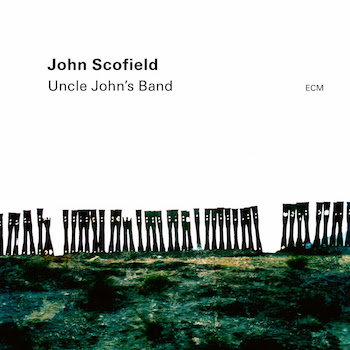
Uncle John’s Band (ECM, 2023), w. Vicente Archer, b; Bill Stewart, dm (Rec. Steinbeck NY, 2022)
One of Sco’s sparest recordings. Without keyboard support, his playing sounds more linear than on earlier releases. Archer offers a flexible foundation and Scofield moves harmonically as he sees fit. Three rock standards (“Mr. Tambourine Man,” “Old Man,” and “Uncle John’s Band” – although Scofield’s “Back in Time” recalls Dylan’s “Girl from the North Country”) are mile markers in a 14-track journey. There also are seven originals, two jazz tunes (“Budo” and “Ray’s Idea”) and two standards from the Great American Songbook (“Somewhere” and “Stairway to the Stars”). Among the originals, I particularly like “Mask,” which has some interesting backwards-guitar looping effects and great drumming from Scofield’s longtime sidekick Bill Stewart. “Nothing is Forever,” in memory of Scofield’s son Evan, who died ten years before this recording at 26, is sui generis. Although it continues a long line of Sco’s ballads with rhythm, it is clear-eyed – not mournful, perhaps as philosophical as its title.
For more detail, see my colleague Michael Ullman’s Arts Fuse review
John Scofield (ECM, 2022) solo guitar (Rec. Katonah NY, 2021)
This recording is hardly an introspective recital, but it does look back, and ECM gives it a lovely atmospheric acoustic that avoids any sense of navel-gazing. Scofield here revisits some of his own back catalog, introduces new material (“Elder Dance” and “Trance du Jour”), and plays some great standards new and old, all featuring to one extent or another the tricks he can achieve using looping and other effects that simulate accompaniments. I saw his Regattabar club date in support of this album, and I was amazed by what one guy and a few bits of electronic junk can do.
The format allows Sco to be as free as he likes, for example barely hinting at the themes of Keith Jarrett’s “Coral” and the classic popular song “There Will Never Be Another You.”
For more detail, see my colleague Allen Michie’s Arts Fuse review
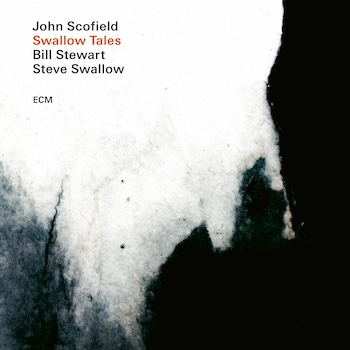
Swallow Tales (ECM, 2020), w. Steve Swallow, e-b; Bill Stewart, dm (Rec. New York University Steinhardt School, NYC, 2019)
Unlike Uncle John’s Band, this trio release has a lot of harmonic variety, and the reason is Steve Swallow, master of the electric bass guitar. Swallow decided, early in his career, after he had switched from the bass violin to the electric bass exclusively, that his new instrument could be not just a harmonic foundation, but a low countermelody component as well, and he made the most of it. In every context – especially with the late Carla Bley – he showed how he could expand the range of the tunes he was playing. I like to think of him as the jazz counterpart of Paul McCartney.
Scofield chose to make this album a direct homage to his older partner, giving the entire program over to another composer’s tunes for the first time that I can remember, but he also engages with Swallow as a true coequal – these older men are young in this music, and there are moments of improvised counterpoint that are inspired. The combination for me prefigures the kind of mutual respect on display in Memories of Home. The program has some Swallow classics – “Awful Coffee” (a staple of Carla Bley’s band), “Hullo Bolinas,” “Eiderdown,” “Falling Grace” and “Radio” – but lots more that delight the ear. Drummer Bill Stewart must play second-fiddle (pun intended) to the double-guitar front line, but he does it with grace.
For more detail, see my colleague Michael Ullman’s Arts Fuse review
Combo 66 (Verve, 2018), w. Gerald Clayton, p, org; Vicente Archer, b; Bill Stewart, dm (Rec. Stamford CT, 2018).
The title of this release comes from Sco’s age at the time. It’s hard to believe, but this seven-year-old session is the last time to date that the guitarist has recorded with a keyboard player. Having the support of piano or organ brings the harmonies in Scofield’s tunes more to the fore –Gerald Clayton knows just how to do this – and as result, the tunes sound more centered here than they do on the subsequent albums. (However, this may soon be redressed with the upcoming tour of “Combo 75” – a reunion of this band – see below for details.) If the later four albums find the guitarist moving in sparer directions, this one feels like a classic Scofield date.
“Icons at the Fair” makes its first appearance here, and there are some other Scoriginals that have become favorites of mine – “Willa Jean,” his blues “Dang Swing,” “New Waltzo,” and “Combo Theme,” alternating an irresistible vamp with the changes of “Giant Steps.” Combo 66 offers an interesting A-B comparison with Uncle John’s Band, since the 2023 recording has the same band minus Gerald Clayton’s keyboards; as even cursory listens will show, the two sessions have very different sounds.
Hudson (Motéma, 2017), eponymous CD by the collective group Hudson [Jack DeJohnette, dm; Larry Grenadier, b; John Medeski, kb; Scofield, g] (Rec. Catskill NY, 2017)
Of all the Scofield releases in the past decade, this one remains the most problematic for me. Medeski and Scofield worked together beautifully on a series of albums (Scofield’s A Go Go [Verve, 1998] and Überjam [Verve, 2002]; Out Louder by Medeski, Scofield, Martin & Wood [Indirecto, 2006]; and Juice by Medeski, Scofield, Martin & Wood [Indirecto, 2014]). DeJohnette and Scofield powerfully recalled The Tony Williams Lifetime with organist Larry Goldings in Trio Beyond on Saudades (ECM, 2006). Larry Grenadier and Scofield have successfully performed duets in concert. And all four love the area they call home, the upper Hudson Valley. But sometimes the parts don’t add up to a satisfying whole.
There are some stellar moments where things come into focus, especially on the two Scofield originals – the Chick Corea-like “El Swing” with a decidedly Spanish tinge, and a blues called “Tony then Jack,” probably making reference to Tony Williams and his successor as King of Jazz Drumming, Jack DeJohnette.
But the covers . . . well, there are good and bad moments. A reggaeish version of Bob Dylan’s slight “Lay Lady Lay” has some welcome reharmonization. Sco’s behind-the-beat statement of Joni Mitchell’s “Woodstock” and the modalish foundation from Medeski make this tune seem more profound than it actually is – in these hands, it is more a lament than an anthem. Robbie Roberston’s “Up on Cripple Creek” goes to New Orleans entertainingly. But another Dylan (“Hard Rain”), rather than say, a Stevie Wonder cover? . . . just sayin’.
For more detail, see my colleague Michael Ullman’s Arts Fuse review
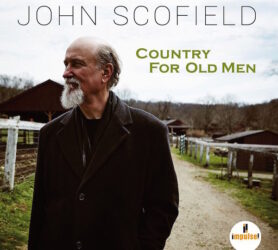
Country for Old Men (Impulse!, 2016), w. Larry Goldings, kb; Steve Swallow, e-b; Bill Stewart, dm (Rec. Stamford CT, 2016) Winner of Grammy for Best Jazz Instrumental Album, 2017.
I confess some apprehension when I first heard about this project. I was delighted when Scofield covered Ray Charles with Dr. John and David “Fathead” Newman (That’s What I Say [Verve, 2005]), and when he ventured into New Orleans gospel with Jon Cleary (Piety Street [Universal Classics, 2009]). But I have a blind spot when it comes to country, primarily because of the limited roles it usually forces on bassists and drummers.
Of course, I was wrong. Scofield gives this program a huge range. Steve Swallow and Bill Stewart could hardly be constrained to two-beat thumping, and whenever Scofield turns them loose, the results are fiery. There are some respectful covers, of which the most moving are two associated with George Jones (“Mr. Fool” and “Just a Girl I Used to Know”). But wait, there’s much more. Hank Williams’s “I’m So Lonesome I Could Cry” is reharmonized, juiced up and turned into pure hard-core Scofield. The ancient “Wayfaring Stranger” becomes one of Sco’s “easy groove” tunes. Merle Haggard’s “Mama Tried” and Patsy Cline’s “Faded Love” are brisk, and just as jazzy as they would be if Scofield had written them. Dolly Parton’s “Jolene” is so darkened that it drains all sentimentality out of the tune. And the finale, a tiny “I’m an Old Cowhand,” is a back-porch joke, with Scofield on ukulele.
For more detail, see my colleague Michael Ullman’s Arts Fuse review of Scofield’s Berklee Performance Center show in support of the album.
Past Present (Impulse!, 2015), w. Joe Lovano, ts; Larry Grenadier, b; Bill Stewart, dm (Rec. Stamford CT, 2015) Winner of Grammy for Best Jazz Instrumental Album, 2016.
Lovano and Scofield both came up through Berklee in the 1970s and I’m proud that they both played back then on my WBUR radio show (on separate occasions). I knew when I first heard them that they both were players of originality and soul, and I have watched both careers with deep satisfaction. It has taken longer for Lovano to reach a pinnacle of attention than it has for Scofield to achieve universal respect, but sometimes talent will out. This date was their fifth recorded collaboration (following Time on My Hands with Charlie Haden, b and Jack DeJohnette, dm [Blue Note, 1989]; Meant to Be with Marc Johnson, b and Bill Stewart, dm [Blue Note, 1990]; What We Do, with Dennis Irwin, b and Bill Stewart, dm [Blue Note, 1992]; and Oh! by ScoLoHoFo [collective group with Dave Holland, b and Al Foster, dm – Blue Note, 2003].
If this is familiar territory, it offers the pleasures of familiarity. It shows Scofield and Lovano were anything but bored with each other’s company. Just listen to the way Lovano matches Scofield’s articulation of the fast theme of “Chap Dance” (built on “I Got Rhythm”) and you know that they are locked in. Those eerily perfect unisons continue throughout the program of eight other Scofield tunes, and this rhythm section, anchored by Bill Stewart (as on three of the other collaborations), is perfectly simpatico. My faves in this outing: “Slinky” and “Get Proud.”
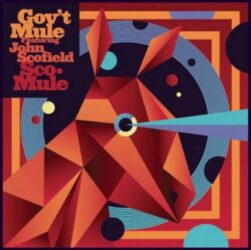
Sco-Mule (Evil Teen, 2015) – Gov’t Mule [Warren Haynes, g; Allen Woody, e-b; Matt Abts, dm], Scofield, g; Dan Matrazzo, kb (Rec. Georgia Theatre, Athens GA & The Roxy, Atlanta GA, 1999)
These 1999 performances fall outside of the past decade, but since it took sixteen years for them to get commercial release, they provide a good way to wrap up and reflect. Scofield is not shy about meeting others on their own terms, and he participates with full commitment (and substantial gear-manipulation) in this joint project with the jam band Gov’t Mule. It’s hard not to like the execution and the excitement of these two shows, and few of Scofield’s own recordings hold such immediately visceral pleasures.
Among the tunes here are Mongo Santamaria’s “Afro-Blue,” two James Brown covers (“Doing It to Death” and “Pass the Peas’), a cover of Wayne Shorter’s “Tom Thumb” (with Sco contributing a solid, behind-the-beat solo that relaxes the feel and sets up the context for a more extrovert rock solo from Warren Haynes), and two very tasty takes on Scofield’s “Hottentot” (first recorded on A Go Go [Verve, 1998]). Sco contributes a spectacular sound-effects solo on Haynes’s “Sco-Mule,” scraping his strings and pushing the envelope into near-free territory but never losing the thread – these few minutes are unique in his discography.
Guitarist Haynes was 39 at the time of the recording and Scofield was 47; however, there doesn’t seem to be any generation gap at all. Haynes has an arsenal of familiar rock tropes at his command, but he goes beyond them frequently, and his originals show more than a little debt to Scofield (and to the Allman Brothers as well). Bassist Allen Woody and drummer Matt Abts are rock-solid, as you would expect, but there’s some spring in their steps, too. The consistent surprise throughout is guest keyboardist Dan Matrazzo, who straddles the two genres expertly.
John Scofield’s fall 2025 tour:
The Combo 66 quartet will be on tour through the West and Midwest in the first weeks of November. Keyboardist Gerald Clayton, bassist Vicente Archer and drummer Bill Stewart round out the group, which is billed for this tour as “Combo 73” because Scofield is now 73 (he’ll turn 74 in December this year). The Uncle John’s Band trio continues the tour without Clayton on the East Coast through the end of the month.
Regrettably, there will be no dates in eastern Massachusetts for this Scofield tour. The only one within a reasonable drive of the Boston-Cambridge area will be at the Groton Hill Music Center in Groton, MA, on November 22, the Saturday before Thanksgiving.
All dates below are in November 2025.
The tour opens with five one-night stands. The quartet will get a rest when they do a residency at the SFJAZZ Center.
1 – Los Angeles, CA – Theatre Raymond Kabbaz
2 – Corvallis, OR – PRAXX Center, Oregon State University
3 – Beaverton, OR – Patricia Reser Center for the Arts
4 – Kirkland, WA – Kirkland Performance Center
5 – Santa Cruz, CA – Kuumbwa
6 – San Francisco, CA – 3-day residency at the SFJAZZ Center
7 – San Francisco, CA – as above
8 – San Francisco, CA – as above
9 – Half Moon Bay, CA – Bath Dancing and Dynamite Society
After a one-day break, the band has six more days on the road, ending with three in Indianapolis at The Jazz Kitchen.
11 – Boulder, CO -Boulder Theatre
12 – Minneapolis, MN – Dakota Bar
13 – Evanston, IL – SPACE
14 – Indianapolis, IN – 3-day residency at The Jazz Kitchen
15 – Indianapolis, IN – as above
16 – Indianapolis, IN – as above
A four-day break follows, during which Gerald Clayton leaves the tour. Vicente Archer and Bill Stewart continue as a trio with Scofield on the East Coast, reprising the personnel of the Uncle John’s Band album.
21 – South Orange, NJ – SOPAC
22 – Groton, MA – Groton Hill Music Center
[this is the closest venue to Boston, about an hour’s drive away]
23 – Fairfield, CT – Sacred Heart Community Theatre
The trio then has a one-day break, followed by a six-day residency at the Blue Note in Greenwich Village.
25 – New York, NY – Blue Note
26 – New York, NY – as above
27 (Thanksgiving Evening) – New York, NY – as above
28 – New York, NY – as above
29 – New York, NY – as above
30 – New York, NY – as above
Steve Elman’s more than four decades in New England public radio have included 10 years as a jazz host in the 1970s, five years as a classical host on WBUR in the 1980s, a short stint as senior producer of an arts magazine, 13 years as assistant general manager of WBUR, and fill-in classical host on 99.5 WCRB.
Tagged: "Memories of Home", Dave Holland, ECM Records