Film Preview: Documentary Days — GlobeDocs and Beyond
By Neil Giordano
GlobeDocs and a standout screening at the Somerville Theatre offer an inviting week of documentaries about mortality, justice, community, and a divided nation.
It’s a documentary extravaganza in the Boston area, with features and shorts exploring local, national, and international subjects in theaters and online. The 12th annual GlobeDocs festival kicks off midweek, with a standout feature outside the festival also screening at the Somerville Theatre.
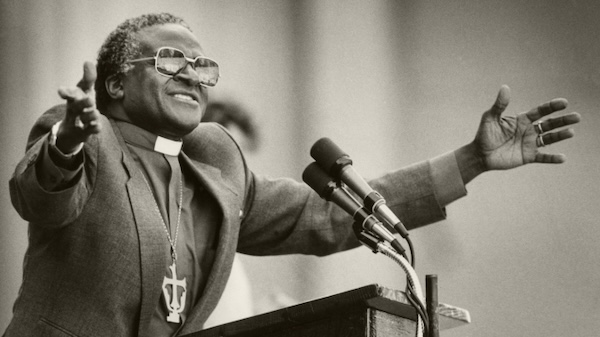
A scene from Sam Pollard’s Tutu. Photo: GlobeDocs
The GlobeDocs opening-night film, Tutu (Coolidge Corner Theatre, Wed., Oct. 21, 7 p.m.), offers a much-needed appreciation of anti-apartheid and human rights activist Bishop Desmond Tutu. Filmmaker Sam Pollard has devoted much of his career to documenting the African American experience, including his work on episodes of the groundbreaking Eyes on the Prize. Here, Pollard turns his attention to South Africa while maintaining his focus on justice and racial progress. As in his documentary portraits of American icons (Ashe, Bill Russell: Legend, Max Roach: The Drum Also Waltzes), he assembles remembrances, archival footage, and new interviews with an assured sense of rhythm and an eye for discovery. Exclusive footage of Tutu and his family, shot during the final 20 years of his life before his death in 2021, adds a personal dimension.
In the struggle associated with Nelson Mandela and Stephen Biko, Tutu exuded a grace rooted in moral and spiritual conviction. After Biko’s murder at the hands of police, and while Mandela remained in prison, Tutu became a vital voice in the international campaign for sanctions against South Africa. Ronald Reagan’s opposition to those sanctions prompts one of the film’s few glimpses of an incensed Tutu. Pollard’s approach has some affinity with his 2020 film MLK/FBI, which examines how the U.S. government relentlessly undermined and sabotaged the Rev. Martin Luther King Jr.’s leadership of a nonviolent movement. Despite his stately, gracious manner, Tutu faced grave danger from both white South Africans and Black militants who refused to renounce violence in pursuit of justice. The film leaves little doubt that his 1984 Nobel Peace Prize was well deserved.
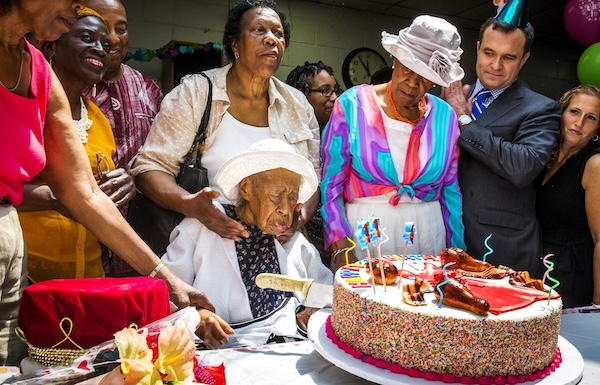
A scene from Sam Green’s The Oldest Person in the World. Photo: Globe Docs
In The Oldest Person in the World (Brattle Theatre, Sun., Oct. 25, 4 p.m.), filmmaker Sam Green (The Weather Underground, 32 Sounds) asks why we are so captivated by people who live extraordinarily long lives. His supercentenarian subjects are fascinating, but longevity is only the starting point for an inquiry into our attitudes to mortality. The question is not just how long we live, but what we do with the years we have.
The record holders illuminate elements in that larger story. Violet Brown, an affable 116-year-old Jamaican, can still recite Byron from memory. Her choice, “Vision of Belshazzar,” neatly echoes the film’s themes, drawing on the biblical story behind the familiar phrase “Your days are numbered.” Elsewhere, Green discovers that extreme longevity does not necessarily make for a compelling documentary subject. Some can no longer participate in their own celebrations: a Brooklyn woman sits slumped in her wheelchair, unable to lift her head to see her cake, as family and friends rejoice around their grandmother—or great-grandmother, or great-great-grandmother.
The film becomes more searching when Green turns the camera on his own life. His son’s birth, a parent’s death, and, most startlingly, his own cancer diagnosis lend his reflections on mortality an intimate urgency. His gentle voice-over invites us to ask elemental questions: Whose lives do we touch? Where do we find meaning? Green plans to continue the project for years—the title passes from one person to another every few months. But the most revealing moments in this documentary are not about the accumulation of years, but how well they are lived.
Elsewhere at GlobeDocs, the shorts programs, offered in theaters and through virtual cinema, contain multitudes. Women Laughing (virtual only) celebrates a diverse group of women cartoonists at The New Yorker and the inroads they have made into a profession long dominated by men. We watch them draw together; individual interviews tease out their idiosyncrasies and favorite subjects.
Closer to home, Commonwealth (Brattle Theatre, Sun., Oct. 25, 11 a.m.) follows Gabe Salazar, a Bostonian who helped transform the region’s newly legal marijuana industry. He came up with a winning formula for a cannabis delivery service rooted in an equitable, community-based business. Drawing on state laws that promoted hiring workers who had borne the brunt of the War on Drugs, Salazar sought to give them a stake in the legal industry. But he found himself squeezed out by regulations favoring corporate interests compounded by conflicting federal and state laws that made compliance prohibitively expensive.
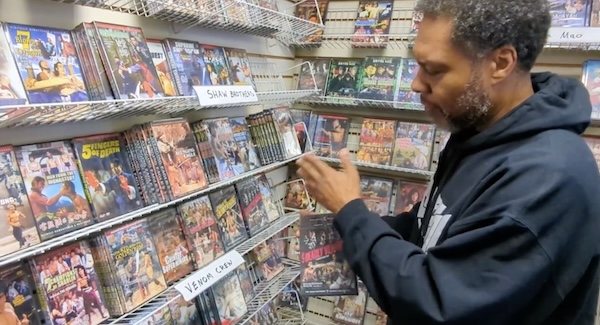
A scene from Kung Fu Video. Photo: GlobeDocs
Screening with Commonwealth is the micro-short Kung Fu Video, a playful portrait of the Downtown Crossing video store whose owner, nicknamed Grandmaster OG Kush, devises a shelving system only a true fan could dream up. Two more locally themed shorts, both virtual only, are A Life Aloft, about hot-air ballooning in New England, with a focus on Vermont’s Paul Stumpf, the region’s last balloon repairman and manufacturer; and On the Tide, a sometimes joyous glimpse of Wellfleet’s oyster farmers.
Also on tap at GlobeDocs:
- Union Town (Brattle Theatre, Fri., Oct. 23, 6 p.m.), the latest from veteran documentarian Barbara Kopple and the third film in her trilogy about the American labor movement. Read the Arts Fuse review here.
- Jean-Michel Basquiat (Brattle Theatre, Fri., Oct. 23, 8:30 p.m.), the first biographical documentary about the artist made with his family’s approval.
- The world premiere of Cut to David (Brattle Theatre, Sun., Oct. 25, 1:30 p.m.), a vérité portrait of an adopted Chinese American transgender teen raised in Brookline and his family.

A scene from Stephen Maing and Eric Metzgar’s The Great Experiment. Photo courtesy of the filmmakers
[]Outside of GlobeDocs, you can catch a screening of The Great Experiment (Somerville Theater, Oct 25, 7:30pm), a new vérité exploration of America. This film will no doubt serve as an important social document of America during the first Trump term. Co-directed by Stephen Maing (2024’s Union which portrayed labor’s success versus Amazon) and Eric Metzgar (the two worked together on Crime + Punishment), America appears in stark black and white, perhaps reflecting the polarities of a divided nation.
The film’s first image is of the border wall, but it is a portion of the wall opening as if we can peer inside and take a peek at what’s going on.
What we see is a nation at odds with itself, not just ideologically but spiritually. People across the political spectrum have their say: everyday workers, political activists, documented and undocumented immigrants, anarchists, Civil War reenactors, and Christian nationalists. American iconography abounds—flags, fireworks, football games, church services. MAGA is well represented, not only by the stereotypical angry older white people but also, notably, by people of color.
Two scenes distill the discord. In New Orleans, a confrontation erupts over a Confederate statue; one defender waves an Israeli flag. The statue eventually comes down. At a Unification Church gathering in Pennsylvania, a baffling ceremony celebrates marriage and AR-15s in the same breath. This political pageant becomes a theme and variations on Americans’ inability to take one another seriously—an attitude that, in some instances, seems justified. Yet more than a few participants recognize the larger problem: we talk only within our own news and social media silos, where everyone cheers us on.
A later section moves into the COVID lockdown, pressing the point a little too hard with an image of people confined to individual painted circles in a field. The title comes from a letter by George Washington, though his phrase sets a more ambitious standard: “the last great experiment for promoting human happiness, by reasonable compact, in civil Society.” We survived Trump’s first term. In the midst of his second, the film gives us pause—but also more than a little hope that the American experiment will continue.
Neil Giordano teaches film, creative writing, and journalism in Newton, Massachusetts. His work as an editor, writer, and photographer has appeared in Harper’s, DoubleTake, Newsday, Literal Mind, and other publications. He is currently in production on Betweens, a documentary about artist Michael C. Thorpe.
Tagged: Barbara Kopple, Boston film, Brattle Theatre, Coolidge Corner Theatre, Cut to David, Desmond Tutu, Eric Metzgar, GlobeDocs, Jean-Michel Basquiat, Neil Giordano, Sam Green, Sam Pollard, Somerville Theatre, Stephen Maing, The Great Experiment, The Oldest Person in the World, Tutu, documentary film, film festivals