Film Festival Reviews: Docs at TIFF — Labor, Harlem Memory, and Iranian Bodies Under Pressure
By David D’Arcy
At TIFF, Barbara Kopple follows exploited delivery workers, William Greaves revives the Harlem Renaissance, and Iranian filmmakers find private lives shadowed by surveillance, war, and repression, yet also beautified in some cases.
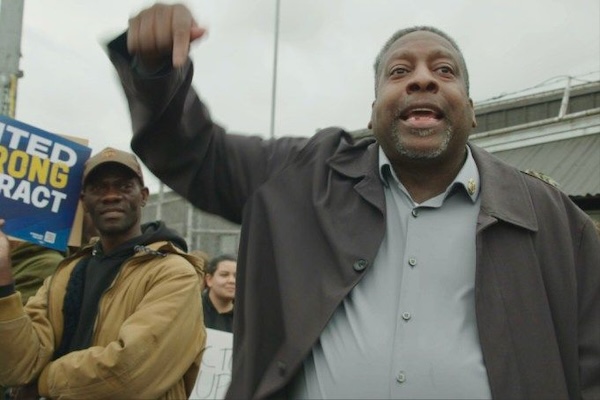
A scene from Barbara Kopple’s Union Town. Photo: TIFF
Canada is a very different place from the U.S. these days, but Toronto was where Barbara Kopple had the North American premiere of her latest film, Union Town, which follows campaigns to protect the health and rights of unionizing workers in New York City’s ever-expanding home-delivery industries.
Those businesses, in New York alone, account for the delivery of 2.5 million packages and 500,000 meals per day. UPS workers are organized by the Teamsters, but alongside them are the unorganized armies of home-delivery workers — deliveristas, in Spanish — who are often at the mercy of companies that barely pay them and expect them to work in the worst conditions.
Kopple, who has won Academy Awards for her films about striking coal miners (Harlan County USA, 1976) and meatpacking workers (American Dream, 1990), spent years with the ill-paid workers struggling in America’s largest sweatshop: the streets of New York. Most are not white, so most of the class line here is a color line. Most of the subjects in this film speak Spanish, although immigrants from around the world are represented. Most of these people, because they have no alternative, are eager to organize.
You understand why when you see them at work, riding bicycles in rain, snow, and blistering heat. They rely on tips because their wages are minimal. In the streets they face the threat of being robbed and the peril of the dreaded “deactivation” by their delivery firms if a complaint of any sort is lodged by a customer. Kopple’s camera is there as they tell their stories. Be prepared for a subtitled film. Most of these workers barely speak English, which makes them easier for corporate bosses to control — or so one might think.
It’s a multi-tiered field. UPS drivers and workers make much higher wages, but their work is grueling, even if they are represented by a union. We rarely hear UPS management respond to workers who ask for better wages and working conditions. Crowds of police press against picketers to keep cameras away from company buildings. Plainclothes security men working for Amazon tell representatives of the firm’s delivery workers, who are bringing grievances to the company’s offices, that the giant that pioneered home delivery does not accept packages. It’s a paradox that could not be more absurd.
As for the lowly deliveristas, we watch them fight, for the first time, against companies that courts have found to have systematically shortchanged them. Remember that practice the next time you use DoorDash.
Kopple manages to capture the squalid conditions at the low end of the service economy, as well as the risks workers face in fighting for more when they are under pressure to make their next deliveries. Too late to be included in the film: New York City has just secured a record $131.5 million settlement from DoorDash over alleged violations of delivery-worker pay rules. More than $115 million will go to over 260,000 workers who were underpaid, paid late, or not paid for compensable waiting time; DoorDash will also pay more than $16 million in penalties and costs.
We see celebrations of some victories — protection for workers against arbitrary “deactivation,” for example, and the provision of thousands of new jobs, which Amazon is now appealing. Still, Union Town closes with ominous words from the grandmotherly head of UPS, Carol Tomé, on a business talk show: “I have seen robots loading trucks and unloading trucks. I like that. Robots don’t get sick. They don’t have an attitude. I like the robots. How do I bring the robots in, but not destroy the jobs?”
Tomé’s vision sounds like a pitch for the next Marvel super-hero blockbuster. Or is it a prediction of future war with UPS workers? Will robots be brought in as scabs in the next strike?
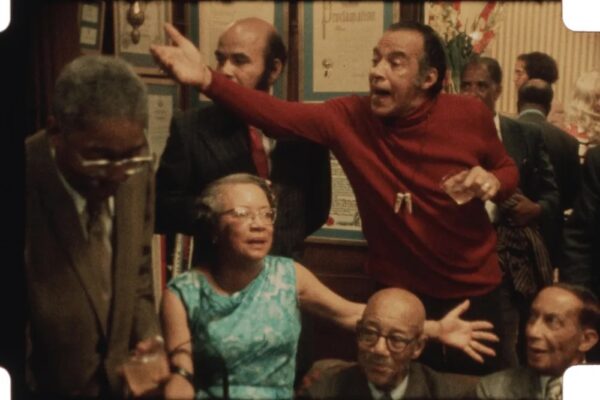
Aaron Douglas, Jean Blackwell Hutson, Nathan Huggins, Richard Bruce Nugent, Eubie Blake and Irwin C. Miller appear in William Greaves and David Greaves’s Once Upon A Time In Harlem. Photo: William Greaves Productions.
William Greaves (1926–2014) is another chronicler of an under-recognized group: the artists, musicians, and writers of the Harlem Renaissance. His documentary Once Upon a Time in Harlem was conceived in 1972 and completed by his son David Greaves in 2026.
The film recounts an event: a 1972 cocktail party at Duke Ellington’s Harlem townhouse. Ellington would die two years later. The guests included figures from Harlem’s cultural scene in and around the 1920s, when Black writers and artists of all kinds lived and worked in the neighborhood. By the 1970s, that work was filed away in history books. Putting these people and their conversations on the screen, father and son bring the spirit of the Harlem Renaissance back to life.
The party was seen as its own archival project, described by some as intimate — though a gathering of around 50 people, by my estimate, is hardly intimate. There is no script; people come and go. There are no extended performances, except for parts of two or three songs, but there are plenty of recollections, as at any reunion.
Black people tended to be concentrated in Harlem and a few other New York neighborhoods in the 1920s. Yet among those whom Greaves films at the party, there is not much talk of discrimination. It is more about camaraderie and what young then-unknown artists accomplished. We hear about that sense of community from the influential photographer James Van Der Zee and pianist Eubie Blake, who had not yet retired.
There is talk of comings and goings at a key gathering place, what was then called the 135th Street Library, now the Schomburg Center for Research in Black Culture of the New York Public Library. The talk is haunted by references to such influential figures as Paul Robeson and Langston Hughes.
Greaves was lucky to get so many veterans of the Harlem Renaissance together to share their insights. Blake, decades later, warines those around him not to try to shake the hand of a white person they do not know. He recalls how Bill “Bojangles” Robinson, one of the few Black entertainers to break out beyond Harlem back then, was rebuffed by Charles Lindbergh when he greeted the aviator. Nonetheless, Robinson established his admired place in cultural history; Lindbergh, a Nazi sympathizer, has lost much of his earlier stature.
This film pays tribute mostly to grand old men, though a few women and some younger artists are around in 1972. One was Romare Bearden (1911–1988), the painter and collagist, who is quiet in the company of his elders. Another is the scholar Nathan Huggins (1927–1989), who went on to teach at Harvard University and to write his own study of the Harlem Renaissance.
Another of the younger artists was William Greaves himself, who for years worked out of his Manhattan apartment near Columbus Circle, before anyone had heard of Spike Lee. His work ranged from PBS productions to experimental film. He belongs in the same room as the greats of an earlier generation.
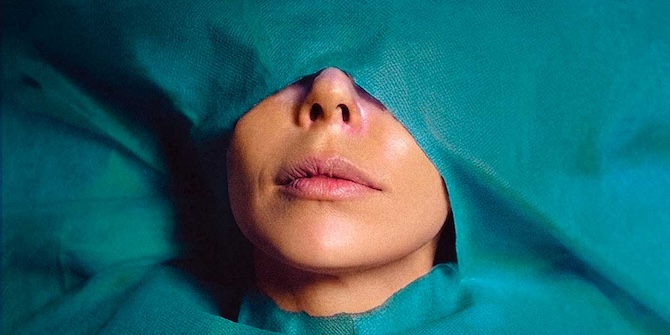
A scene from Afsaneh Salari’s Tehran, Under the Skin. Photo: TIFF
From Iran comes Afsaneh Salari’s Tehran, Under the Skin, a look at plastic surgery in the Iranian capital, which continues despite the destructive surgery visited on the city through aerial bombardment. We are taken to a clinic where patients — given what is being done, they are more than mere customers — change their appearance under the knife.
The clients are mostly female, but males are doing it as well. Those whom we meet, of either sex, talk about the process and their reasons for it: vanity, personal fulfillment, personal identity, pleasing a partner or spouse, entering adulthood, and fighting the blight of age. The latter reason is odd, given that most seem to be in their twenties or thirties. Salari’s interviews with them are refreshingly intimate, given that so much news from that part of the world seems to come via megaphone.
We meet clients in the clinic, where plastic surgeons evaluate potential candidates, all unveiled in the Islamic Republic. As we watch, many are rejected because their faces will not safely support the desired work. These surgeons have plenty of customers, despite one doctor’s observation that U.S./Israeli attacks and a failing economy have put a dent in demand. Still, the cost of a nose job, the operation of choice, is about that of a cell phone, says another surgeon, and every teenager owns a cell phone.
“Forbidden to dance? To sing? Forbidden to be seen?” an off-camera voice asks. “Is our body the only territory we truly control?”
Outdoor walls are covered with giant portraits of war heroes and quotations from religious leaders. Women desiring breast implants, the removal of fat from their legs, or the straightening of their noses wait their turn in the surgeon’s office, where interviews with mullahs play on television.
A surgeon sits at a desk with two sculptures of nude male and female torsos. On the wall behind his right shoulder. is an idealized painting of himself. “Iranian society is bipolar,” he says, citing both the mandated concealment of women and the persistent pursuit of beauty.
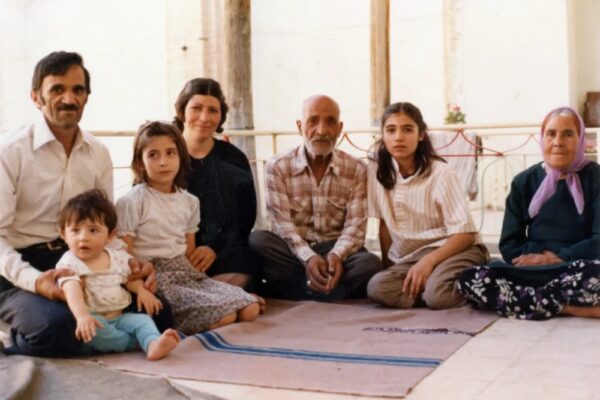
A scene from Pegah Ahangarani’s Rehearsals for a Revolution. Photo: TIFF
In Tehran, Under the Skin, plastic surgery becomes a means of probing realities that Iranian culture keeps concealed. At TIFF, a second, starker reality check came in Rehearsals for a Revolution, a documentary by the actress-director Pegah Ahangarani. Structured in discrete sections, the film traces Iran’s course from royal absolutism to the sharia regime administered by Shiite clerics. Each chapter also follows the fate of a dissident connected to Ahangarani’s own family.
The picture is bleak: protest movements are met with brutal repression, and executions happen every day. Ahangarani finds a potent visual metaphor for oppression’s continuity in the recurring destruction of demonstrators’ cameras—an act that seems to accompany each police crackdown. The footage that survives is explosive, literally, recalling the aftermath of Israeli attacks on Palestinians documenting abuses in 5 Broken Cameras (2011), filmed in the occupied West Bank.
Why, then, does Ahangarani call these Iranian uprisings “rehearsals”? Does she mean that the real performance—the revolution itself—is somewhere over the horizon? For now, both Ahangarani and the director of Tehran, Under the Skin live in Paris.
David D’Arcy lives in New York. For years, he was a programmer for the Haifa International Film Festival in Israel. He writes about art for many publications, including the Art Newspaper. He c0-produced and co-wrote the documentary Portrait of Wally (2012), about the fight over a Nazi-looted painting found at the Museum of Modern Art in Manhattan.
Tagged: Afsaneh Salari, Amazon, Barbara Kopple, Black arts and culture, Duke Ellington, Eubie Blake, Harlem Renaissance, Iranian cinema, Iranian protests, Iranian women, James Van Der Zee, Nathan Huggins, New York City, Once Upon a Time in Harlem, Pegah Ahangarani, Rehearsals for a Revolution, Romare Bearden, TIFF, Teamsters, Tehran Under the Skin, Toronto International Film Festival, UPS, Union Town, censorship, deliveristas, delivery workers, documentary film, gig economy, labor organizing, plastic surgery in Iran