Arts Commentary: “From the New World” — A State-of-the-Art Symphonic Exercise
By Joseph Horowitz
While the Boston Symphony drafts plans for humanities-based festivals, the South Dakota Symphony has been building them for a decade.
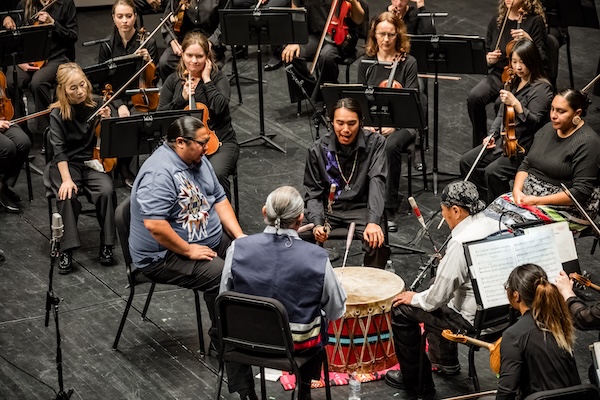
The Creekside Singers and the South Dakota Symphony Orchestra. Photo: courtesy of 4Front Studios
Last spring, the Boston Symphony paired Antonin Dvořák’s “New World” Symphony with excerpts from John Adams’s opera Nixon in China—a curiously eclectic program. However, according to a much-discussed planning document, the BSO newly aspires to mount festivals using “programmatic themes” and “humanities-based collateral presentations,” and also to initiate “affinity programming, intended to appeal to segments of our communities who have not traditionally felt welcomed.”
Dvořák’s symphony is an obvious candidate for such exercises, not least in Boston. For one thing, it intimately relates to Henry Wadsworth Longfellow, who lived in Cambridge for four decades. For another, its humane “New World” impressions of Native Americans and African Americans retain pertinence today. Notwithstanding the symphony’s continued omnipresence on American orchestral programs, few conductors or orchestras disclose awareness of its fascinating genesis.
Over the course of its recent “From the New World” Festival, the South Dakota Symphony Orchestra—always an exception—feasted on “humanities-based collateral presentations.” The 12-day festival appealed to communities “who have not traditionally felt welcomed.” In fact, it featured a Lakota drumming group from the Pine Ridge Reservation. It potently cited Longfellow, and also the canvases of George Catlin and Frederic Church. It linked to four universities and four high schools. Had it been presented by the Boston Symphony, it would have had a sensational impact.
Delta David Gier began a dress rehearsal a week ago by asking the members of his South Dakota Symphony to find an adjective for the beginning of Dvořák’s symphony, an elegiac cello song. “Sadness” and “sorrow” were obvious answers. Imagine that, Gier continued. In conveying his impressions “From the New World” in New York in 1893, Dvorak did not think to begin with an apostrophe to the reckless energy and vertiginous scale of Manhattan. Instead, he keyed on the sorrow songs of Black Americans once enslaved, on Native Americans facing extinction, and on a vast uninhabited prairie “sad to despair.” Gier wished to impress upon his musicians that empathy is this symphony’s keynote. It may even be what most distinguishes Dvorak, generally, as a composer.
He loved the countryside, never the city. He kept birds—uncaged—in his Manhattan apartment on East Seventeenth Street. He feared the din of traffic. The Metropolitan Opera’s affluent boxholders were an alien species to him. Fleeing urban frenzy, he would visit the Battery Park piers to watch transatlantic liners arriving and departing.
When Dvořák conceived “From the New World,” he had not yet interacted with Indians or inhabited the midwestern plains. That would come a little later, during his Iowa summer of 1894. But he had read—first in Czech, then in English—the best-known American literary work: Henry Wadsworth Longfellow’s The Song of Hiawatha (1855). As the music historian Michael Beckerman disclosed four decades ago, many passages from Longfellow’s narrative poem inspired passages from Dvořák’s non-narrative symphony. Its most poignant music—the Largo’s C-sharp minor episode, with its shivering tremolos—sets Longfellow’s most poignant episode: Minnehaha’s death in winter. At the South Dakota performance, a visual track by my longtime colleague Peter Bogdanoff produced Frederic Remington’s portrayal of Minnehaha in her sickbed (go to 5:08).
But it was Bogdanoff’s interpolation of a famous George Catlin canvas of a buffalo hunt that searingly mated Dvořák’s pathos with the pathos of a vanishing world (go to 5:57).
Gier’s reading of the Largo, meanwhile, was among the slowest and most poetic I have ever encountered. This is the movement that begins with Dvořák’s most famous melody: the English horn solo later transformed into the spiritual “Goin’ Home,” for which Bogdanoff furnished both a Winslow Homer canvas of a Black slave girl and renderings of Native American domesticity (go to 1:47). The images mutually interacted with Dvorak’s pentatonic tune. It was overwhelmingly sad.
Elsewhere, Dvořák’s symphony is dramatic and energetic, but seldom cheerful. Its ending is singular: a dirge with timpani taps, an apotheosis, a refulgent E major chord that, however, instantly diminishes. A story is evidently in play. The obvious story is Hiawatha’s leave-taking as recounted by Longfellow:
Westward, westward Hiawatha
Sailed into the fiery sunset,
Sailed into the purple vapors,
Sailed into the dusk of evening.
The receding chord signifies a receding world: a leave-taking. Why is Dvořák’s symphony to this day the most beloved ever composed on American soil? However subliminally, we experience an act of empathy.
Empathy is a Dvořák keynote. Consider his most beloved concerto, for cello in B minor. It, too, was composed in New York, in response to Victor Herbert’s Cello Concerto No. 2, which the composer heard Herbert premiere with the New York Philharmonic. As is well known, the second movement quotes a Dvorak love song favored by his sister-in-law Josefina. Theirs was an ardent relationship. Not long after the concerto was finished, Dvořák learned that Josefina had died. He then added its most eloquent passage—a mournful coda recording the sad passage of time, in which the cello’s lullaby is answered by a solo violin: Josefina in heaven.
Dvořák made his name as a Romantic nationalist with his swirling Slavonic Dances. But his deeper métier, consummated in America, was that of a great humanitarian.
I first encountered the South Dakota Symphony as director of Music Unwound, a national orchestral consortium funded four times by the National Endowment for the Humanities. The goal was to rethink orchestras as “humanities institutions,” purveying thematic festivals linked to universities and conservatories. Dozens of orchestras have taken part. But only in South Dakota has Music Unwound taken root. With the NEH grant fated to expire, I am now the orchestra’s Scholar-in-Residence.
The first American orchestra ever funded by the NEH was the Brooklyn Philharmonic, during my tenure as executive director in the 1990s. Our first festival was “From the New World” in January 1994, celebrating the centenary of Dvořák’s symphony. Keying on Beckerman’s cutting-edge scholarship, I commissioned Bogdanoff’s visual presentation of the Largo and Scherzo. It has since been deployed in dozens of cities, large and small—but never by any of our “major orchestras.”
The visuals first arrived in Sioux Falls for the first South Dakota Symphony Music Unwound festival, in 2016. I discovered an orchestra already steeped in the humanities. This was thanks to a visionary music director, Delta David Gier, who has made Sioux Falls his home since 2005. Gier’s signature initiative (I have told this story many times) is the Lakota Music Project, which links the SDSO to Indian reservations throughout the state. But the Lakota Music Project had never linked to Dvořák and the Indianist movement he inspired. This “appropriation” of Native America by white Americans was initially received with ambivalence. Gier mediated a three-month conversation. It resulted in a mega-program including the New World Symphony with visuals, a mini-tutorial in Lakota song, a Hamm’s Beer TV commercial from the 1950s, the Dagger Dance from Victor Herbert’s Indianist opera Natoma, and a new work for the Creekside Singers with orchestra. The entire show was performed both in Sioux Falls and on the Sisseton Reservation 160 miles away. It was exhilarating but messy, and the new piece proved a shotgun wedding.
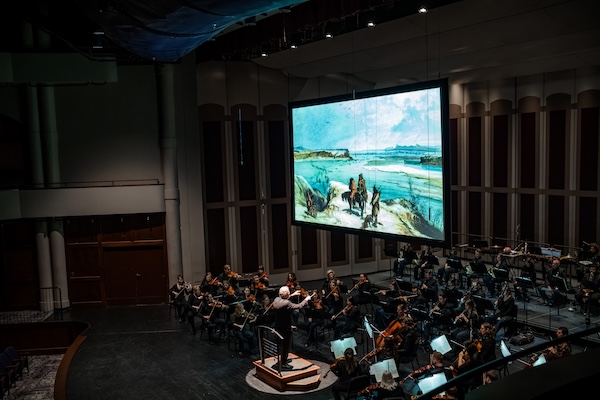
Delta David Gier conducting the South Dakota Symphony Orchestra. Photo: courtesy of 4Front Studios
I subsequently hosted the Lakota Music Project in Washington, D.C., where I co-presided over a chamber orchestra. “Native American Inspirations” included events at the National Cathedral and the National Museum of the American Indian. Our repertoire now embraced not only Dvořák, but remarkable Indianist compositions by Arthur Farwell (who called himself the “first composer to take up Dvořák’s challenge”) and Ferruccio Busoni (who used Native tunes collected out West by his onetime student Natalie Curtis). And we heard contemporary works by a pair of notable Native and non-Native composers: Jerod Tate and Curt Cacioppo.
Not long afterward, the superb Dakota String Quartet (comprising string principals from the South Dakota Symphony) made the first recording (on Naxos) of Farwell’s most ambitious Indianist composition: the Hako String Quartet (1922). It is formidable music that will ultimately gain ground as prejudice against the Indianists recedes. Though Indianists are hounded by present-day accusations of cultural appropriation, Farwell once exhorted Americans to view Native Americans differently. The only relationship “compatible with democratic ideas,” he wrote, would be “to bring the American people as a whole into a sympathetic relation with the Indian.” He regarded the mystic reverence ingeniously expressed in the Hako as an attempted escape from “the artificialities and technicalities which have latterly beset European culture.”
Last fall, the Lakota Music Project toured South Dakota reservations with new compositions by Derek Bermel and Jeffrey Paul in which the synergies binding Native and non-Native performers attained new sophistication. Bermel’s Lakota Refrains, in which Lakota singers, drummers, and dancers partnered with the Dakota String Quartet and Wind Quintet, was co-composed by Emanuel Black Bear, who created and gifted seven new Lakota melodies. As I subsequently opined on an NPR radio show incorporating excerpts from both new works: “Two decades into the Lakota Music Project, Bermel and a heterogeneous group of 15 musicians had realized a musical fusion clinching the project’s highest ecumenical aspirations—it was a breakthrough moment.”
All this formed the backdrop to last month’s South Dakota Symphony festival, comprising seven concerts (including four by the Dakota String Quartet and two by university ensembles) plus assorted lectures and special events in four South Dakota cities. The composers included Dvořák, Farwell, Tate, and Louis Ballard, who in the 1960s became the first notable Native composer of classical music. But the pièce de résistance was an expanded version of Lakota Refrains, in which the Creekside Singers were joined by Gier’s orchestra and a quartet of brilliantly costumed Lakota dancers.
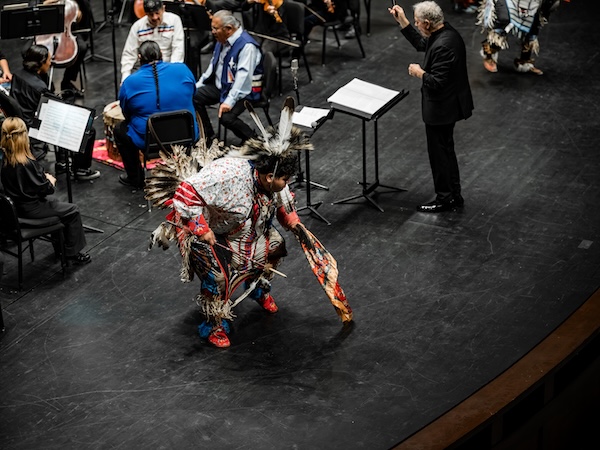
Lakota singers and dancers performing “Lakota Refrains.” Photo: courtesy of 4Front Studios
Following a demonstration of Lakota song at Jefferson High School in Sioux Falls, Emanuel Black Bear said: “I hope you’ve enjoyed our time together today—that you can see us for who we are. And remember to be kind. To be human to each other. That’s the intent of the Lakota Music Project. It’s that we’ve got to be better human beings in today’s world. If we’re better human beings together, we can build a lot more than what we have today. We can have a better life. We can have better things. If we learn to work together.”
Days later, in the aftermath of the South Dakota Symphony festival, Shane Wuebben, the arts coordinator for the Sioux Falls public schools, wrote a thank-you note. It read:
“‘That was epic!’ I walked out of Saturday’s [symphonic] performance alongside one of the school district’s Native American program liaisons. That was her quote, and I wholeheartedly agree. The [additional] presentations at our high schools were a once-in-a-lifetime opportunity for our students. At one point I was just a few feet from Emanuel and Ari Black Bear, with the drum reverberating throughout my being. It was thrilling to see students’ faces as they heard music that I assume most have never heard before.”
All four Sioux Falls high schools had hosted visits by Emanuel Black Bear and his son Ari, who is the Creekside Singers’ lead singer. The same assembly programs featured high school violinists playing the Larghetto from Dvořák’s Violin Sonatina, which, in combination with a snatch of The Song of Hiawatha, comprises a tragic cameo of Minnehaha. For Saturday’s main event, ninety high school students shared a preconcert dinner. The SDSO audience that night also included bused college students from as far away as Iowa.
“From the New World” was the penultimate SDSO festival to be supported by the NEH. (My Music Unwound grant was one of 1,400 canceled by a pair of DOGE zealots in their twenties—and subsequently reinstated by a court order.) The orchestra’s final Music Unwound project, next fall, will feature music by Charles Ives and George Gershwin. It will again link to universities and high schools—and also to a cross-disciplinary course, “From the New World—How Writers and Composers Once Helped to Define ‘America,’” that I will teach at Augustana University in Sioux Falls and South Dakota State in Brookings, an hour away.
The South Dakota Symphony’s Lakota Music Project has been more than twenty years in the making. The orchestra’s Music Unwound festivals have been ten years in the making. The New York Times is paying attention. So has Alex Ross in The New Yorker. Meanwhile, countless American orchestras continue to confront financial, artistic, and governance challenges that have bedeviled the Boston Symphony, the Seattle Symphony, the Chicago Sinfonietta, the Nashville Symphony, the Phoenix Symphony, and surely others to come.
South Dakota shines a beacon light. And so does Dvořák.
Joseph Horowitz has written about orchestras in crisis for The New York Review of Books and The New York Times.
Tagged: "Music Unwound", Antonín-Dvořák, Arthur Farwell, Boston Symphony Orchestra, Delta David Gier, Lakota Music Project, Native American music