
Watch Closely: “Carrie” Comes of Age—and Gets Complicated
By Peg Aloi
Mike Flanagan’s ambitious update of Stephen King’s classic pairs a superb cast with social media cruelty and an expanding supernatural world that sometimes overwhelms the story.
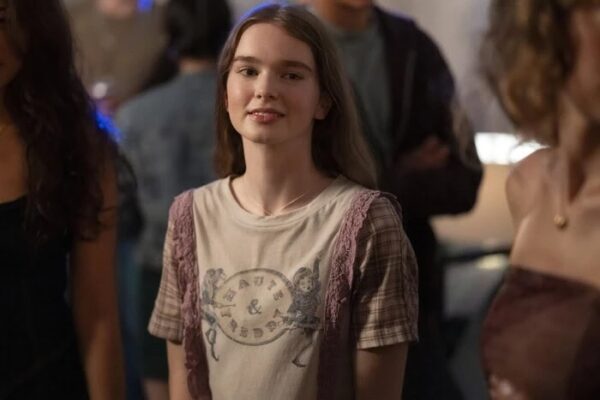
Summer H. Howell in a scene from Mike Flanagan’s update of Carrie. Photo: Prime Video
Hello, readers, and welcome back to my erstwhile TV column! It’s been a while, but what better time to revive my TV musings than my favorite season—and probably yours: spooky season! It’s been an eclectic and rewarding year for horror films, with more on the way. One of this season’s most anticipated horror series arrives this week: Mike Flanagan’s version of Stephen King’s Carrie. Adapted from King’s debut novel and clearly influenced by Brian De Palma’s classic 1976 film, the series updates this dark coming-of-age tale for the present, invoking the spectres of school shootings, social media bullying, and witchcraft.
Like King’s novel, Flanagan’s Carrie has an epistolary quality. King pieces together his story from book excerpts, letters, and transcribed eyewitness accounts; Flanagan opens with videotaped interviews with survivors of the cataclysmic prom night that is the centerpiece of De Palma’s film. De Palma tells the story chronologically, arguably heightening its suspense and shock. Flanagan reconstructs the events leading to prom night through flashbacks and exposition, expanding the narrative and laying the groundwork for future seasons. The framing is intriguing and ambitious, but it grows unwieldy, and some of the additions feel derivative. The direction and performances are uniformly excellent; the writing, divided among a team, is less consistent.
Perhaps you know the story. Carrie White is a shy, socially naïve teenager bullied at school and tormented at home. Her mother, Margaret, is a proselytizing Christian with delusions of grandeur who responds to Carrie’s attempts to integrate with her peers with humiliating punishments. De Palma’s film opens with Carrie—Sissy Spacek in a star-making performance—showering after gym class. The dreamy sequence is softcore fodder: naked young women enveloped in soap and steam. Then a drop of blood breaks the spell. Carrie has started her period—an ordinary event made terrifying by an upbringing that has left her ignorant of basic reproductive biology. Her classmates greet her panic by pelting her with tampons and sanitary napkins, chanting, “Plug it up!”
Strange phenomena sometimes occur in the wake of Carrie being bullied: light bulbs burst, doors slam, people trip and fall. Discovering that her anger can unleash extraordinary powers, Carrie begins researching telekinesis at the local library. Sue (Amy Irving), a popular student ashamed of joining in the bullying, tries to make amends by helping Carrie attend the prom. But Chris (Nancy Allen) and her delinquent boyfriend (John Travolta) turn that gesture into a trap, drawing forth an explosive eruption of rage and vengeance. King was exploring female adolescent rage and power long before they became a familiar cinematic force in films such as The Craft, Ginger Snaps, Jennifer’s Body, Assassination Nation, and Raw.
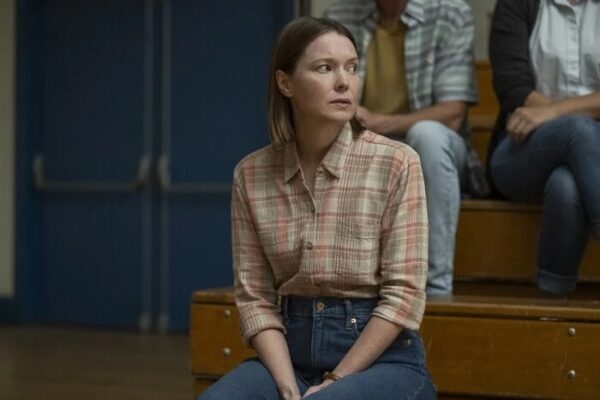
Samantha Sloyan in a scene from Mike Flanagan’s update of Carrie. Photo: Prime Video
In Flanagan’s version, Carrie (Summer H. Howell, in a stunning breakout performance) is a sheltered, homeschooled teenager thrust into high school after her father dies in a construction accident. To retain custody, her mother—the excellent Samantha Sloyan, a veteran of Flanagan’s television work—must find a job and enroll Carrie in public school. This Margaret is a less delusional zealot than Piper Laurie’s brilliant incarnation, but she still cruelly locks Carrie in a closet for breaking household rules. Socially naïve but intellectually curious, Carrie longs to learn about the world. A friendly neighbor feeds that curiosity by secretly supplying her with books.
The shower scene, which comes shortly after Carrie starts school, is emphatically unerotic: everyone remains fully clothed. Sue (Siena Agudong) joins in the bullying, though less enthusiastically than her friends Chris (Alison Thornton) and Tina (Josie Totah). When a photo of Carrie in the shower goes viral, the humiliation escalates into an online campaign that engulfs the school and community. Her telekinetic powers begin to surface, though no one—not even Carrie—pays much attention at first.
Distraught over her parents’ impending divorce and how it threatens her college plans, Chris poses as Carrie’s friend and protector while relentlessly sabotaging and humiliating her. Tina, desperate for social clout, serves as her accomplice. Carrie is thrilled to have companions, but nearly every social triumph turns out to be the setup for another cruel prank. After Carrie sneaks out to a party, Sue’s kind boyfriend, Tommy (Joel Oulette), drives her home and becomes an unofficial protector. A savvy loner, Emaline (Thalia Dudek), also befriends Carrie, urging her to fight back as she cultivates her powers.
Flanagan’s series delves deeper into the school’s social milieu. Gym teacher Miss Desjardin (Amber Midthunder) cracks down on the bullies, then commiserates at the local bar with fellow teacher Seth (Flanagan veteran Rahul Kohli). Principal Grayle (Matthew Lillard) and openly gay guidance counselor Mr. Morton (Tim Bagley) are caring, but powerless to stem all the online abuse. Sue makes a more sustained effort to support Carrie, while Emaline builds her confidence through secret telekinetic practice sessions.
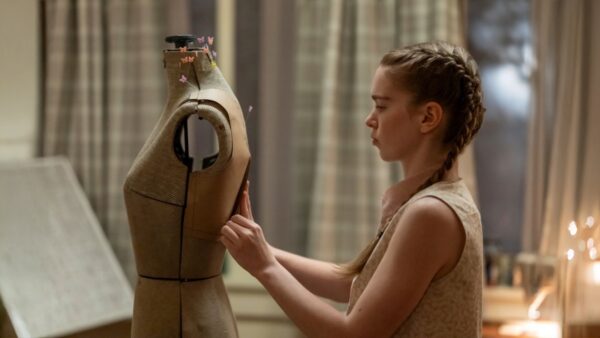
Summer H. Howell in a scene from Mike Flanagan’s update of Carrie. Photo: Prime Video
Shadowy women on the periphery also take an interest in Carrie’s powers. One belongs to a secret activist network that Margaret discovers when she navigates social media looking for ways to understand her daughter’s predicament. Ground down by her dead-end job at a big-box store, Margaret falls under the unhealthy spell of online drama. Soon she is a firebrand at school meetings, denouncing bullying and exposing Chris as the creator of the vicious “Carrie Red” account. It’s a clever conceit: Margaret White has been rebranded from town weirdo to Instagram influencer. But, hypocritically, her private abuse of Carrie mirrors the anonymous digital tactics of her daughter’s sadistic classmates. The irony is not lost on us—or on Carrie, who begins to question her mother’s motives.
This plotline reminded me of the social media intrigue in Caryn Waechter’s coming-of-age film The Sisterhood of Night (2014), adapted from Steven Millhauser’s marvelous short story. Its high school girls form a secret society, gathering at night in the woods to sit in silence — it is a way to reject the online drama that dominates their lives. The mysterious women drawn to Carrie’s powers also recall Eliot Laurence’s Motherland: Fort Salem, in which adolescent witches undergo military training tailored to hone their supernatural abilities. There are echoes, too, of The Power (2023), based on Naomi Alderman’s novel, in which teenage girls develop physical abilities that upend the social order. Witchy girl power is all the rage in entertainment, even as misogyny bears down from every direction in society.
After the climactic prom night, the final episode introduces an investigation led by a character played by another Flanagan veteran, Kate Siegel. She belongs to an apparently extensive network of women who are involved in investigating paranormal activity. The structure and purpose of the organization are murky, but its members appear to be mercenaries intent on protecting Carrie, who, unlike her earlier incarnation, survives the prom. Perhaps Flanagan added this supernatural scaffolding to sustain the serial format. The concepts and layers of connectivity are compelling, but it is hard not to wonder if the material deserved a series of its own, apart from King’s story. Still, the excellent cast is reason enough to return, and I’m curious to see where Flanagan takes this expanded world.
Peg Aloi is a former film critic for the Boston Phoenix and member of the Boston Society of Film Critics, the Critics Choice Awards, and the Alliance for Women Film Journalists. She taught film studies in Boston for over a decade. She has written on film, TV, and culture for web publications like Time, Vice, Polygon, Bustle, Dread Central, Mic, Orlando Weekly, Refinery29, and Bloody Disgusting. Her blog “The Witching Hour” can be found on substack.
Tagged: Brian De Palma, Carrie, Mike Flanagan, Prime Video, Samantha Sloyan, Social Media, Stephen King, Summer H. Howell, book adaptations, bullying, coming-of-age, horror, telekinesis