Doc Talk: At The Newburyport Documentary Film Festival — Hope and Guidance in Evil Times
By Peter Keough
The festival’s strongest films find courage, comedy, and unexpected forms of kinship amid political repression, mortality, war, and the complications of family.
The Newburyport Documentary Film Festival. September 25-27 at the Firehouse Center for the Arts.
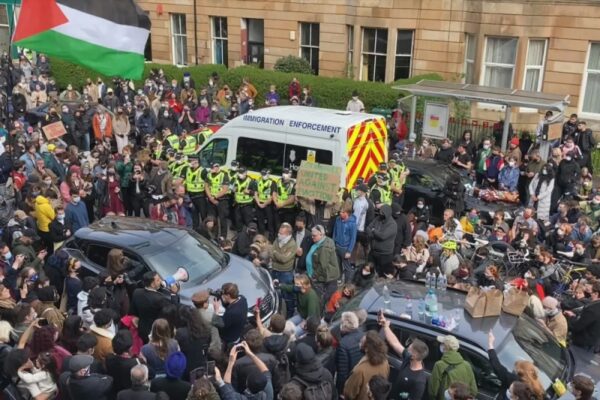
A still from Felipe Bustos Sierra’s Everybody To Kenmure Street. Courtesy of Sundance Institute.
Some of the best documentaries at the Newburyport Documentary Film Festival don’t just confront tough issues; they show how those issues can be surmounted, or at least endured.
For example, what can be done if government goons show up to kidnap your neighbors? As the title of Felipe Bustos Sierra’s rousing Everybody to Kenmure Street (2026; screens September 26 at 7:30 p.m. at the Firehouse Center for the Arts) indicates, the residents of this highly diverse Glasgow neighborhood responded quickly and en masse in 2021 when the London-based UK Home Office tried to detain two Muslim men who had lived there for years and were valued members of the community. One brave soul even inserted himself under the van in which the prisoners were held, preventing it from leaving until more than a thousand chanting demonstrators could gather and confront a small army of local police.
Evoking Bill Morrison in Incident and Geeta Gandbhir in The Perfect Neighbor, Sierra compiles footage from the phones of participants, news broadcasts, and other sources to briskly record how events unfolded. He also includes a compact political and economic history of Glasgow — much of whose wealth came directly and indirectly from the slave trade — illustrated with archival footage that puts this incident into insightful context. Less convincingly, and in part to preserve the subjects’ anonymity, he has reenactors provide the testimony of key players.
These include “Van Guy” (played by Emma Thompson, who also produced the film), whose initial act of bravery allowed the subsequent demonstration to occur, and the nurse who tended to Van Guy through the several hours of his ordeal. “The fact that I am a nurse gives me some level of protection that most people wouldn’t experience,” says the latter, a distinction that tragically didn’t help Alex Pretti when he was gunned down by ICE.
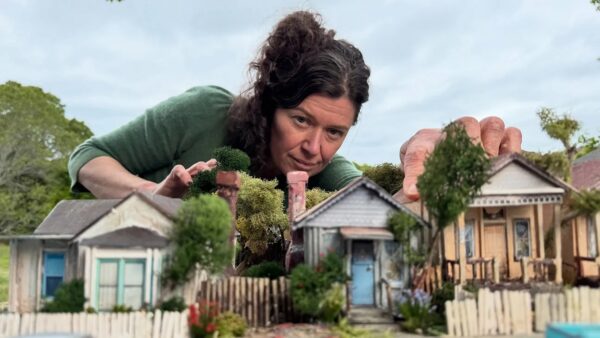
A scene from Anna Fitch and Banker White’s’s Yo (Love Is a Rebellious Bird). Photo: Mirabel Pictures/Courtesy of Berlinale
Old age, death, loss, and grief are taken on in Anna Fitch and Banker White’s Yo (Love is a Rebellious Bird) (2026; screens September 27 at 1 p.m. at the Firehouse Center for the Arts). The Yo of the title is Yolanda Shea, a Swiss-born California artist who bumped into Fitch in 1997 when they were both reaching for the same item at a rummage sale. They bonded instantly, with each recognizing the unconventional artistry in the soul of the other, despite the discrepancy in their ages (Yo was 73 and Fitch was 24). When Yo died in 2013, Fitch decided to memorialize her friend by building a one-third-scale model of Yo’s already doll-like little house — with a puppet Yo to dwell in it — and by making a movie about building the house that included interviews with her friend relating the story of her life.
Like the woman herself, Yo’s house was tiny, strange, and packed with wonders. She was born in Switzerland into a Freudian textbook case of a family. She went to art school and worked with the great surrealist sculptor Jean Tinguely. Eventually she ended up in America, married, had children, abandoned her family, became a vagabond, and that was just the 1960s. It’s best to hear Yo tell the story herself and experience Fitch’s inspired reenactments, which include Yo’s first acid trip, her confrontation as a teenager with a creepy Swiss priest asking her about masturbation, and her return home after her mother’s death, when she had sex in her mother’s bed while her relatives squabbled over the dead woman’s belongings.
Oh, and Fitch is also an entomologist, so the latter scene is enacted with a variety of bugs shot in nightmarish, Kafkaesque close-up. As fascinating, poignant, and often hilarious as is the subject itself — nearly 90 years blithely crammed into 74 minutes — Fitch’s head-spinning miniatures and equally inspired, life-spanning montages are what truly dazzle. Reminiscent at times of Jeff Malmberg’s Marwencol (2010) and certain parts of Spike Jonze and Charlie Kaufman’s Being John Malkovich (1999), Yo is an in-memoriam portrait of a unique genius. My one quibble — aside from understandable moments of sentiment — is that Yo’s own artwork does not seem to make an appearance. But perhaps the point is that her life itself was the work of art.
Fitch and White’s documentary pairs nicely with Massachusetts filmmakers Tim O’Donnell and Sam Oldmeadow’s The Last Yztari (2025; screens September 26 at 3:45 p.m. at the Firehouse Center for the Arts), which I wrote about previously when it screened at the Independent Film Festival of Boston last April. In it, Iraq War veteran Mary Dague, who had saved scores of lives by defusing IEDs until one of them went off and she lost both arms, faces life unable to perform her vital mission. Undaunted, she decided to write a fantasy novel and create a video game about the world of the title, in which female superheroes battle the forces of evil.
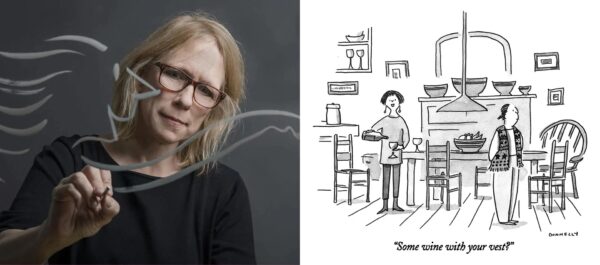
Roz Chast are among the cartoonist profiled in Women Laughing.
Battling the forces of evil with the unstoppable power of a punchline are the New Yorker cartoonists profiled in Kathleen Hughes and Liza Donnelly’s Women Laughing (2025; screens September 25 at the Firehouse Center for the Arts). They include such greats as Roz Chast, one of the first to break into the old-boys’ club that had long dominated the cartooning pool (her “The Glass Floor” sketch shown here is ruefully funny), and Emma Allen, the magazine’s first female cartoon editor. Donnelly, herself a longtime veteran of the publication, honors some of the pioneers of the past, such as Mary Petty, and attributes her own decision to enter this brutally competitive and notoriously poorly paid field to the desire to make her mother — to whom the film is dedicated — laugh.
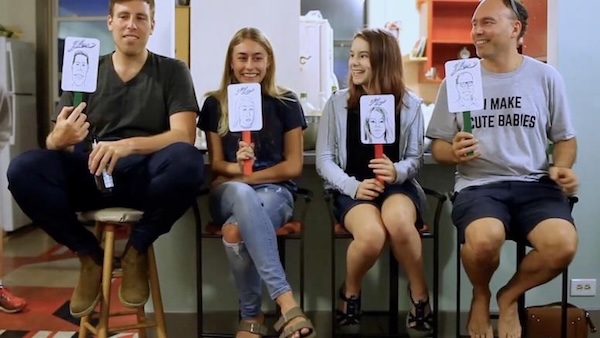
A scene from Craig Downing’s Dad Genes. Photo: courtesy of the artist
Which brings us to that ultimate unit of society, the family, investigated in Craig Downing’s debut feature Dad Genes (2025; screens September 25 at 7:30 p.m. at the Firehouse Center for the Arts). Back in the ’90s, Aaron Long, a free-spirited, long-haired Seattle cab driver with an advanced arts degree, took advantage of an opportunity to make a little extra money (“$40 a pop”) by selling his sperm. Years later, on a whim, he sent his DNA to 23andMe and was surprised to hear back from some of the estimated 60 or so children that his mercenary seed-spreading had engendered. Still easygoing, living in an arts co-op, and caring for his Alzheimer’s-stricken mother, Long agreed to meet with the kids and have Downing film what happened.
What followed grew as complicated and unpredictable as extended families tend to be. Let’s just say that Aaron’s co-op ends up with some interesting new residents. Though at times a bit glib — it covers a lot of ground in its 62 minutes — Dad Genes is one of those blessed documentaries that take astonishing twists and turns in a situation as they develop. It also captures the essence of what a family means beyond the basics of biology.
Peter Keough writes about film and other topics and has contributed to numerous publications. He was the film editor of the Boston Phoenix from 1989 to its demise in 2013 and has edited three books on film, including Kathryn Bigelow: Interviews (University Press of Mississippi, 2013) and For Kids of All Ages: The National Society of Film Critics on Children’s Movies (Rowman & Littlefield, 2019).
;
Tagged: "Dad Genes", "Everybody to Kenmure Street", "Women Laughing", "Yo (Love is a Rebellious Bird)", Anna Fitch, Banker White, Craig Downing, Felipe Bustos Sierra, Kathleen Hughes, Liza Donnelly