Book Review: The Long, Strange Journey of the Christmas Carol
By John Tamilio III
John Potter’s deeply researched history follows English carols from streets and taverns to churches, choirbooks, and the contemporary musical vernacular.
Christmas Carols: An English Enchantment by John Potter. Yale University Press, 336 pages, $28 (hardcover).
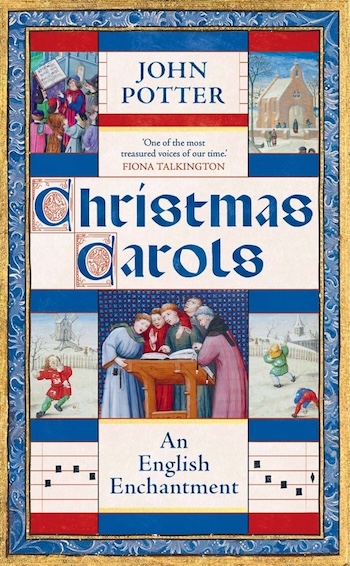 John Potter opens his lucid, comprehensive history of Christmas-carol collections with a jaunt down memory lane. When we think of the season, many of us recall Christmases past—particularly childhood holidays, when the celebration brimmed with enchantment. Potter was a chorister who, in the winter of 1960, sang the solo verse of “Once in Royal David’s City” in the esteemed King’s College, Cambridge, Festival of Nine Lessons and Carols. His memories are idyllic—and he makes them vivid in this exceptional volume.
Most people imagine carols as church staples that have enriched Advent and Christmas services since time immemorial. Yet many began as secular songs, sung by working people around hearths and on street corners. In his opening chapter, Potter examines one of the earliest carol collections, whose contents, like much ancient music, circulated orally before Davies Gilbert committed them to print in 1822. Discussing Gilbert’s Some Ancient Christmas Carols with Tunes to Which They Were Formerly Sung in the West of England—a title rather grander than its eight-song contents—Potter notes that the volume was “the first by a member of the prosperous and literary classes to value the music of his largely illiterate social inferiors.” Yet the music remained the property, culturally if not legally, of those singers.
Potter goes on to examine how, in the eighteenth and nineteenth centuries, British culture made the music its own. In his influential Literary Theory: An Introduction, Oxford theorist and critic Terry Eagleton argues that British literature and song were part of a cultural project whose intent was to educate all levels of society to accept a notion of shared Englishness. Its political purpose was to encourage “solidarity between the social classes, the cultivation of ‘larger sympathies,’ the instillation of national pride and the transmission of ‘moral’ values.” As Eagleton puts it: “If the masses are not thrown a few novels, they may react by throwing up a few barricades.”
In that pointed sociological spirit, Potter traces the development of the carol in sacred and profane contexts during a pivotal period of English history. Unsurprisingly, Gilbert’s collection inspired successors. Tunes sung in taverns and on docks from Advent through Christmas found their way into volumes whose prefaces were often as compelling as their musical contents. Editors explained how the books collected songs that had been passed down in communities from generation to generation. Now they were being rescued, in print—saved from eventual extinction. In some cases, only the texts of the songs survived, which explains why different melodies were subsequently attached to the same lyrics.
Potter’s text is robust: it is a richly detailed account that preserves material that might otherwise have disappeared. Its scholarship is deep but accessible to lay readers and seasoned hymnologists alike, although its density will most reward the latter. General readers, however, will find much to savor—including the story of how “Stille Nacht” began as a poem by Fr. Joseph Mohr and was set to music by Franz Xaver Gruber for Christmas Eve 1818. It was accompanied on guitar because the church organ was unusable. The anecdotes serve the book’s overall aim: to chart the carol’s evolution. Out of “the publications of the first collectors, the carol emerges from a rather vague antiquarian past as a secular-ish Christmas song retrieved from ancient oral tradition.”
The author also cogently examines popular music’s influence on the carol and its absorption into the modern vernacular. As a classic-rock devotee—and an admirer of some of the more inventive music to emerge in the 1980s—I have long been drawn to Gordon Sumner, better known as Sting, particularly his solo work. When my family hangs the greens, our Christmas soundtrack ranges from Vivaldi’s “Winter” and, naturally, Handel’s Messiah to Sting’s If on a Winter’s Night… (2009).
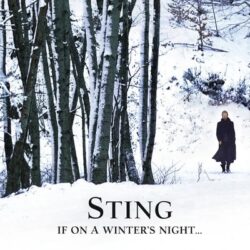 Sting’s album offers faithful renditions of traditional carols—including “Gabriel’s Message,” “There Is No Rose of Such Virtue,” and “The Cherry Tree Carol”—alongside original material. Potter argues that this recording “refreshes the carolscape,” introducing “‘classical’ carols to an audience who may not have heard them before.” And, because it is a recording made by a popular artist, it carries the carol “to new-sounding space.”
Yet the twentieth-century transformation of the Christmas carol began well before rock music entered the picture. One of Potter’s most immediately resonant sections is where he concentrates on English-language carols that helped shape the Western musical canon. George Ratcliffe Woodward—whom Potter credits with “a vast increase in the number of European carols given English texts”—published his first carol collection in 1888. Twelve years later, Woodward and Charles Wood issued The Cowley Carol Book. With more than 100 selections, it was the most popular English carol collection before The Oxford Book of Carols, published in 1923. That volume “became the definitive carol book until Carols for Choirs [was published] more than thirty years later.”
The legendary Ralph Vaughan Williams co-edited The Oxford Book of Carols—referred to as OBC, in choral circles. Reflecting the folk-revival spirit of its time, the collection spans the liturgical year, although it has become especially revered for its rich Christmas repertoire. It inspired a host of subsequent collections, a number of which reflect changing political attitudes. One hopes Potter will someday produce a second volume to chronicle their history.
This informative study ends where it began: at another performance of Nine Lessons and Carols in the early ’60s. As the choir waited in the cold outside the vestry, another boy sang at the west-door entrance. Potter closes this celebratory account with a sentence worthy of a classic literary text: “We could barely hear him begin the first verse as the warmth of the packed and candlelit church came to meet us.”
John Tamilio III, Ph.D. is the Pastor of the Congregational Church of Canton, a professor of Philosophy at Salem State University, and a professional guitarist who plays solo acoustic and for the Boston-based classic rock band 3D. His playing has been applauded by David Brown (Simon & Garfunkel, Billy Joel), Jack Sonni (Dire Straits), and Carter Allen (WZLX). An aficionado of classical music, particularly the Baroque era, Tamilio’s publications are vast, covering not only music, philosophy, and theology, but the poetry of T.S. Eliot as well. He resides in Beverly with his wife Cynthia.